By Georgia Jackson, College of Arts and Sciences
A year ago, Sabrina Karazoun was one of many college students working an hourly job that didn’t align with her career goals. Today, she's living in Brazil and teaching English at an institution that supports language learners of all ages. Her secret? Applying for a paid internship through the Mellon Humanities Internship Program.
Sabrina Karazoun pursued an English teaching certification (TEFL) and moved to Brazil to teach English full time after interning with ReDefiners World Languages. [Photo courtesy of Karazoun]
"The Mellon Humanities internship showed me what my true passion is and helped me get where I am today," said Karazoun, who graduated from USF this year with a degree in international studies.
A minor in world languages made her eligible for the program.
It has been a year since the first cohort of Mellon-funded interns went to work across Tampa Bay — the initial wave of what will eventually account for up to 900 paid internships a year, made possible by a five-year, $4.8 million grant from the Mellon Foundation, the nation's largest supporter of the arts and humanities. Now, with a full year behind the program, USF is getting its first real look at what paid, credit-bearing internships can do for humanities students.
“This is a signature initiative for USF,” said Elizabeth Spiller, dean of the College of Arts and Sciences. “It builds on our decades-long commitment to securing meaningful internships for our students, and it reflects our belief in the transformative power of experiential learning.”
From an hourly job to a classroom in Brazil
Before she found the Mellon program, Karazoun described her situation plainly: she needed a steady paycheck to stay in school, but her job wasn't contributing to her resume in any meaningful way.
"I worked an hourly job that did not connect to my major but allowed me to keep studying," she said. "Participating in the program allowed me to earn money while focusing on something I am interested in and that would advance my career."
A recent study abroad experience in Spain had deepened her interest in language and culture. Through the Mellon program, she found ReDefiners World Languages, an organization that offered classes in English, Spanish, Arabic and Mandarin to students as young as eight. Karazoun, who speaks Spanish in addition to English, jumped at the opportunity to provide bilingual support to families in the community.
By the time she finished the internship, Karazoun had a clearer sense of where she wanted to go. She quickly pursued an English teaching certification (TEFL) and moved to Brazil — a country she already had a connection to through her mother — to teach English full time.
“The Mellon Humanities internship showed me what my true passion is,” she said. “It helped me get where I am today.”
Turning community work into a future in medicine
Like Karazoun who minored in world languages, Kadence Relente — a biomedical sciences major — wasn't a traditional humanities student. It was her minor in women’s, gender, and sexuality studies that made her eligible for the program.
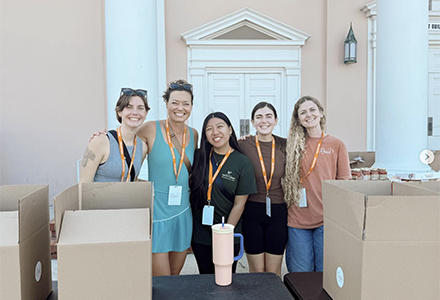
Relente said her internship with Reach St. Pete taught her skills in interpersonal communication, problem-solving, teamwork and adaptability — all of which have already come in handy at work. [Photo courtesy of Relente]
Relente interned with Reach St. Pete, a Pinellas County nonprofit serving people experiencing homelessness and financial hardship. At food distribution events that drew anywhere from 100-200 community members, Relente worked directly with people from a wide range of backgrounds, all of whom were navigating food insecurity.
"I realized that those who seek food assistance services are not limited to just one type of individual," Relente said. "Each individual has a lived experience that is shaped by broader circumstances, and each individual has a unique story that deserves to be heard."
Today, Relente is taking a gap year and working as a medical scribe while she applies to medical school. She said the soft skills she built during her internship — interpersonal communication, problem-solving, teamwork, adaptability — have already carried over into how she interacts with patients at the clinic.
"I hope to use my internship experiences at Reach St. Pete as a foundation for how I will treat my future patients with their unique lived experiences in mind," she said.
A new wave of interns is following the same path
This summer, a new group of USF students set forth along a similar path, testing out career options, building skills and, in some cases, discovering entirely new directions for their futures.
Communication major Krisan Rampersad went into her internship with The CALI Project, a nonprofit supporting foster youth and people experiencing homelessness, expecting a typical social media and marketing internship. Instead, she found herself reconsidering her career path altogether.
"I enjoyed my work there more than I expected,” said Rampersad, who connected with the organization's mission. “For a long while I had my career path decided, but after a few months in this organization, I realized that I found my calling.”
Rampersad enjoyed her experience so much, she signed up to continue interning with the organization while she finishes her degree.
Emma Margelowsky, another communication major, spent her summer as a vocational support intern at Hope Services, Inc., helping teach a construction training program, proctoring tests, developing materials and working hands-on in the shop.
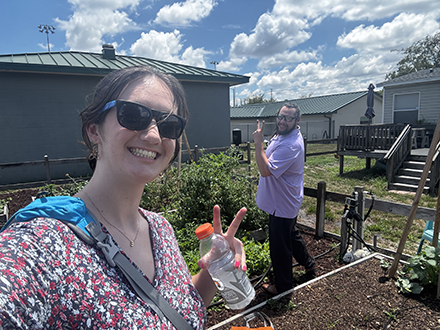
Emma Margelowsky launched a few home construction projects of her own after interning at Hope Services, where she taught a construction training program, proctored tests and worked in the shop. [Photo courtesy of Margelowsky]
"This internship has made me consider more possibilities for myself than before," said Margelowsky, who is considering pursuing a career in the trades or applying to graduate programs. "It empowered me to even start my own construction projects at home.
"You feel like a badass after using a sledgehammer."
Noor Emara, a philosophy major, worked as a research intern for Black Innovation Leaders of Florida, mapping the state's innovation infrastructure and identifying innovation deserts — regions with less access to the resources that drive economic mobility. At the end of the summer, she presented her findings to the organization's board.
Now preparing to apply to medical school, Emara said the analytical and communication skills she built will carry directly into her next role as a clinical research coordinator.
"The skills I learned in analysis and professional communication from this internship will allow me to better fulfill my role," she said.
At the Florida Holocaust Museum, history major Adalyn Case worked as a collections and exhibitions intern, cataloguing and installing artifacts — building on the same kind of archival work that shaped former Mellon intern Arielle Kessler's experience at the museum last year. Case is continuing her museum work this fall as an intern at USF's Centre Gallery while she applies to graduate programs in public history.
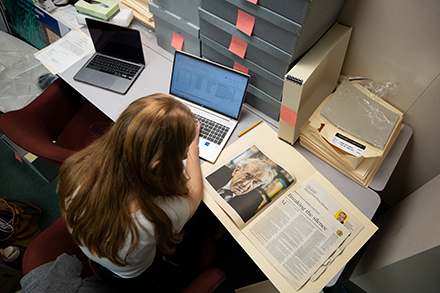
Arielle Kessler archived documents related to the life and legacy of Nobel Laureate and Holocaust survivor Elie Wiesel. [Photo by Corey Lepak]
"What surprised me most was how valuable each experience was," Case said. "The skills I learned were very versatile. I learned how to carefully utilize archival tools, became proficient with Excel and navigated a professional workplace."
Sophia Li, an English major, spent her summer as a grant writer for One Love Nest learning that the work involved far more than filling out forms.
"It's really about telling an organization's story in a way that connects with funders while also backing it up with research and data," she said.
The experience reinforced her long-term goal of going to law school.
"It reminded me that I genuinely enjoy work where I get to solve problems and help people."
English major Iman Bhyat worked as a visual projects and design outreach intern for Packs of Love, an organization supporting children transitioning out of foster care. She designed outreach materials — flyers, one-pagers, email templates — and came away with newfound confidence in her design skills.
"I feel I've become a more capable and confident professional," she said.
For Olivia Cummings, another English major who completed her first-ever internship as a program developer at the Skills Center, the experience offered something she didn't expect: calm.
"I usually worry about things I am trying to do well, and this was my first internship ever," she said. "But I never felt worried while I was there."
Her research into youth leadership programs across Florida gave her the clearest sense yet of a possible career path in documentation work.
SOME STUDENTS FORGE THEIR OWN INTERNSHIP PATH
History majors Benjamin Apfelbach and Brendan McLaughlin took their summer internships home with them. Apfelbach, who lives in Daytona, secured a position for himself at the Cici and Hyatt Brown Museum of Art, and McLaughlin, who lives in Ocala, did the same at the Marion County Museum of History and Archaeology.
Rachael Rich went even further. The English major spent her summer in Decorah, Iowa, working with Dragonfly Books and the Oneota Valley Literary Foundation. Before her internship even began, Rich put her writing skills to the test by cold-emailing independent bookstores across the state to secure the position for herself.
"Cold email people you want to work with — store owners, writers, professors, whoever," she said. "People can't help you if they don't know you exist."
At Dragonfly, Rich learned bookstore management software, helped coordinate author events and community literacy programs and interviewed local writers for a project introducing customers to the region's literary community. The experience left her energized about a future in publishing. In the meantime, Rich is working with a fellow USF alumna to launch a literary magazine spotlighting young and emerging writers in Florida.
The difference a year makes
Together, these stories reflect the range and promise of the Mellon Humanities Internship program. Students majoring or minoring in the humanities at USF are interning with a variety of businesses and non-profits and emerging with new skills, confidence and, in some cases, entirely new directions for their future.
“Our students’ experiences show how humanities degrees create career opportunities,” said Lauren Arrington, chair of the Department of English and principal investigator for the grant. “Our first year is just the beginning.”
To sustain the program into the future, the Mellon Foundation is matching up to $1 million in private support to build an endowed fund for the program. Support the Mellon program at USF.