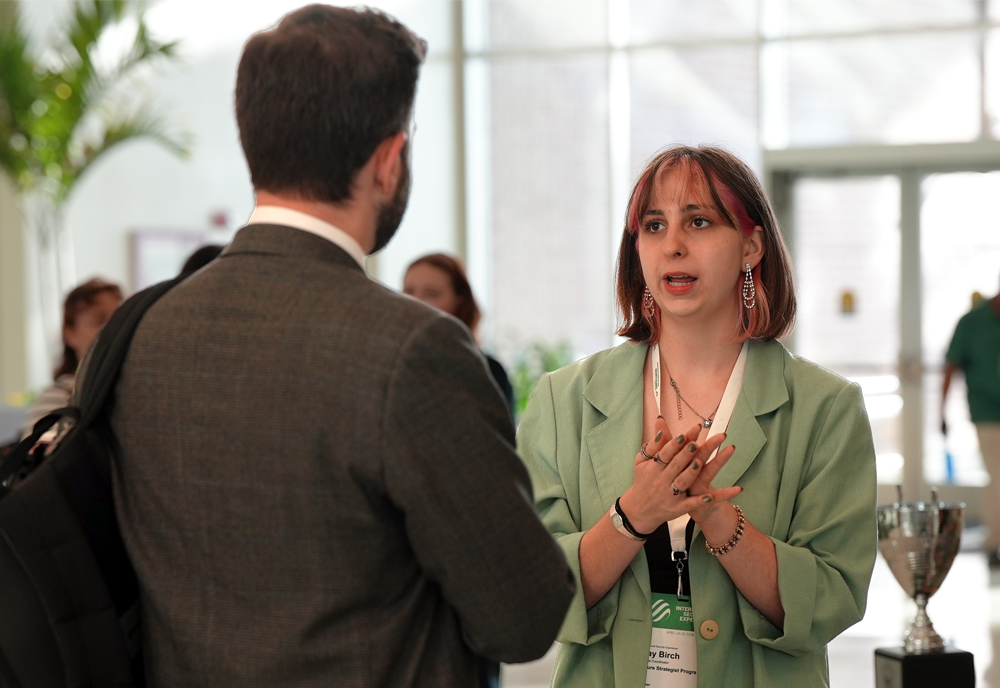
By Dakota Galvin, College of Arts and Sciences
As the Global and National Security Institute (GNSI) expands its engagement across the university, USF College of Arts and Sciences (CAS) students are benefitting from real‑world opportunities that enhance their academic experience and career readiness. At this year’s International Security Experience — a week‑long event focused on the rapidly evolving national security landscape — CAS students in the Future Strategist Program (FSP) led the planning and execution of the conference’s second day, gaining practical experience in agenda development, speaker coordination and strategic communication.
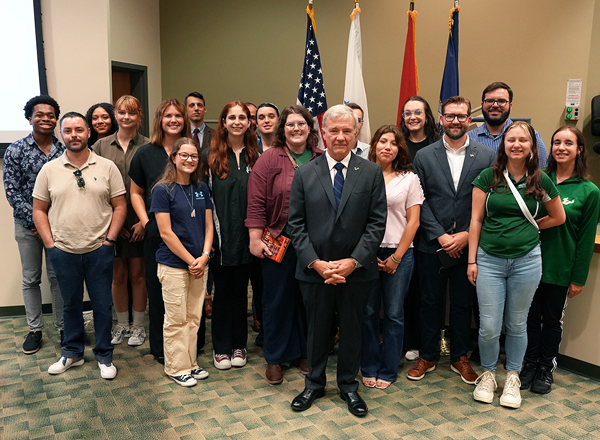
The original Future Strategist Program (FSP) cohort, established in 2024, with GNSI founding director Gen. (Ret.) Frank McKenzie. [Photo by Glenn Beckmann]
Launched in 2024, the Future Strategist Program brings together students from across USF who are interested in global and national security. Since its founding, the program has steadily broadened its offerings, providingincreasingly substantive opportunities to engage with leading figures in the field.
David Oakley, academic director at GNSI and one of the founders of the Future Strategist Program, emphasized the importance of giving students this level of exposure and responsibility.
“I spent most of my professional life in the Army and the CIA and started my life as an academic while in the military. Through these experiences, I learned the importance of continuous education in nurturing thoughtful and empathetic practitioners,” Oakley said. “The experiential learning opportunities students receive through FSP complement the education they receive in the classroom, and they will be more thoughtful and more effective national security leaders because of both.”
For international studies major May Spinney — the main organizer for the conference and an active member of FSP since its inception — the experience helped shape her career goals beyond her time at USF.
“Before FSP, I was somewhat certain about what I wanted to do, but I wasn’t sure how to tie my interest in national security to my interest in law. After being part of FSP and speaking with GNSI, I found a way to do both and that national security is a broad field with a need for many careers,” Spinney said. “FSP has been invaluable in teaching me just how many career opportunities are available to those interested in national security and international relations.”
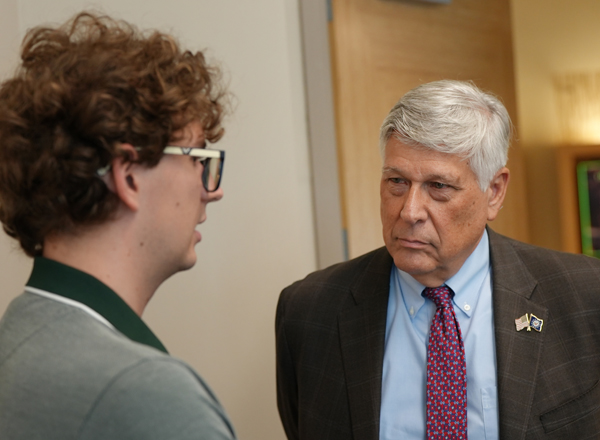
One of the Future Strategist Program’s core goals is to connect students with leading security professionals, helping them build both their network and their understanding of the field. [Photo by Ty Lindsay]
Spinney’s experience reflects what program leaders see across the board. According to Jeff Rogg, a senior research fellow with GNSI who has served as an FSP adviser since the program launched, FSP was designed to give students a clearer pathway into national security careers — not only in intelligence or the military, but also in diplomacy, public policy and the private sector.
“It can be tough as a student to break into a career field,” Rogg said. “There’s also some mystery and mythology around national security, especially intelligence. Through GNSI, FSP students get insights into these careers and access to opportunities that can give them a professional boost."
Together, these elements — mentorship, exposure and hands‑on learning — converged at the International Security Experience, where students took the stage to apply what they’ve learned. By the time Spinney stepped up to the mic at 9 a.m. to open the FSP Conference, “Shadows and Circuits,” the Marshall Student Center Oval Theatre was already buzzing.
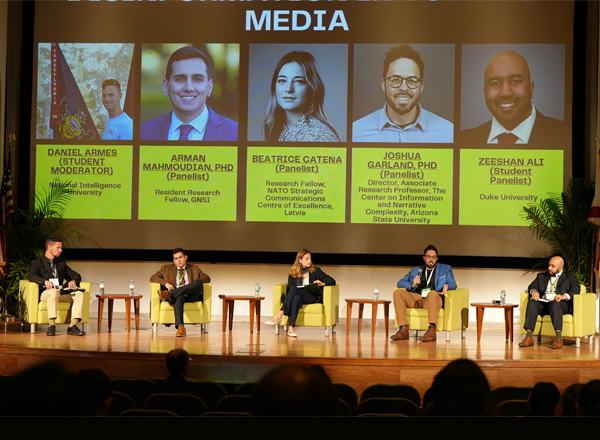
Day 2 of the International Security Experience, the student‑led conference “Shadows and Circuits,” brought experts from around the world to discuss today’s most urgent security challenges — including a panel on the rise of disinformation in the media. [Photo by Ty Lindsay]
Throughout the day, student moderators from USF and partner universities guided discussions with experts from the CIA, NATO, King’s College London, Georgetown and several U.S. institutions. Sessions explored the future of human intelligence, the implications of quantum technology, the rise of disinformation and the evolving relationship between surveillance, privacy and human rights. The conference closed with a fireside chat on preparing the next generation of leaders in technology, intelligence and security.
For many CAS students like Spinney, opportunities like this offer clarity and direction. Her work on the conference showed how hands‑on experience can sharpen career goals and build confidence in a competitive field. As FSP continues to grow, events like the International Security Experience are helping CAS students discover where their interests, skills and ambitions intersect.