
By Josh Napier, College of Arts and Sciences
Savannah Neal and Mandy Steenbergen are getting ready to watch people watch ads.
At the University of South Florida’s Advertising Research and Implementation Science (ARIS) Lab, they’ll monitor what holds participants’ attention, track where their eyes move and measure their physiological responses to what they see on screen.
Neal, a USF senior studying psychology and advertising, and Steenbergen, a graduate student in the Zimmerman School’s M.S. in Advertising program are part of the research team preparing the study.
Neal and Steenbergen have used AI to organize the research they’re reviewing and map out the steps as they work through a study of this scope for the first time.
Once participants come in, the data collected through the eye-tracking and biometric tools will allow the research team to look for patterns in what people notice and how they respond. Then, they’ll use what they learn to better understand consumer behavior and what those patterns say about how the advertising is received.
That distinction between processing information and understanding it is at the heart of what students and faculty in the Zimmerman School are working through now as AI changes how quickly information can be gathered, organized and analyzed.
From novelty to normal
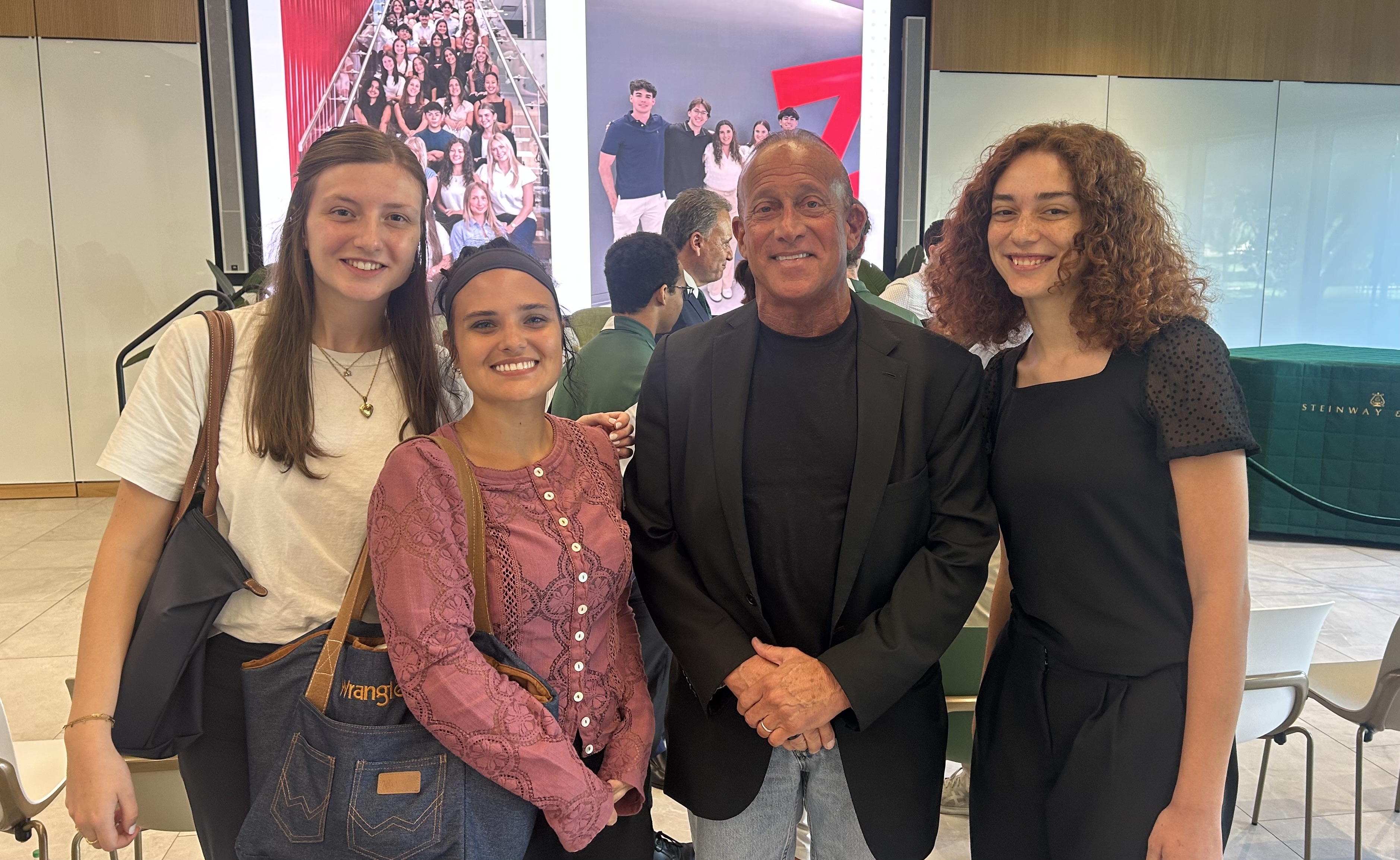
Advertising students Mandy Steenbergen (left), Isabelle Shim (left center) and Savannah Neal (right) with Jordan Zimmerman, founder of Zimmerman Advertising.
Neal remembers trying an early version of ChatGPT in high school and recalls it often being finicky, robotic and frequently wrong.
A few years later, AI was already part of day-to-day work in advertising. She spent the summer in New York working as an advertising sales intern with Katz Media Group. There, she worked with audience and market data and saw how data and research come together to influence creative decisions in advertising.
“To see it come from like a weird robot that was always wrong … to now, seeing working professionals creating AI agents to conduct research for them has been shocking,” Neal said.
That shift happened before Neal had even finished college.
Steenbergen experienced a similar shift. She began her undergraduate studies in 2020 before generative AI became a normal part of classroom conversation. Now, in a graduate program built around advertising analytics, AI is part of discussions about research, ethics and professional practice. Both students were in the audience earlier this month when Jordan Zimmerman, founder and chairman of Zimmerman Advertising and a longtime force behind advertising education at USF, returned to campus for a conversation with USF President Moez Limayem about the state of advertising and AI.
Zimmerman described data as one of the reasons his agency can compete with much larger firms, and explained how his business uses AI to organize and make sense of information faster. Neal and Steenbergen also heard from Zimmerman Advertising interns who described using AI to break down raw data and better understand what it shows them about consumers.
For Neal and Steenbergen, the better they understand the data and the people behind the numbers, the more informed their creative decisions become.
The fundamentals behind the tools
Janelle Applequist, the Jordan Zimmerman Endowed Professor of Advertising and director of the ARIS Lab, says AI has only made those fundamentals more important.
“There’s always going to be something new,” Applequist said. “Today it’s AI, but before that it was social media, and before that it was the internet. We always try to remember that the foundational skills are most important as channels continue to evolve.”
That ethos is built into the school’s creative curriculum, too. Applequist pointed to a principle her colleague Christine McCarty builds into Mass Communication Design & Content Creation, where students create their own work in Photoshop, Illustrator and InDesign while learning the fundamentals behind good design.
“If you can’t understand typography and composition, you’re not going to be able to tell if an AI output is wrong,” Applequist said.
The same principle applies to research. Students have to understand the evidence before they can evaluate what an AI system says about it.
In advertising, that understanding gives the creative work somewhere to start. The research helps students understand who they’re trying to reach and what the audience is actually responding to before they decide what to make.
Through the Zimmerman School’s Media Research Center, faculty and students work with tools like Brandwatch, which can analyze conversations across roughly 1.3 billion publicly available social posts. It can surface patterns across that data quickly, but the value of the analysis still depends on the questions being asked and how the results are interpreted.
Across Arts and Sciences
Dean Elizabeth Spiller sees the same idea extending well beyond advertising.
“Words tell a story, but so does data,” Spiller said. “And you can’t do one if you don’t understand the other.”
Across disciplines, students increasingly have access to tools capable of processing enormous amounts of data. But making something useful from that data still requires them to interpret evidence, understand context and connect what the data shows to the people and problems behind it.
For Neal and Steenbergen, that means using data to better understand the people they’re trying to reach — and bringing that understanding into the creative work that follows. Learn more about advertising programs in the Zimmerman School and explore research underway in the ARIS Lab.