
TAMPA – A University of South Florida student team placed in the top 3% at the 2025
Bloomberg Global Trading Challenge, an annual investment competition for college students.
The USF Bulls 2025 team finished No. 69 among 2,700 teams representing 400 universities
across 50 countries. The challenge gives each team a virtual $1 million portfolio
to invest. The USF team generated a relative return of $53,194 over the five-week
competition.
The competition offers a hands-on experience for students to apply classroom theory
to real-world market scenarios. All activities, including market analysis, strategy
development, and trade execution, occur within the Bloomberg Terminals.

“I’m very proud of the team’s performance.” said Wendy Liu, a professor of instruction
in the Kate Tiedemann School of Business and Finance and advisor to the team. “Team
captain Jim Phan’s initiative, energy, and passion for learning were instrumental
in shaping a winning strategy under challenging market conditions. His leadership
inspired the team to think critically and adapt quickly, combining rigorous research
with market learning.”
In addition to Phan, the team consisted of Logan McCorvey, Duc Doan, Hanh Vo, and
Han Nguyen — all USF students who are majoring in either finance, quantitative economics
and econometrics, or computer science.
Early in the competition, Liu advised the team that standard momentum strategies were
unreliable in the current economy. She challenged them to look deeper at market efficiency
and liquidity imbalances.
As a result, Phan steered the group toward a strategy focused on earnings volatility.
That led to deep dives into multiple sectors, including technology, healthcare, energy,
and rare earth materials.
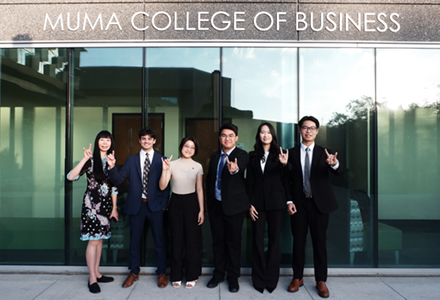
“We chose stocks that had appropriate volatility on their earnings day, depending on our position and risk appetite,” Phan said. “We knew that in a market with this many uncertainties, volatility was a double-edged sword — it was our opportunity to make returns, but also a risk.”
Phan said there were two defining moments that helped them climb up the leaderboard.
One notable trading victory involved Nvidia. The team bought in while the CEO was
speaking at a conference about bolstering AI utilization, which resulted in a 10%
profit in a single trade.
Another strategic win was with Seagate Technology. Recognizing that the AI boom would
drive temporary demand for hard drive storage, the team bought in prior to earnings,
closing the trade for a 7% profit.
The team’s winning strategy had them analyzing trades in between classes and conducting
rapid, high-pressure analyses late in the evenings.
“We were fortunate to maintain a balanced risk strategy,” Phan said about the five-week
sprint. “There were definitely moments where we hoped we hadn’t over-leveraged a position,
but our risk management held strong, especially towards the end of the competition,
where at one time the S&P 500 was down more than 200 basis points in two consecutive
days.”