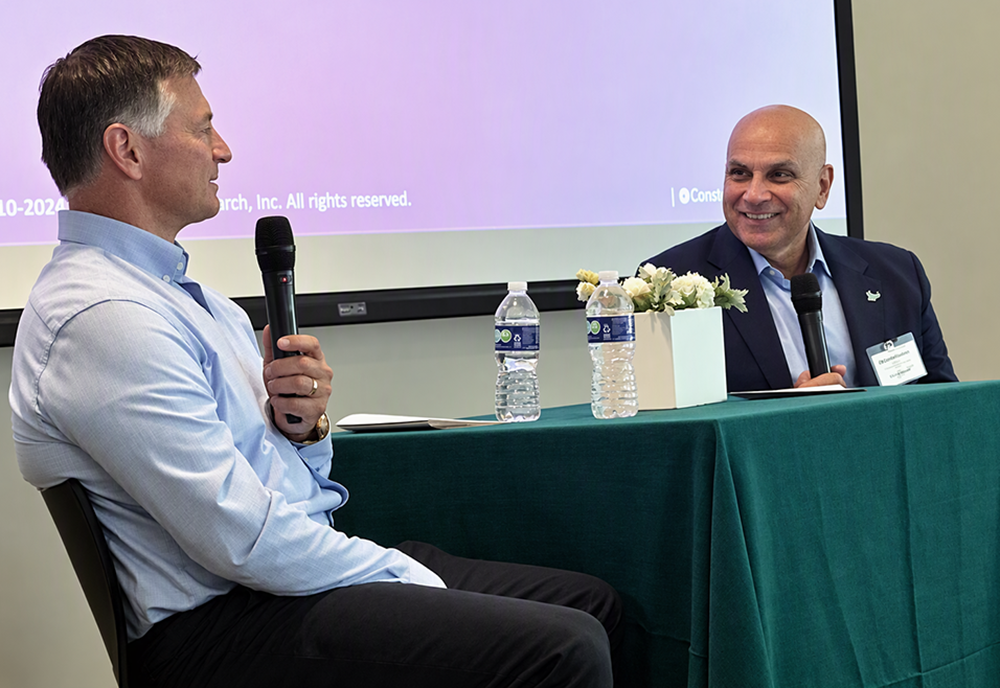
TAMPA — Artificial intelligence may be transforming business, but organizations that succeed with the technology are the ones that focus on data, process design and practical business outcomes, according to technology journalist and industry analyst Larry Dignan told attendees Thursday at the University of South Florida's Digital Business Lunch.
USF’s Institute for Digital Business hosted Dignan, founder of TechRepublic and former ZDNet editor in chief, for a luncheon featuring a presentation on “Enterprise AI: What is Working, What is Failing, and What is Contested.”
Around 50 students, faculty and business leaders attended the event, which included a moderated conversation with Munir Mandviwalla, director of the university’s School of Information Systems.
The wide-ranging conversation examined the state of enterprise AI adoption, the economics and infrastructure supporting the technology, and the workforce implications for organizations seeking to scale AI initiatives.
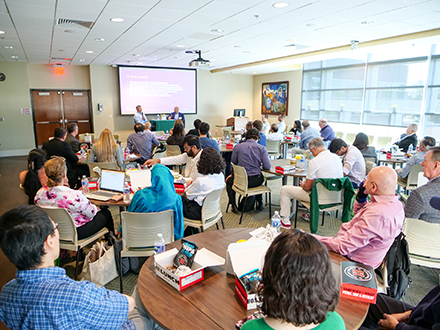
Much of the discussion centered on why many organizations remain stuck in what industry leaders call "pilot purgatory" despite years of experimentation. Challenges include change management issues, poorly understood business processes, and AI tools that perform well in demonstrations but struggle to meet the reliability requirements of enterprise-scale deployment.
Dignan argued that organizations are increasingly recognizing that successful AI implementation depends as much on process redesign and data accessibility as it does on the underlying technology. He noted that companies that invested in digital transformation and data governance before the AI boom, or who are in highly regulated industries, are generally better positioned to adopt AI at scale. McDonald's, Walmart and Capital One were mentioned as leaders who spent years modernizing systems and making data more accessible across their organizations.
"You need to get the data right," Dignan said, emphasizing that organizations do not need perfect data but must make information accessible across systems. "You probably never have perfect data…the goal is to be less disorganized than your competitors."
Attendees from industry and academia participated in an extended question-and-answer session covering topics ranging from AI infrastructure and data centers to workforce development and higher education.
Discussing the future workforce, Dignan suggested that AI may reduce the need for some routine entry-level work while increasing demand for employees who can build, manage and improve AI-enabled systems. "Companies still need to hire entry-level people because AI systems require people to build, maintain and support them,” he said, encouraging students and professionals alike to gain hands-on experience with emerging technologies and continue developing practical skills.