By Georgia Jackson, College of Arts and Sciences
Jason Nethercut hasn't stopped thinking about “The Odyssey” since the film hit theaters on July 17.
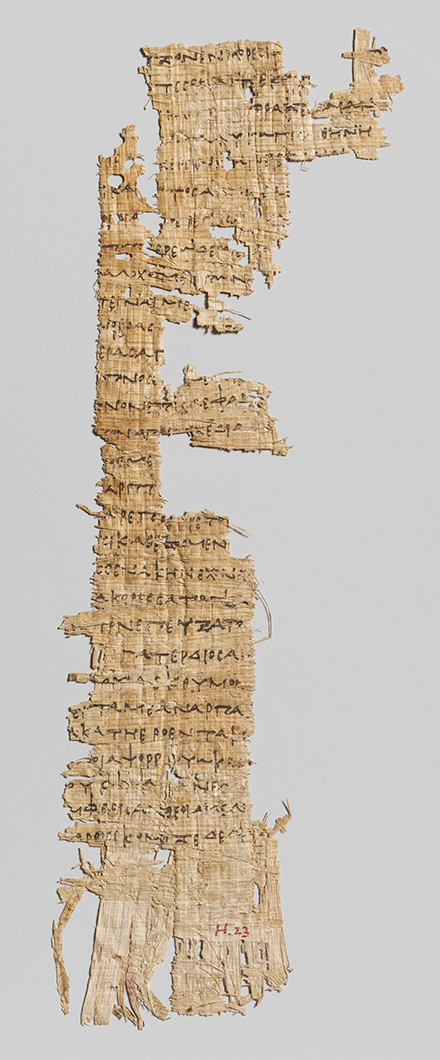
Papyrus fragment with lines from Homer's "Odyssey" from the third century B.C.E. [Photo courtesy of The Met]
“It’s a gift,” said Nethercut, an associate professor and head of classics in USF’s Department of World Languages. “The sort of conversations people are having on the internet right now are what I strive to cultivate in the classes I teach on Homer at USF.”
The film amassed $264.1 million in global ticket sales in its first weekend, marking filmmaker Christopher Nolan’s biggest global box office event to date, according to Forbes.
Audiences have been divided over Nolan’s creative direction since Universal Pictures released the first promotional images last year, and the debate only sharpened when the film reached theaters. Critics say the Phaeacians are missing, Polyphemus is missing his famous wordplay and the Trojan horse has been relocated to the story’s heart. But for the USF faculty who teach the poem, none of that settles the question of whether the film is any good. Three spoke with the College of Arts and Sciences about what Nolan changed, what he got right and why every generation seems to need its own Odysseus.
“Before it came out, there was all this debate about the casting that got so toxic. And now that it is out, classicists are like, ‘There were no Phaeacians,’ or ‘Polyphemus didn’t have his nobody pun,’ or whatever,” said Nethercut, whose latest book, “Alter Homerus: Ennius and Homeric Culture in Republican Rome” is forthcoming from Oxford University Press. “If you’re saying it’s a bad movie because of those divergences, I’m not sympathetic. The whole oral tradition out of which ‘The Odyssey’ ultimately came was nothing short of a process of adjudicating the authoritative story of Odysseus.”
Assistant Professor of Instruction Robert Hedrick had a similar reaction to criticisms of the film, pointing out that while the original text is set in the Bronze Age, it features technologies from the later Iron Age.
“Some have complained about anachronisms, but Homer is also filled with anachronisms — it is a poem about the Bronze Age, passed down orally through the Greek Dark Age, then finally written down around the seventh century with layers of references to all of these intervening time periods,” said Hedrick, who assigns an English translation of Homer’s “Odyssey” to his students at USF.
“Even the attribution to Homer is deeply problematic,” he added. “The two epics were clearly composed orally over many generations and only later written down after the reintroduction of writing to Greece after about three centuries without it. Even the language is a mix of earlier and later Greek — no one ever naturally spoke Homeric Greek; it is an amalgam of various dialects and time periods.”
A 21ST CENTURY TAKE ON AN ANCIENT CLASSIC
Nolan’s adaptation diverges from the original in several ways, including structurally, narratively and in its values.
This fact neither bothered nor surprised Nethercut, who went to see the movie on opening night with his wife and 13-year-old son.
“There are many classicists who don’t agree with me and are unhappy with the film,” Nethercut said. “But there’s not one thing that Nolan did in this movie that doesn’t have some authority.”
The Odysseus of Nolan’s movie, according to Nethercut, finds its origins in Books 7 and 8 of Homer’s “Odyssey,” where Odysseus visits the Phaeacians on the island of Scheria and is welcomed into their palace.
While the scene was not included in the movie, Homer's Phaeacians represent Greek culture at its best.
“They practice perfect xenia, Zeus's law,” Nethercut said. “It’s Odysseus's chance to try and find out if he can be a Greek again, given what he's experienced.”
In the palace, a Phaeacian bard named Demodocus sings of the Trojan War. The song accounts for little more than 50 lines of Homer’s epic poem, but Odysseus’s response is significant.
“He starts crying, weeping hysterically,” Nethercut said. “He's described in his weeping to be like a widow when her city is being sacked and her husband is being murdered and she's dragged away into slavery, lamenting all the destruction that has come upon her. It’s the one place where you get this sort of intervention from Homer, tying all of Odysseus’ trauma to the Trojan horse.”
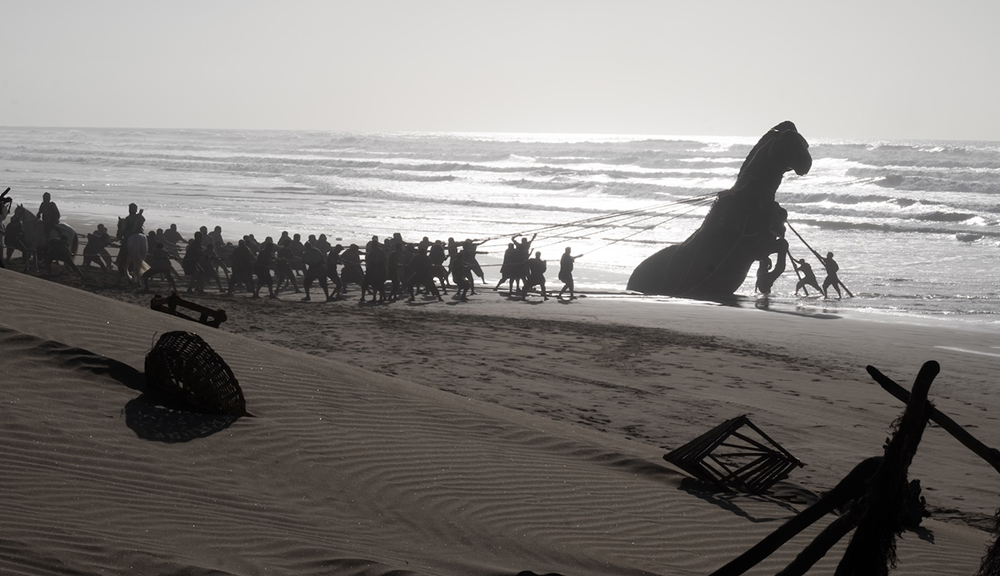
In the film, Nolan situates the Trojan horse — Odysseus’ clever trick to bring an end to the war — as the root of Odysseus’ suffering and trauma, suggesting it may even be the reason he is unable to return home for so many years after the war.
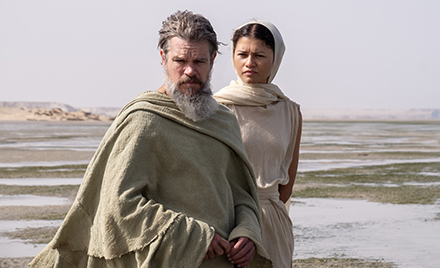
In Nolan’s film, Odysseus (Matt Damon) communes with Athena (Zendaya), who appears as a cryptic, psychological presence rather than an active divine interventionist [Photo courtesy of Universal Pictures]
“The fact that Nolan runs with this is enough evidence for me to give him the benefit of the doubt,” Nethercut said. “He locked in on that one thing and made it central to the film.”
Nethercut suspects Nolan "did his homework” and consulted a number of sources, including Jonathan Shay’s “Achilles in Vietnam: Combat Trauma and the Undoing of Character” and “Odysseus in America: Combat Trauma and the Trials of Homecoming,” both of which connect the Homeric epics with modern combat trauma and post-traumatic stress disorder (PTSD) and are taught in conjunction with Homer’s “Odyssey” at USF.
“I assume that Christopher Nolan was very conversant with Jonathan Shay,” Nethercut said. “That's a pretty cool aspect because there's a scholarly element to it, but also a therapeutic one.”
Brendan Cook, a professor of instruction in the Department of Humanities, Arts and Film, offered another perspective on the film — one that is shared by many familiar with the original text. For Cook, who led an invitation-only seminar on Homer’s “Odyssey” in the spring, the film’s divergences are distracting.
“I keep thinking about how profoundly different it is from the poem in terms of its basic outlook,” he said. “That’s understandable because Nolan is a modern person telling a modern sort of story and he naturally won’t be interested in the same sort of story as the author of the ‘Odyssey.’”
Cook pointed to Nolan’s emphasis on the characters’ responsibility to maintain social order, which is less central to the original text.
"That’s a great message,” said Cook, who is in the process of organizing an academic conference on Homer’s “Odyssey” for faculty who teach it across the U.S. “But in the poem, the question isn’t what Odysseus or any of us mortals will do. It’s whether Zeus will continue to ensure that justice is upheld on Earth. In this sense, the original poem is much closer to the early parts of the Jewish and Christian Bibles than to Nolan’s film.
“I enjoy thinking about these differences, but I also find it a little distracting when I’m trying to enjoy the film as its own thing.”
That being said, Cook agreed the film is “definitely worth seeing in IMAX.”
SITUATING ODYSSEUS IN THE NOLANVERSE
Like Nethercut, Hedrick found Nolan’s adaptation effective — and a natural extension of Nolan’s body of work, which now includes 13 feature films.
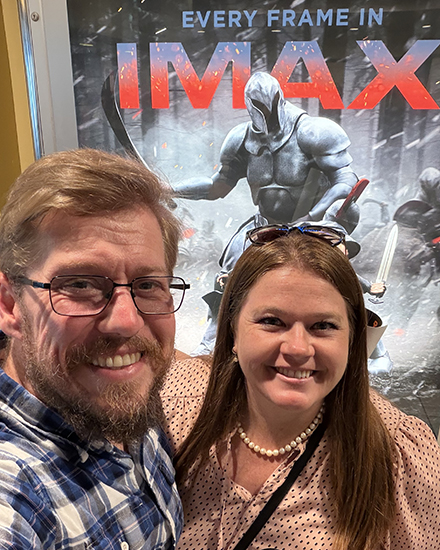
Hedrick saw "The Odyssey" with his wife Ashley in IMAX, as Nolan intented [Photo courtesy of Hedrick]
"Its narrative is deeply interwoven in time and structure ultimately converging to the battle with the suitors; that is, in fact, how Homer's text works. It is also naturally an extension of what Nolan has done throughout his film oeuvre — from ‘Memento’ to ‘The Prestige’ to ‘Inception,’ ‘Interstellar,’ ‘Dunkirk’ and ‘Oppenheimer.’”
Of all the ancient texts Nolan could have selected for adaptation, Hedrick understands why the English-American filmmaker was drawn to “The Odyssey,” especially after directing a film like “Oppenheimer,” which grapples with the burdens of intellect and accountability.
“More than any other current filmmaker I can think of, he is obsessed with time and narrative, so the structure seemed perfectly attuned to his particular talents and interests,” Hedrick said. “I very much like what he did with it. It is not Homer, it is Nolan; but it is the best rendering of the text we will get for at least a generation, and it is quite remarkable.”
Hedrick did have a few complaints about the film, namely regarding Nolan’s Odysseus, played by Matt Damon, who wasn’t quite clever enough rhetorically or strategically. Cunning is perhaps Odysseus' greatest attribute in Homer’s "Odyssey.”
“While I have my quibbles, I thought it was definitely the best adaptation of an ancient text in several generations,” he said.
THE MYTH THAT LAUNCHED A THOUSAND ADAPTATIONS
Rather than focus on the differences between Nolan’s film and the Homeric epic, Nethercut is interested in situating it within the long tradition of texts inspired by Homer’s work, including Virgil’s epic poem “Aeneid” and Cormac McCarthy’s 1985 novel “Blood Meridian."
“If you look at this film as a representative of the responses to Homer, then it’s absolutely up there with the ones that we have from antiquity,” he said. “Because those are always much more about the moment they are produced than they are about Homer.”
In the "Aeneid,” Virgil repurposes the Greek legend for a Roman audience, laying claim to Greek culture and legitimizing the new Emperor Augustus’ political power.
“That poem is really about the fact that Rome has ceased to be what it once was because it went through a sustained period of civil war,” said Nethercut. “And we have Augustus saying, ‘Hey, that period’s over and there’s a golden age now.’
“Virgil uses Homer to explore what that might mean, if it’s true, what the cost of buying into that story might be and the cost of ignoring the violence that was done in order to get them there.”
According to Hedrick, Nolan is doing something similar in “The Odyssey” by interrogating the psychological burden of war.
"The values of the film are modern and speak to our own time,” he said. “The real questions the film asks are about PTSD and its ramifications, how a society functions if it chooses to break with its values of decency, welcoming the stranger and abiding by rules of engagement.
“These are issues that are deeply in the zeitgeist now. It seems perfectly appropriate to me that Nolan would use the epic poem's narrative to speak to contemporary issues.”
The film’s popularity points to the almost 3,000-year-old story’s enduring relevance.
“Every generation retells parts of it,” Hedrick said. “It still delights, engages and challenges us. Odysseus both sets the template of what a hero is and confounds it.”
STUDY THE CLASSICS AT USF
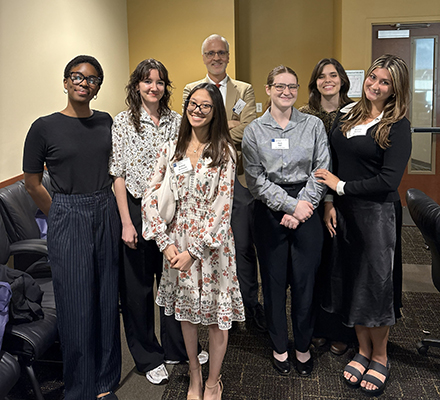
Cook taught a special, invitation-only seminar course focused exclusively on Homer's "Odyssey." The group spent three months going through the story line by line [Photo courtesy of Brendan Cook]
The College of Arts and Sciences offers numerous opportunities for students and senior citizen auditors to study the ancient civilizations of Greece and Rome and explore their languages, literature, history, philosophy, art and archaeology. The Department of World Languages — where Nethercut and Hedrick both teach — offers courses on ancient texts like Homer’s “Odyssey” as well as classical mythology, while the Department of History offers courses on Classical Greek life.
The college also offers students several faculty-led study abroad opportunities in Greece, Italy and the Mediterranean.
When Nethercut returns from sabbatical in the spring, he will teach “Greece and Rome in World Film," guiding students through movies like Ridley Scott’s “Gladiator,” Wolfgang Petersen’s “Troy,” William Wyler’s “Ben-Hur,” Joseph L. Mankiewicz’s “Cleopatra” and, yes, Nolan’s “Odyssey.”
“I imagine it will be pretty central to the course,” he said.