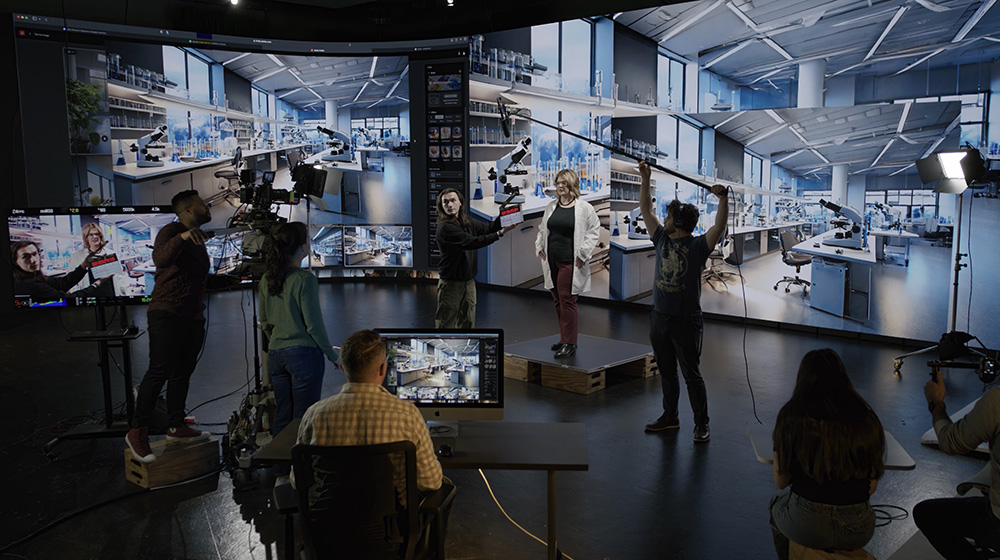
InEd Studios's 55-foot-long LED Volume screen
By Paul Guzzo, University Communications and Marketing
May 4 — better known as Star Wars Day, or “May the 4th Be With You” — perhaps hits a little harder at USF’s Innovative Education Studios than anywhere else on campus.
Being a Star Wars fan isn’t required to work there, but it certainly helps if you want to fit in with the dozen or so staff who, through video, animation, podcasts and graphic design, power the state-of-the-art production facility that creates multimedia for USF’s online courses and university projects.
“We’re Star Wars geeks here,” said Christine Brown, associate vice president for the Innovative Education department, which oversees the studio. “When a new show or movie comes out, we’re talking about it the next day.”
Even employees who aren’t Jedi-level fans appreciate the ingenuity of the 49-year-old franchise. After all, it’s Star Wars that currently helps put the “innovative” in Innovative Education Studios.
In 2019, “The Mandalorian” did more than introduce Grogu, the cuddly Force‑wielder known as Baby Yoda. The LED Volume screens, which create the show’s virtual worlds for characters clad in armor, were specifically designed for the production and then made available to the public.
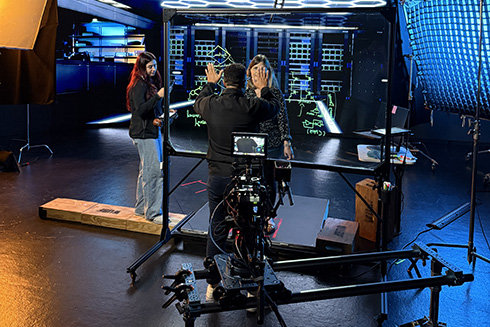
InEd Studios installed a second Volume in their main facility ...
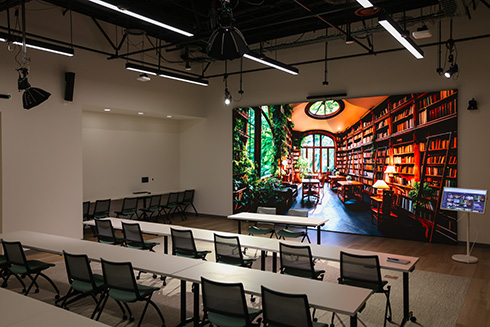
... and a third screen in a second location - Research Park
In 2023, USF’s facility — known as InEd Studios — installed one of its own. It proved so popular, that last year they added a second screen. This month, with demand continuing to increase, they’re rolling out a third screen at a new location in the USF Research Park.
The newest screen and production facility will also give more power to faculty who teach online courses as part of a DIY studio.
“Our goal is to make it as simple as possible so a faculty member can walk in, press a few buttons and start creating,” said Jared Brown, director of InEd Studios. “You don’t always need a full crew to support it.”
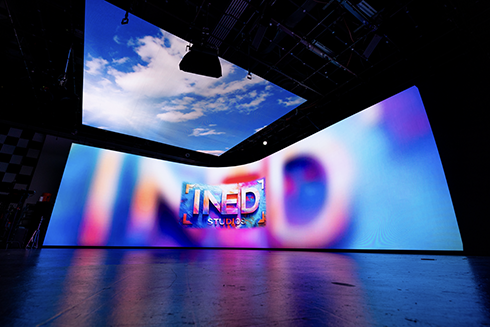
InEd Studios's 100-foot-long LED Volume screen
How LED Volume screens work
LED Volume screens are the latest tool for creating virtual locations.
An image cast in real time onto a background screen with a projector has a low resolution, so it looks dull and obviously fake on TV and the big screen.
So, most studios place a blank screen — usually colored green — in the background of a shot. Editors then digitally remove the screen and replace it with a virtual backdrop.
The LED Volume digitizes the virtual image in high resolution in real time as the scene is shot, allowing the actors and crew to interact with the environment as though it is authentic. Plus, the background can move with the camera, making the world both immersive and interactive.
Tampa was home to one of the early examples.
In 2021, Vū Technologies, located near the Tampa campus, unveiled a 100-foot-long Volume screen, popularizing the approach for commercials and national campaigns.
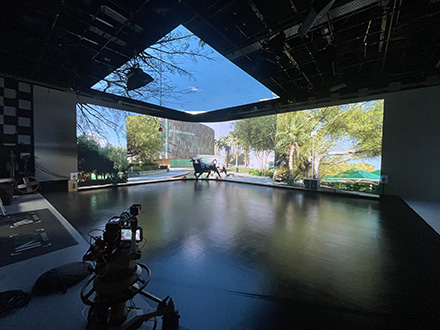
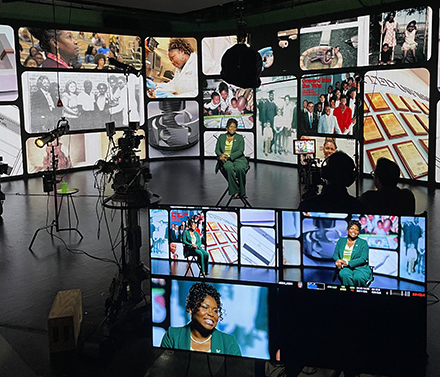
USF's campus comes to life virtually inside InEd Studios
“When Vū opened its doors, we could only imagine how incredibly useful and efficient it would be to have an LED Volume,” Jared Brown said. “It felt like a pipe dream.”
Vū CEO and co-founder Tim Moore attended USF and interned with the studio while a student.
Through that connection, Moore’s company sold virtual‑production equipment to the studio, including its first LED Volume, which measures 55 feet by 14 feet.
The two additional screens — both obtained through Vū — measure 18 feet by 10 feet.
Bringing immersive learning to online courses
The screens are used primarily to create multimedia for USF’s digital content and growing number of online courses, helping faculty engage students through immersive, subject‑driven environments. Faculty collaborate with InEd learning designers, support consultants and production teams to meet learning outcomes and tell their stories effectively.
Johnny El‑Rady, a professor of instruction in the Department of Molecular Biosciences, worked with InEd to create a video introducing himself to students in his online genetics course. The piece spoofs the Dos Equis “Most Interesting Man in the World” commercials, using the LED backdrop to place El‑Rady in a series of playful settings — from a library to a dusty, cluttered attic — as “The Most Interesting Professor in the World.”
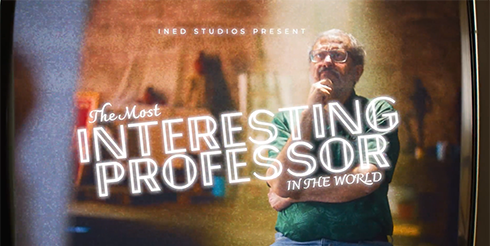
Screenshots from professor of instruction Johnny El‑Rady's video introduction to his online genetics course

The video - "The Most Interesting Professor in the World" - spoofs Dos Equis “Most Interesting Man in the World”
“It's a Hollywood studio on campus,” El-Raday said. “It’s an absolute treasure that I plan on using more and more.”
T.H. Culhane, an associate professor of instruction at the Patel College of Global Sustainability, created a 16‑episode sitcom for his Envisioning Sustainability course. Titled “Nexus Time!,” the approximately 10‑minute episodes enhance each day’s lesson through narrative storytelling.
Set in the 1970s, the show stars Culhane as a teacher on a set inspired by the era’s hit sitcom “Welcome Back, Kotter.”
“I’m a child of the ’70s,” Culhane said with a laugh. “I loved that show. Now, I get to star in it.”
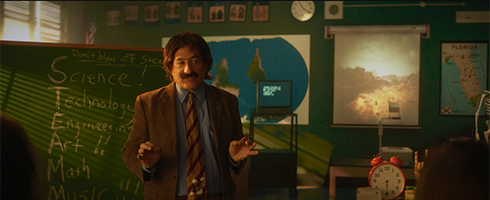
T.H. Culhane, an associate professor of instruction, is a big fan of the 1970s sitcom, "Welcome Back, Kotter" ...
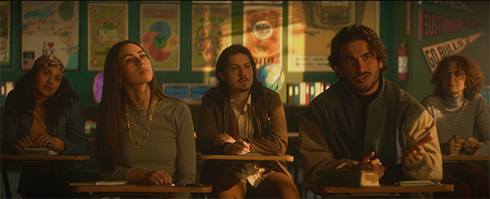
... so he worked with InEd Studios to recreate the set for online course videos
Using the LED Volume, the production team created a vintage classroom where Culhane teaches environmental policy before transporting the class to a modern sustainability farm — a future world within the 1970s-era storyline.
“It’s liberating,” Culhane said. “For years, my students and I talked about a future where teachers and students could create their own content. Thanks to InEd, that day has arrived.”
The sustainability farm featured in the show is the Rosebud Continuum Eco Science Center where Culhane has resided for the last decade. The 14-acre Land O’Lakes nonprofit sustainability education and research campus was fully 3D scanned by InEd and then recreated on the LED Volume.
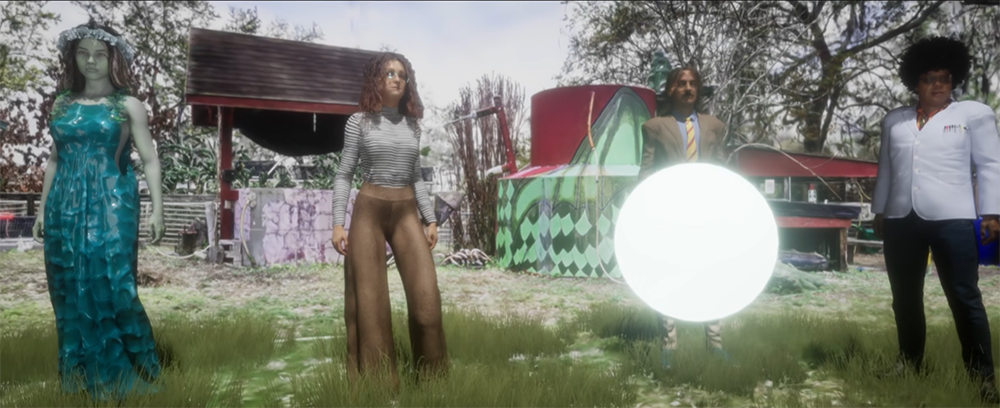
The Rosebud Continuum Eco Science Center's sustainability farm, recreated virtually by InEd Studios
“It makes it much more efficient than packing up our equipment and our crew to drive over an hour,” Jared Brown said. “What would take five days on location we can now do in one day in the studio. Name the location and we can scan it and bring it inside our space, virtually, in a way that looks as authentic as the real thing.”
InEd Studios works on hundreds of productions a year, pushing the team to the limits of their available time.
The new DIY space in the Research Park will allow faculty to be trained on the most innovative approaches and be empowered to produce learning content on their own.
“This is how we scale,” Christine Brown said. “This is the present. This is the future.”
Or, as the Mandalorian would say — “This is the way.”