By Dakota Galvin, College of Arts and Sciences
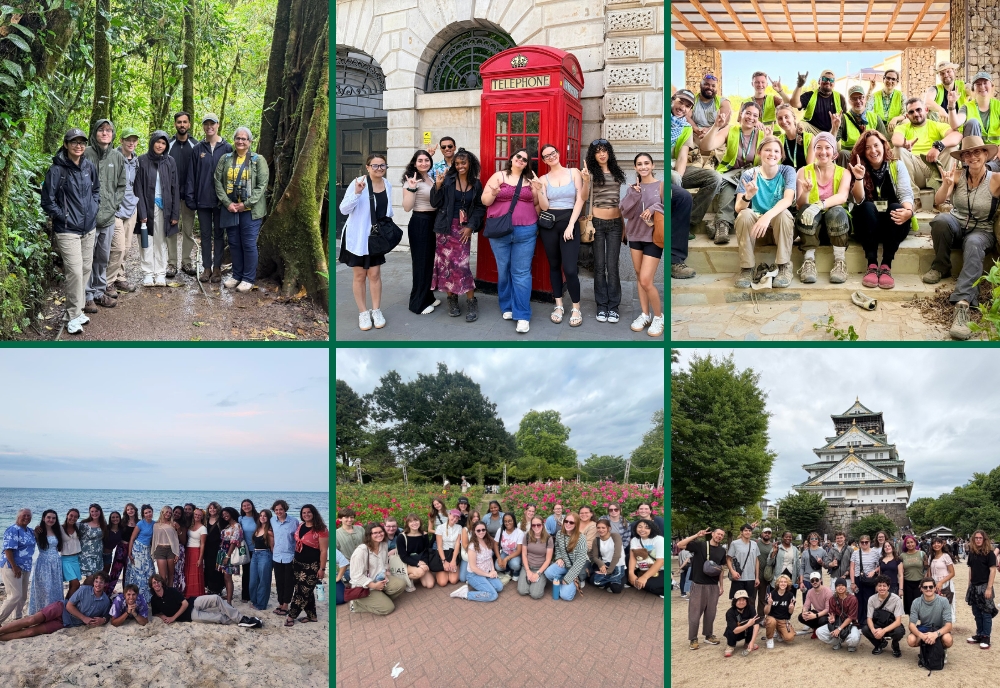
Students from across USF’s College of Arts and Sciences explore global classrooms — from forests and beaches to historic cities and cultural landmarks — during immersive study abroad programs.
Whether diving into coral ecosystems in the Bahamas, excavating ancient ruins in Sicily or navigating the urban streets of Tokyo and London, CAS students spent the summer seeing how place reshapes what — and how — they learn. Across five countries and multiple disciplines, students stepped into environments that challenged them to think differently, apply their skills in real-world settings and understand their fields through the cultures, histories and communities that shape them.
24.7060° N, 77.7980° W — Andros Island, Bahamas
On Andros Island in the Bahamas, CAS students joined peers from the College of Marine Science (CMS) for a fully immersive field course exploring the ecological, geological and cultural forces that shape tropical island environments. Guided by CMS professor Teresa Greely, the interdisciplinary program brought CAS students together with marine science experts, giving them a chance to apply their academic skills in a setting where land, sea and community intersect.
The course emphasized hands‑on exploration — from identifying reef fish and corals in the field to documenting observations through photography and video, including underwater work. Daily field and lab activities challenged students to think critically about how island inhabitants are interconnected, how ecological and geological systems influence where people live and how local sustainability efforts support the surrounding environment.
For marine biology major Alyssa Hall, the Andros experience brought her coursework to life in ways a classroom never could.
“My first time seeing a barrier reef brought me to tears,” she said. “It was genuinely one of the most beautiful things I’ve ever seen.”
According to Hall, meeting local community members deepened her understanding even further and expanded her perspective on how communities around the world rely on the ocean and how diverse — and fragile — those ecosystems truly are.
By the end of the program, CAS students strengthened skills in marine and island ecology while also building key career competencies central to CAS learning: teamwork, communication, ethical observation and field research. The collaboration with CMS offered a unique interdisciplinary experience — one that allowed CAS students to see how scientific inquiry, environmental stewardship and cultural understanding come together in a place shaped entirely by its natural surroundings.
And for Hall, the program shaped what she wants to do for the rest of her life.
“I would love it if I could find a career that allows me to be in nature, advocating for its protection and working with the communities that rely on the ocean.”
10.2750° N, 84.8255° W — Monteverde, Costa Rica
Surrounded by Monteverde’s misty mountain landscape, anthropology and environmental engineering students worked with professors Nancy Romero-Daza and David Himmelgreen to study wastewater systems in rural communities.
The interdisciplinary field school centers on finding practical solutions to complex challenges — in this case, wastewater management in rural Costa Rican communities where a centralized sewage system doesn’t exist.
“The work our students do is guided by the principle that research needs to benefit the communities with whom we work,” Romero‑Daza said. “This means we do research not only for the sake of acquiring knowledge, but more importantly, to provide local stakeholders with information that can bring direct benefit to them and their communities.”
Regardless of their major, students conducted observations and surveys and tested water samples from different wastewater treatment systems. “It’s our belief that we must break out of our disciplinary silos in order to truly address global problems,” Himmelgreen said.
For anthropology and geography major Gabriela Brunk, that interdisciplinary approach was exactly what made the experience transformative. Inspired by Romero-Daza’s Anthropology of Infectious and Contagious Diseases course, Brunk joined the project to experience the fieldwork firsthand.
She embraced the interdisciplinary nature of the work by helping engineering students learn anthropological methods — from conducting interviews to documenting observations — while everyone adapted to the unpredictable realities of rural fieldwork.
“It’s easy to be good at teamwork in a controlled lab setting,” Brunk said. “It’s a lot harder when you’re in the field and it’s raining, you’re starving, your equipment isn’t working and you’re covered in ants.”
Biomedical anthropology major Natalie Barcazar echoed that sentiment, noting that the experience pushed her to grow as both a researcher and a teammate. “My travels taught me a lot about teamwork, more than I had experienced beyond a classroom,” she said. “Everyone will have different ways of interpreting a result or an interaction… It taught me a whole other level of teamwork.” She added that learning to advocate for herself and her peers became one of the most meaningful parts of the trip.
The experience strengthened both students’ confidence as researchers and clarified their future goals. Brunk hopes to pursue applied anthropology or environmental science work — ideally in roles that allow her to travel and continue communitycentered research. Barcazar plans to pursue public health, carrying forward what she learned about wastewater, community health and the importance of integrating human culture into environmental solutions. “World travel will enrich your life in every way imaginable,” Brunk said. “There is so much more to learn from how people in other cultures live.”
51.5074° N, 0.1278° W — London, United Kingdom
As CAS’s largest study abroad program, USF in London immerses students in one of the world’s most influential global cities — a place where politics, culture, literature, psychology and media intersect. For four intensive weeks, students live, commute, study and explore London, experiencing firsthand how place reshapes what — and how — they learn.
Across disciplines, London offered CAS students a chance to see their fields through a global lens — from politics and migration to literature, culture and psychology.
Learning global politics through lived experience
For students in the School of Interdisciplinary Global Studies, London annually becomes a hub for understanding global politics, migration, identity and citizenship. Associate Professor M. Scott Solomon, who has been part of the USF in London program since its inception in 2015 and has co-directed the program since 2019, says the city’s complexity makes it an unparalleled classroom: students don’t simply visit London — they live, commute and learn in it.
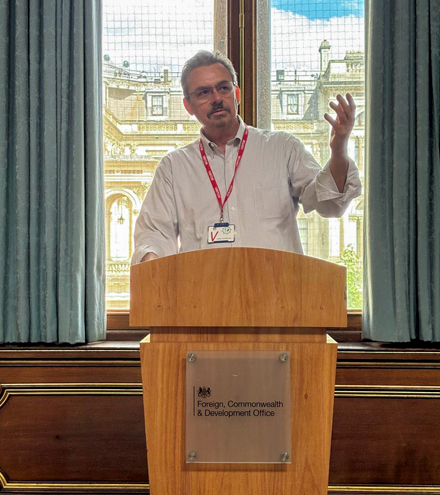
Scott Solomon during this year's tour at the Foreign, Commonwealth and Development Office in London.
“Seeing students adapt and grow more confident in a new environment is one of the most rewarding moments in a teaching career,” Solomon said.
Solomon’s courses — Empire, Blood and Belonging; and British Politics, Culture and Life — trace how migration and identity have shaped the United Kingdom over centuries. Through walking tours, museum visits and neighborhood explorations, students saw how political decisions, cultural histories and global forces intersect in one of the world’s most influential cities.
For political science and history major Kamdyn Mildenhall, those lessons came through during a walking tour in Brixton. After studying the Windrush generation and the stereotyping of the neighborhood, seeing “Buy Back Brixton” signs and witnessing the community’s response to gentrification made the political issues she’d learned about feel urgent and real.
“Seeing the impact of these stereotypes, gentrification and history overall was super life changing,” Mildenhall said.
Political science and Africana studies major Kayli Hamilton found similar clarity in London’s political and cultural spaces. Visiting the British Museum’s reading room — where Marcus Garvey, Virginia Woolf and Karl Marx once worked — made the intellectual history she studied feel newly tangible.
“I could not only envision these historical figures doing their work here, but I could picture myself doing impactful work as well,” she said.
Both students said London taught them things no classroom could: how political systems shape communities, how history lives in public spaces and how global citizenship feels in practice. Their advice to CAS students interested in studying abroad is simple — go. As Mildenhall put it, “It was truly the best experience I have ever had.” Hamilton agreed: “Living and learning in another country and culture is a unique experience that can’t be replicated.”
Learning how place shapes storytelling
In Lindsey Kurz’s Literature and the Occult course, English and creative writing students discovered how deeply place shapes storytelling. London’s streets, archives and historic neighborhoods became extensions of the classroom, allowing students to experience literature in the environments that inspired it.
For creative writing major Jumaanah Gibbs, that immersion transformed how she observes and writes. “There is so much more to learn by walking the streets rather than sitting in a class,” Gibbs said. Standing beneath the building that inspired the novel “Dr. Jekyll and Mr. Hyde” or tracing the path of the 1666 fire turned literary history into something she could see and feel. The experience left Gibbs feeling “never more excited to write.”
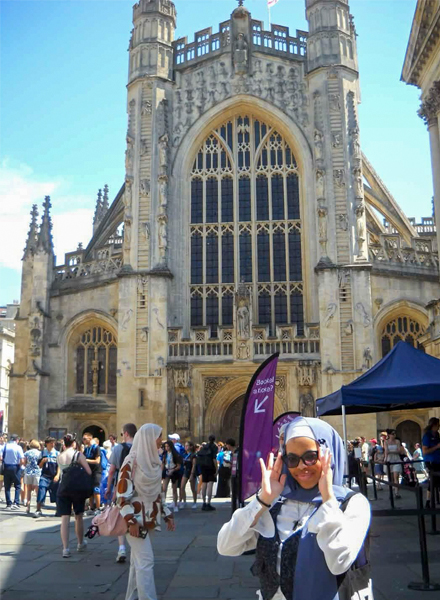
Creative writing major Jumaanah Gibbs in front of Bath Abbey in Bath, England. Bath Abbey is one of the most recognizable Gothic landmarks in the city. [Photo courtesy of Jumaanah Gibbs]
English major Madeline Kossow joined the program after hearing about it in her class with Professor of Instruction Jessica Cook. According to Kossow, Cook’s enthusiasm and the reassurance of taking courses with a familiar professor while abroad made the decision to travel to London less intimidating.
Cook, who taught Jane Austen in London and Film & Culture: Harry Potter Films, said she consistently sees students grow more independent, confident and connected in just four weeks abroad. Her courses gave students the chance to study Austen’s world through the city’s Georgian and Regency architecture and to explore Harry Potter filming locations while applying film studies concepts.
“I’ve taught in this program several years now, but I’m still amazed at how much I see the students grow in just four weeks,” Cook said. “They become more independent and confident in navigating a complex and busy city, develop friendships with peers they might never meet on campus and discover not just a new place but aspects of themselves they didn’t even know existed.”
Those lessons came to life while Kossow explored the places that shaped the literature she was studying.
“I went to Bath with two new companions I met during the study abroad program, and we strolled along Pulteney bridge then around the Parade Gardens,” Kossow said. ”Much like Austen’s protagonists, we used this walk to find a sense of renewal in the beauty around us and strength in our ability to navigate a new world outside of our comfort zone.”
The experience also broadened her sense of what’s possible after graduation. Learning about international internships and global career paths sparked her interest in the Fulbright program, and the independence she gained abroad helped her realize she could thrive outside the United States.
Learning the psychology of home in a global city
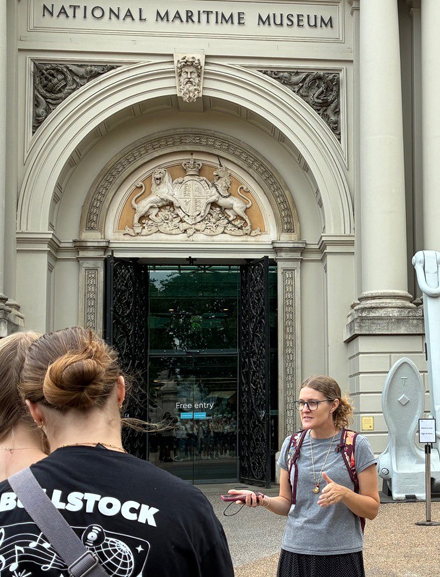
Jennifer O'Brien teaching in front of the National Maritime Museum. [Photo courtesy of Elizabeth Spiller]
According to Associate Professor Jennifer O’Brien, London is an ideal setting because it’s a place where students can observe culture, identity and behavior in real-time. Her study abroad courses center on building intercultural awareness and global competency, encouraging students to rethink the psychology of home, and how belonging shifts when navigating a new environment.
“My hope is that students finish the program with an expanded sociocultural perspective so that they are confident in their ability to build their ‘home’ wherever life’s adventures take them,” O’Brien said.
The program did just that for O’Brien’s student, Isis Cruz. She joined the program hoping that stepping into the unknown would push her to grow personally and academically.
“I thought that throwing myself into an unfamiliar environment could be the push that I needed to realign my focus. I gained that and more,” Cruz said.
In London, Cruz found herself adapting to new routines, new expectations and a new cultural landscape — the very kind of perspective building O’Brien hopes students will embrace. The experience didn’t just broaden her worldview; it reshaped her goals. After visiting universities and meeting international psychology students, Cruz began to see graduate study abroad as a real possibility and even felt inspired to pursue a doctorate.
As she explored museums that confront Britain’s global past, walked through historic neighborhoods and stood inside the Freud house reading Anna Freud’s letters, Cruz began to see psychology through a broader, more culturally grounded lens.

O'Brien's class posing in front of London's iconic telephone booth. [Photo courtesy of Jennifer O'Brien]
“Psychology isn’t just about the brain,” Cruz said. “It’s about stepping outside yourself to understand people across cultures.”
36.8600° N, 15.0600° E — Villa del Tellaro (Sicily), Italy
In Noto, Sicily, CAS students with USF’s Institute for Digital Exploration (IDEx) stepped into the world of ancient Rome through a month-long archaeological excavation at the Roman Villa del Tellaro — a historic site that has served as a summer research base for IDEx since 2019. Led by IDEx Director Davide Tanasi, students used traditional excavation and high-tech remote-sensing techniques to uncover new details about the 4th century villa’s structure and history.
For anthropology graduate student Manny Mazariego, the excavation brought his CAS coursework to life “in ways the classroom never could.”
“There’s only so much you can learn from a lecture,” Mazariego said. “Actually seeing and feeling the soil change and recognizing archaeological features in real time is when everything finally clicks.”
Mazariego arrived in Sicily with the skills he practiced in his Archaeological Methods course, but applying the proper techniques on an actual Roman site gave him a new understanding of his field.
“Reading about careful excavation is one thing,” Mazariego said. “Knowing when to switch from a pickaxe to a trowel or how to recognize a subtle change in soil layers only really makes sense once you’re standing in the trench.”
For Mazariego, the dig was a powerful reminder that archaeology rarely works alone. From analyzing artifacts alongside historians and forensic anthropologists to watching artifacts get 3D digitized, the experience showed just how many specialties unite to bring a site's story to life. “Seeing those disciplines come together completely changed my appreciation for how modern archaeology is conducted,” he said.
What made this journey “real” for Mazariego wasn’t a singular moment — it was the start of each new day.
“It was waking up every morning, looking out my window at historic buildings like the Cathedral of Noto and realizing that I was about to spend another day doing the work I’ve dreamed about,” Mazariego said. “It all hit me at once that I had traveled across the world to uncover real history alongside an incredible team of researchers.”
“That was the moment I realized archaeology wasn’t just anything; it’s something I’m passionate about and I look forward to making it my career,” he added.
43.7696° N, 11.2558° E — Florence, Italy
Over 600 miles away from Sicily, other CAS students studied at the Florence University of the Arts. The program’s interdisciplinary structure — spanning communication, nutrition, humanities and the sciences — allowed students to see their fields through a global lens shaped by culture, community and lived experience.
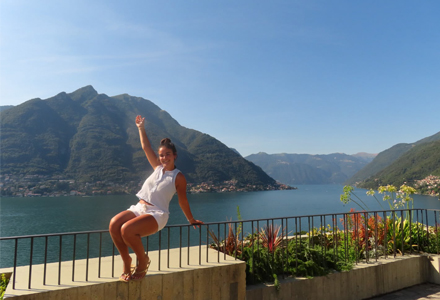
Caila Menichella at Lake Como, Italy
For biomedical sciences major Caila Menichella, studying abroad offered a chance to step outside her comfort zone and see how culture shapes patient care.
“Studying abroad allowed me to view the diverse cultures and backgrounds you need to learn to work with as a physician,” Menichella said.
The experience also strengthened her sense of independence. Traveling on weekends, navigating unfamiliar places and adapting to new routines taught her flexibility and confidence.
“Traveling at a young age often comes with challenges,” she said. “Being able to navigate them allows the development of independence and problem-solving skills.
Meanwhile, strategic communication management graduate student Allison Smith found that Florence reshaped her understanding of communication itself. Her CAS coursework had taught her that meaningful interactions are relational, not transactional — and that lesson took on new depth abroad. A conversation with a shop owner became a moment when her coursework clicked, showing her how empathy and curiosity can transform everyday interactions.
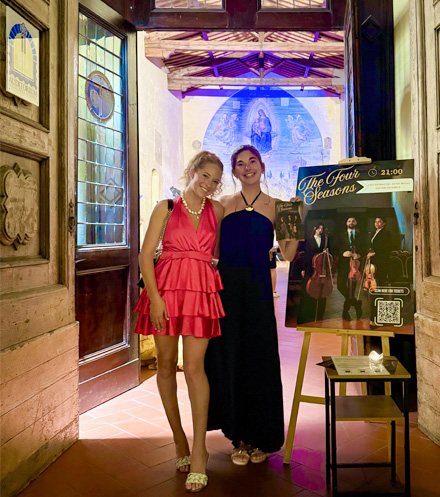
Allison Smith (right) with [name?] at a Vivaldi's Four Seasons chamber concert.
“While I initially entered the store simply to make a purchase, I found myself slowing down, asking the shopkeeper’s name and learning a little about her life and experiences,” Smith said. “It showed me that even brief interactions can become meaningful when we approach others with genuine curiosity and care.”
Smith said Florence expanded her global perspective by revealing how values shape communication across cultures. Whether navigating language barriers, forming friendships or connecting with locals, she saw firsthand how people create meaning across differences.
“Communication is ultimately about creating meaningful human connection,” she said.
Both students said the experience changed them personally as much as it changed them academically. Menichella said traveling helped develop her empathy – something she hopes to continue to build on as she continues her path toward medical school. Smith said the experience strengthened her patience, humility and trust, deepening her commitment to servant leadership and her long-term goal of becoming a business ethics professor.
35.6762° N, 139.6503° E — Tokyo, Japan
In Japan, CAS students experienced language, culture and history firsthand as they traveled through Tokyo, Osaka, Kyoto, Nara and Hiroshima. Led by Brian Thompson of the Department of World Languages, students got to learn about the country through a blend
of traditional and modern Japan, offering a historical context that deepened the students’ understanding of Japan’s relationship with the United States.
For Delanie Mickley, an East Asian Languages and Cultures graduate, the experience reignited her love for the country. “I feel as though I got caught up in the logistics of graduating and forgot why I picked this major in the first place,” Mickley said. “This trip reminded me of the childlike curiosity that fueled my decision [to study Japan], and will continue to fuel my want to learn for years after I graduate.”
Japan also taught Mickley a level of self‑awareness she couldn’t have gained in a classroom. “Being in an unfamiliar place with unfamiliar people, especially with an unfamiliar language, can be mentally exhausting,” she said. “You have to learn to stand up for yourself, especially for basic necessities like food and water, so that you can be fully present in your experiences.”
Thompson said he hopes students carried home two things: curiosity and flexibility. In a world where translation apps can solve most problems instantly, he said he was impressed by how readily students embraced moments when technology couldn’t help — choosing instead to navigate uncertainty with openness and confidence.
27.9506° N, 82.4572° W — Tampa, Florida, USA.
After a summer of learning abroad, CAS students returned home with new skills, new perspectives and a deeper understanding of their fields. Whether studying marine ecology, archaeology, media ethics, global politics, psychology or cultural history, they saw firsthand how global learning enriches every discipline and expands what’s possible in the classroom.
Students interested in future study abroad programs can learn more through USF World.