News and Events
Graduate Alumni Spotlight
Click through the tabs below to see what some of our amazing alumni have been up to!
Dr. Anje Woodruffe
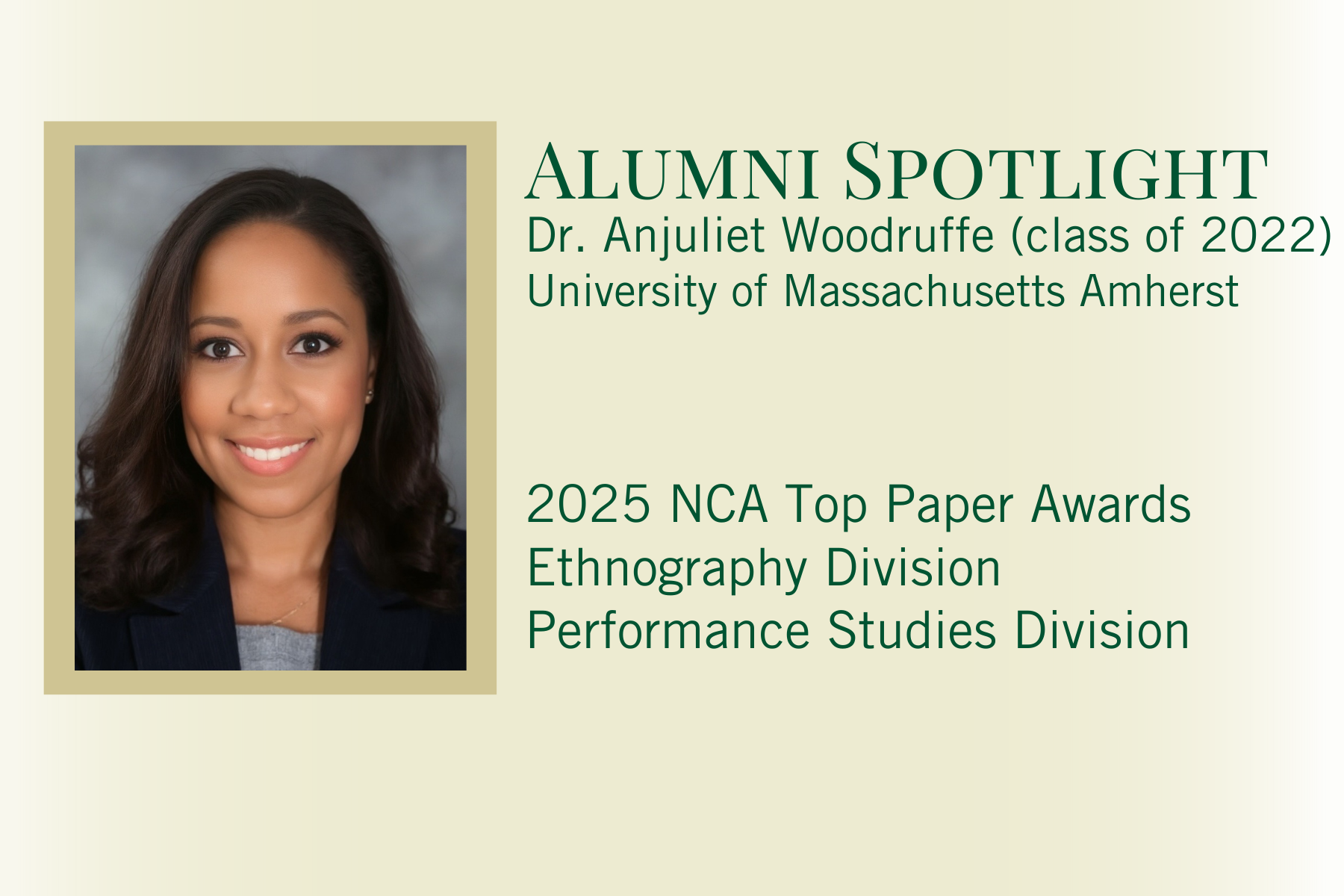
Dr. Anjuliet Woodruffe is an Assistant Professor of Critical Performance Studies at
the University of Massachusetts, Amherst. Prior to UMass Amherst, Dr. Woodruffe held
a Postdoctoral Fellowship at the Charles Phelps Taft Research Center at the University
of Cincinnati, where she was also a faculty affiliate in the Department of Women’s,
Gender, and Sexuality Studies. She earned her Ph.D. in Communication Studies from
the University of South Florida, along with a Graduate Certificate in Women’s and
Gender Studies in 2022.
Dr. Woodruffe’s research centers identity and transnational migration, using autoethnography,
and storytelling methodologies to explore themes of affective citizenship and belonging.
Her research has been published in leading journals including Departures in Critical
Qualitative Research, Cultural Studies ↔ Critical Methodologies, International Review
of Qualitative Research, and the Journal of Autoethnography. Her recent article, “Home
as a Space, Not a Place: Narrating Transnational Identity” (2024), reflects her sustained
engagement with questions of cultural memory, affect, and diasporic identity.
Dr. Woodruffe’s creative scholarship includes award-winning poetry, narrative performance,
and collaborative projects like L.I.V.E.: Learning (through) Voices (and) Expression,
performed at the Contemporary Arts Center in Cincinnati, Ohio. Her work has been featured
by the National Communication Association as well as the Brooklyn Caribbean Literary
Festival. She is currently working on completing her monograph, Making a Way Out of
No Way: Trinidadian Women’s Migration Narratives, which explores how Black Caribbean
women navigate migration, identity, and memory.
Dr. Woodruffe is the recipient of multiple honors, including the John T. Warren Award
and the Donald P. Cushman Award. Her article “Surviving from the Margins: A Conversation
about Identity with James Baldwin was included in the Best Special Journal Issue Award
from the Ethnography Division (2022). Her growing portfolio includes annual Top Paper
Awards from the National Communication Association.
In 2025, her submissions “Borderline Justice: Judicial Boundaries and Legislative
Barriers” and “The Audacity to Dream: Performing Hope in the Midst of Uncertainty
and Change” received Top Paper honors in the Ethnography and Performance Studies divisions,
respectively, at NCA.
Dr. Woodruffe currently serves on the Editorial Board of Text and Performance Quarterly
and is active in shaping the field through peer review, mentorship, and interdisciplinary
collaboration.
Dr. Jay Baglia
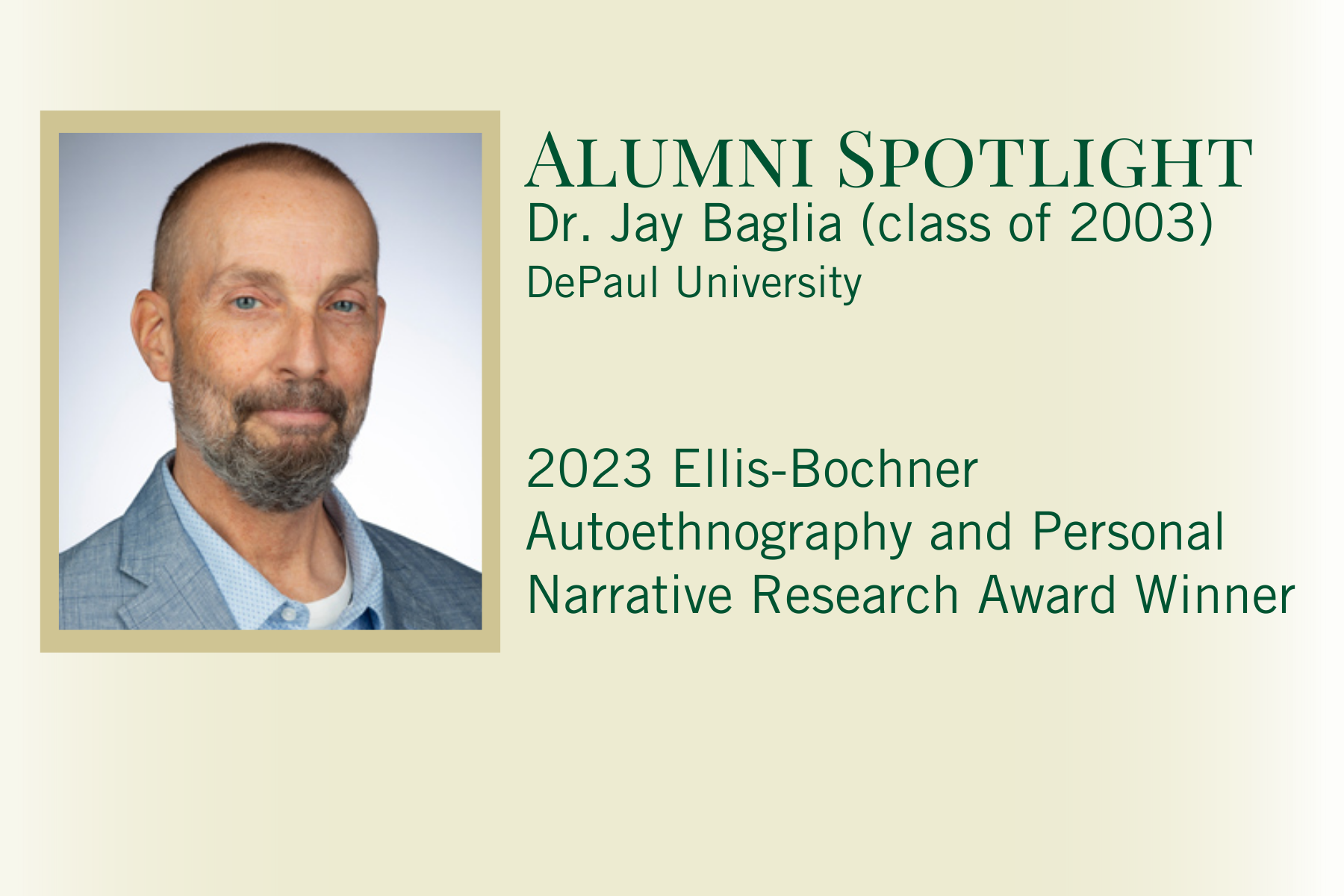
Dr. Jay Baglia graduated from the USF Communication Department with his PhD in 2003. Since then, he has gone on to teach at several universities, in Texas, California, Pennsylvania, including here at USF! Currently, he serves as an Associate Professor in the College of Communication at DePaul University. His research is focused on health and gender communication, and performance studies.
Jay has published two books, "The Viagra Ad Venture: Masculinity, Media, & the Performance of Sexual Health," which won the 2012 Distinguished Book Award from the Health Communication Division at the National Communication Association, and "Communicating Pregnancy Loss: Narrative as a Method for Change" (a volume co-edited with Rachel E. Silverman). In addition, he has published several essays, chapters, and reviews in journals such as Cultural Studies <> Critical Methodologies, Family Medicine, Health Communication, Text & Performance Quarterly, Women & Language, and the Journal of Dramatic Theory & Criticism.
Most recently, he was awarded the 2023 Ellis-Bochner Autoethnography and Personal Narrative Research Award for his article, “The Ontology of Oncology: Navigating Cyborgs and Assemblages Through Cancer Treatment,” which was published in Health Communication.
Jay was recently featured in a NPR spot where he spoke about human touch and healing during the pandemic. Click here to listen to the discussion.
Dr. Elizabeth Hintz
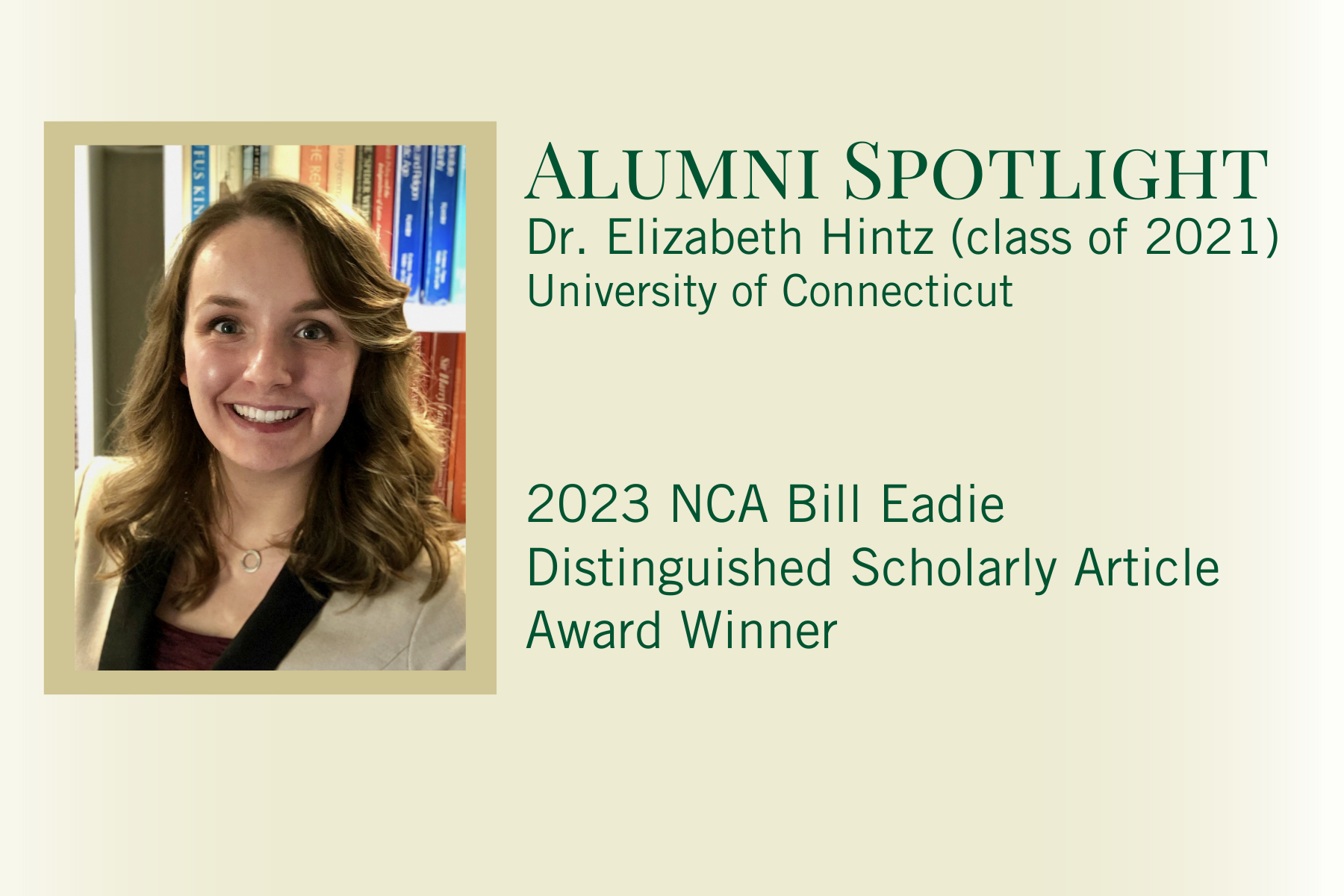
Dr. Elizabeth Hintz graduated from the USF Department of Communication with her PhD in 2021. She is now a tenure-track Assistant Professor of Communication at the University of Connecticut. Her research examines how people managing complex, stigmatized, and poorly understood health conditions experience and navigate challenging conversations with partners, family members, and clinicians.
Elizabeth’s work can be found in journals such as Journal of Communication, Human Communication Research, Communication Monographs, and Health Communication. Her work has also appeared in outlets such as the BBC, WIRED U.K., ScienceLine, the American College of Obstetricians and Gynecologists, and NCA’s Communication Currents.
Elizabeth has received several top paper and research and teaching awards. She is the 2023 recipient of both the Early Career Award from the NCA Interpersonal Communication Division and the 2023 Leslie A. Baxter Early Career Award from the NCA Family Communication Division. Most recently, Elizabeth received the 2023 NCA Bill Eadie Distinguished Scholarly Article Award for her co-authored article, "E-Sisters and the Essure coil: Power, representation and voice in women’s public docket accounts to the FDA of medical device adverse events" (Journal of Applied Communication Research, 2023).
Dr. Sasha Sanders
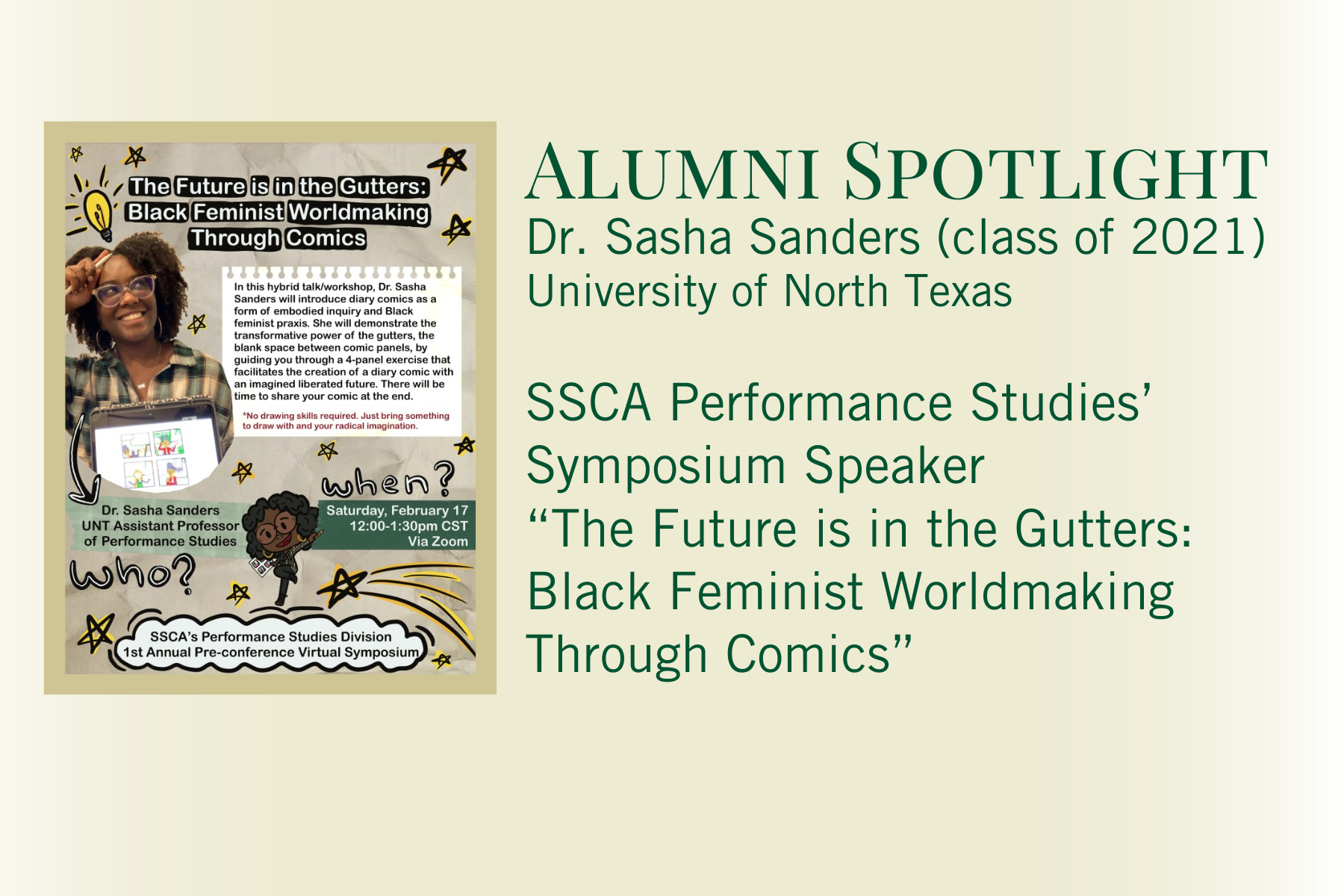
Dr. Sasha Sanders (she/her/hers) is an Assistant Professor of Performance Studies in the Department of Communication Studies at the University of North Texas and an affiliated faculty member of the Women's and Gender Studies Program and LGBTQ Studies Program. She graduated from the USF Department of Communication with her Ph.D in 2021.
Dr. Sanders draws on autoethnography, performance, and Black feminist aesthetics to question and reimagine identity, power, and place. Her embodied, reflexive approach to exploring media and culture intersects with Performance Studies, Critical Cultural Studies, Women's and Gender Studies, and Comic Studies. In her recent publications, “Gutter Futures” and “(Be)coming Out in Comics: Navigating Liminality and Queer Identity Formation,” she argues that the gutters in comics open liminal spaces of possibility and transformation that welcome fluidity and future-oriented world-making.
Her scholarship can be found in Text and Performance Quarterly, Communication and Critical/Cultural Studies, Departures in Critical Qualitative Research, Journal of Autoethnography, and Synoptique: An Online Journal of Film and Moving Image Studies.
In February, Dr. Sanders was featured as the SSCA Performance Studies Division's first Symposium speaker. The symposium was titled "The Future is in the Gutters: Black Feminist Worldmaking through Comics."
Sasha was also awarded the Southern States Communication Association's 2024 Dwight L. Freshley Outstanding New Teacher Award, and was honored at the Award Luncheon at the 2024 SSCA Conference in April.
Dr. Brian Johnston
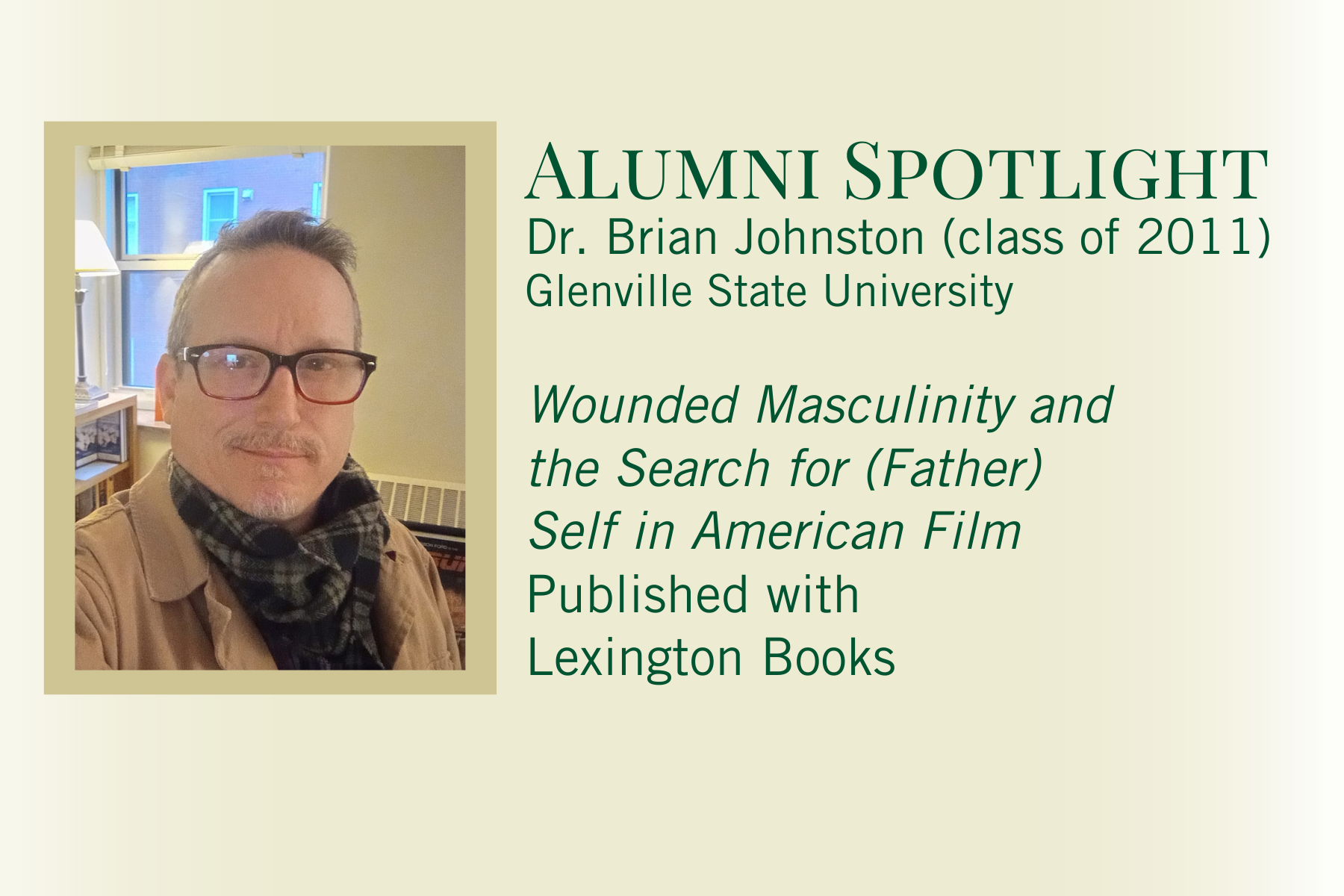
Dr. Brian Johnston graduated from the Department of Communication with his Ph.D. in 2011. Since then, he has gone on to teach as an assistant professor of communication in the Department of Language and Literature at Glenville State University in West Virginia. In addition to teaching, he serves as the director and coach of GSU’s Pioneer Debate team, as well as a reviewer for the Journal of Autoethnography, and a member of the Profs Do Pop editorial board.
Brian’s scholarship focuses on the study of media, media audiences, public memory, organizational culture, and civic discourse, with a rhetorical and autoethographic approach.
His research appears in the Journal of Communications Media Studies, and the Journal of Autoethnography. In addition to authoring book chapters in The Routledge International Handbook of Organizational Autoethnography and The Trump Years, he has co-authored two books, the Popular Appeal of Liminality in the Music of U2, and his most recent, Wounded Masculinity and the Search for Father (Self) in American Film.
Dr. Marquese McFerguson
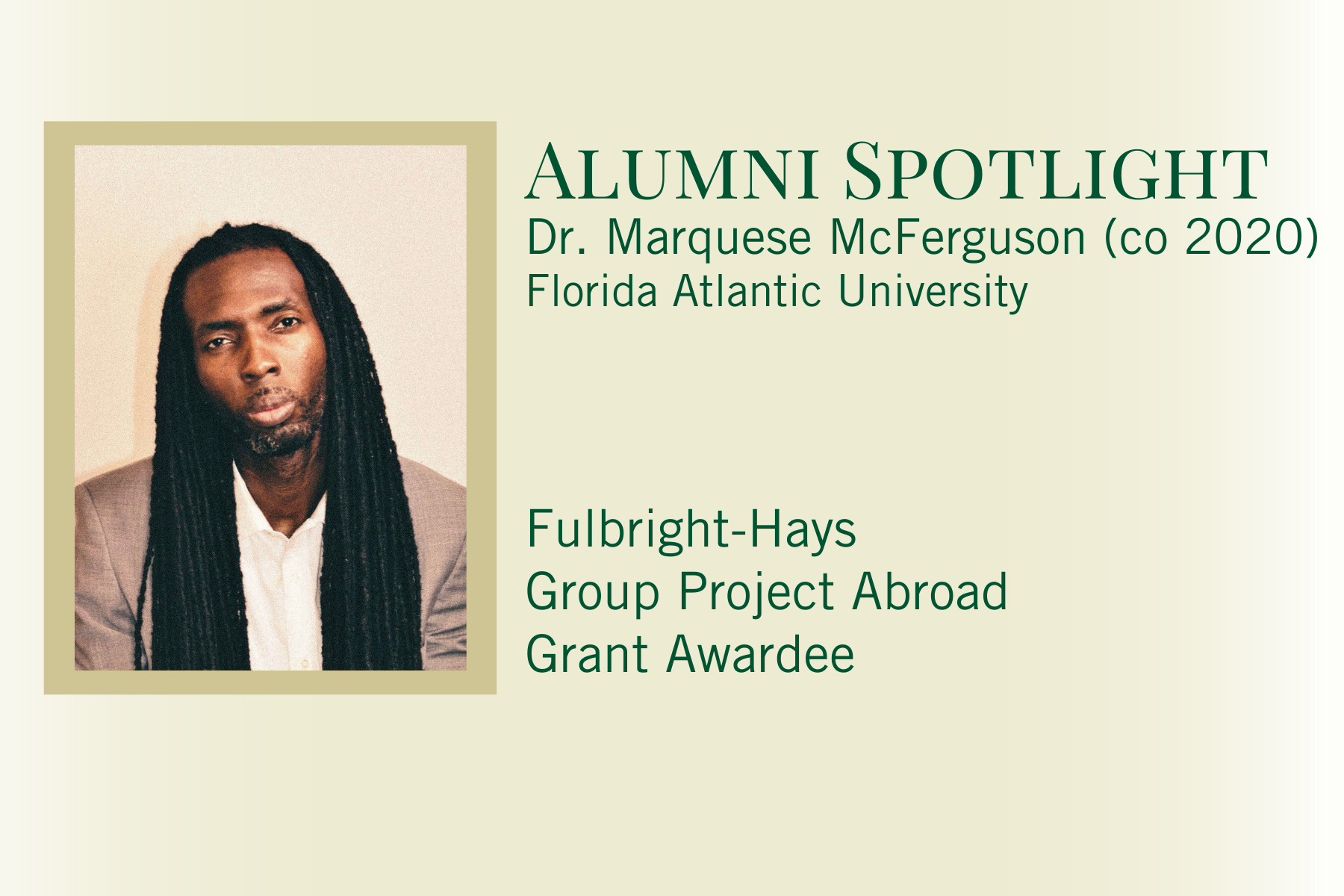
Dr. Marquese McFerguson graduated from the USF Communication Department with his Ph.D. in 2020. Since then, he has gone on to teach in the School of Communication and Media Studies as an Assistant Professor of Intercultural Communication at Florida Atlantic University.
His teaching and scholarship focus on the ways identity is performed, communicated, and reimagined by individuals across a diverse number of cultural intersections in society. Marquese focuses his research on building cross-cultural understanding through examining the creation and portrayal of racialized identities in media, and how those identities are then interpreted and performed by audiences.
In addition to teaching and research, Marquese has won awards for his slam poetry, and has performed throughout the United States and United Kingdom.
Recently, Marquese was awarded a Fulbright-Hays Group Project Abroad Grant. He will study in Brazil, exploring the ways Afro-Brazilian communities have historically used art, especially poetry and music, as a tool for activism and protest.
Dr. Brianna Cusanno
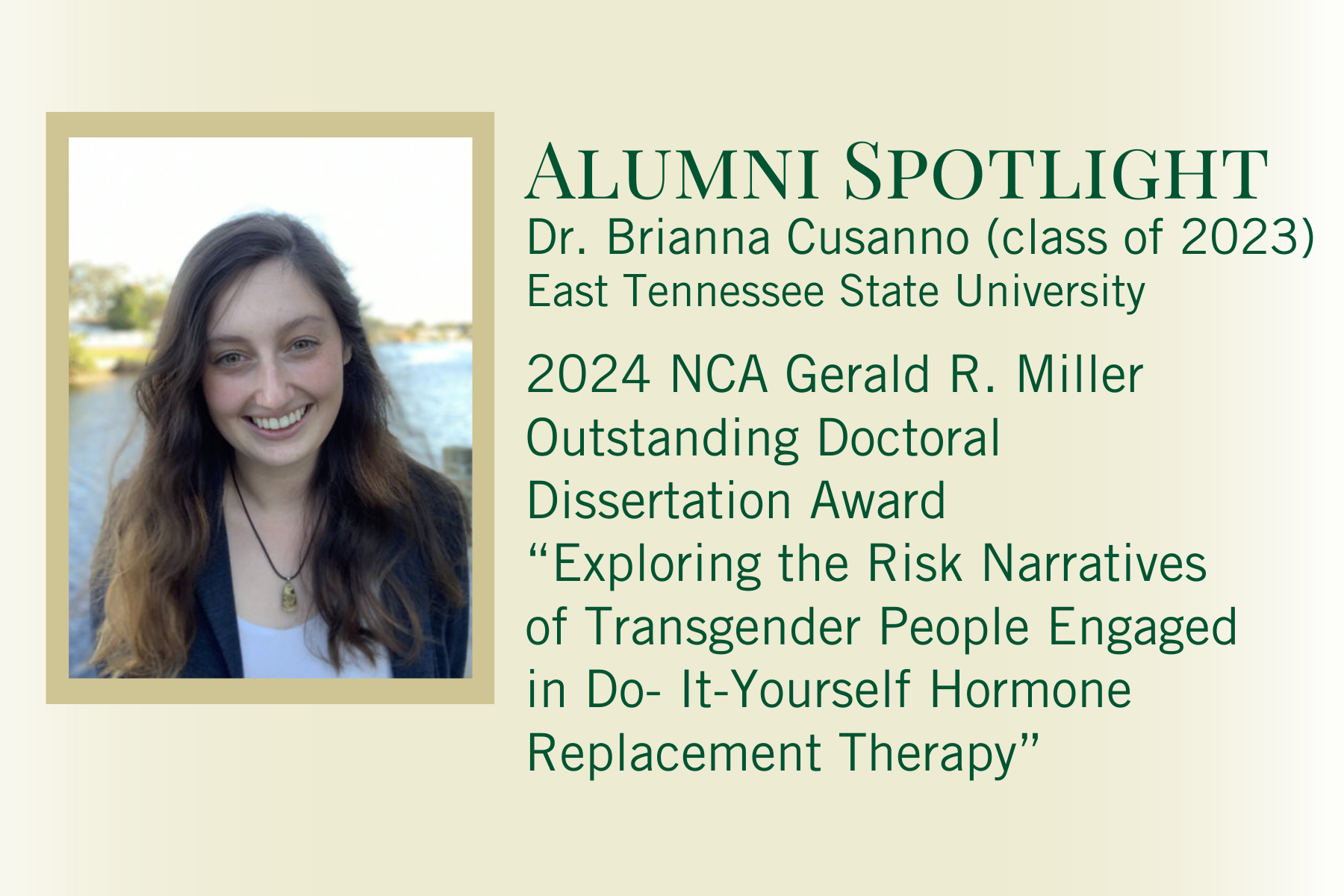
Dr. Brianna Cusanno graduated from the USF Department of Communication with her Ph.D. in 2023. Since then, she has gone on to teach at East Tennessee State University, as an Assistant Professor within the Department of Communication Studies and Storytelling.
Her teaching and scholarship focus on health communication, qualitative methods, and narrative medicine, with a particular emphasis on how narratives can perpetuate or disrupt health inequities, and how they can open possibilities into building healthier, more equitable futures. In addition to her scholarship, Brianna participates actively in narrative medicine and health humanities groups.
Most recently, Brianna was selected to receive the 2024 Gerald R. Miller Outstanding Doctoral Dissertation Award from the National Communication Association, for her dissertation "Exploring the Risk Narratives of Transgender People Engaged in Do-It-Yourself Hormone Replacement Therapy." This dissertation was directed by faculty colleagues Dr. Sonia Ivancic and Dr. Patrice Buzzanell during her time with our department.
Kyle Romano
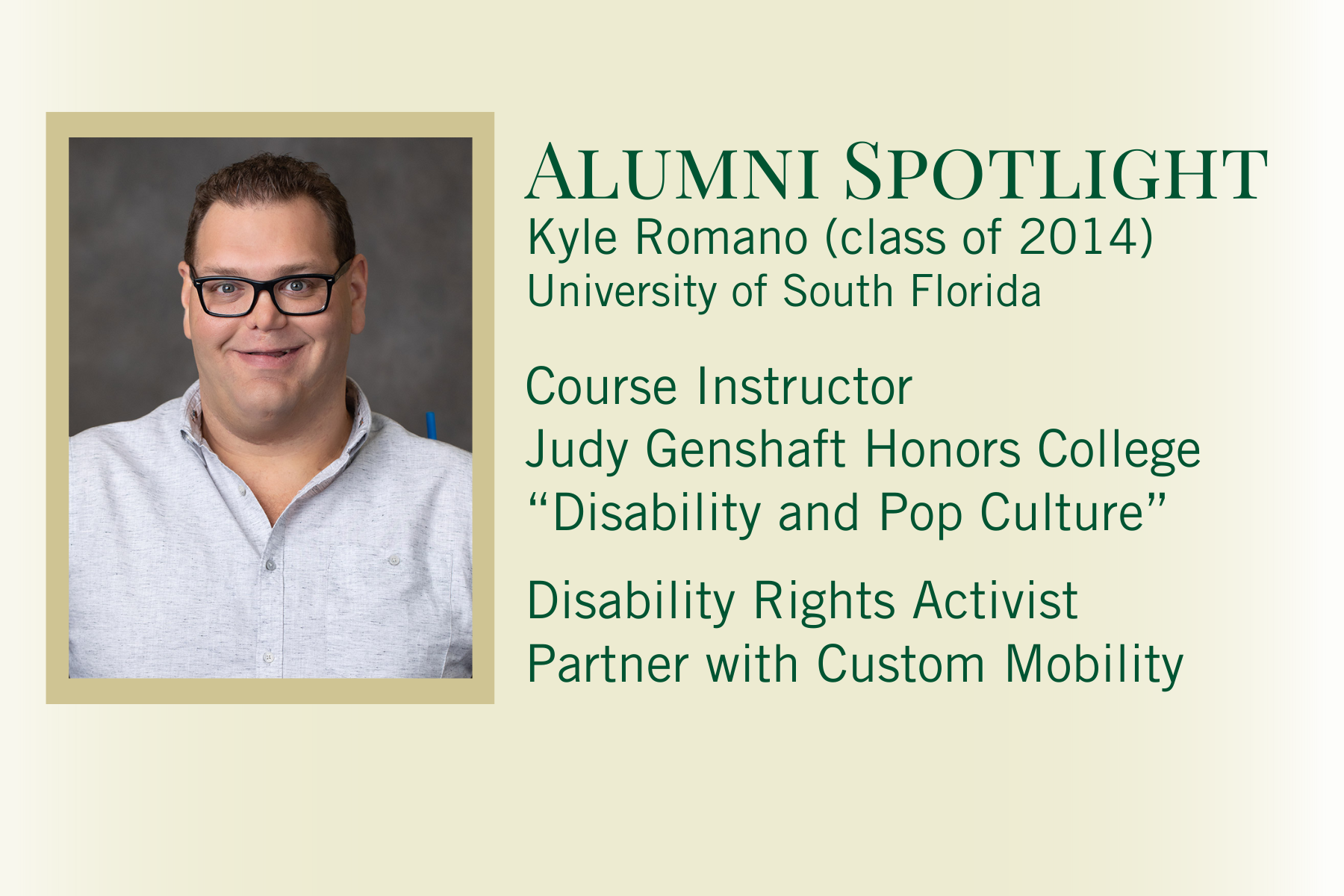
Kyle Romano is an instructor, public speaker, and Disability Rights activist. After receiving his M.A. in Communication, from the University of South Florida, he now uses his knowledge to teach others about the intricacies surrounding the lives of disabled people. At USF, Kyle is currently teaching an Honors class called Disability In Popular Culture. Through his work with Custom Mobility, he regularly educates legislators, industry leaders, clinicians, and students, about the struggles of limitation and discrimination, offering a valuable and practical perspective on the topic of Disability Rights.
Around the age of one, Kyle contracted bacterial meningitis. As a result, physicians had to amputate all four of his limbs. He’s been a power wheelchair user since the age of three. He enjoys reading, writing, teaching, watching anime, and playing video games.
Dr. David Jenkins

David Jenkins graduated with his Ph.D. in Communication from USF in 2015. He is a co-founder and Producing Artistic Director of Jobsite. Recent directing credits include Ghost Brothers of Darkland County, PUFFS, The Butterfly’s Evil Spell, The Pillowman, Macbeth, Gorey Stories, and The Rocky Horror Show. He has been on stage in recent years in the Nederlander Worldwide/Straz Center world premiere of The Boy Who Loved Batman (Michael Uslan) as well as the Jobsite productions of The Beauty Queen of Leenane (Pato Dooley), Misery (Paul Sheldon), and The Complete Works of William Shakespeare (abridged) (himself). David also serves as narrator for The Florida Björkestra’s Buffyfest. In addition to his full-time work for Jobsite, David teaches coursework at the intersection of sociology and culture in the USF Judy Genshaft Honors College. He has received several awards, including Creative Loafing’s Best Stage Director (7x), Best Artistic Director (3x); Theater Tampa Bay’s Outstanding Director, Outstanding Featured Actor (2x), Outstanding Sound Design; and BroadwayWorld’s Regional Best Actor, and Best Director of a Musical. David has published articles in the scholarly journals Text & Performance Quarterly, Liminalities, and Departures in Critical Qualitative Research.
Recently, he received the following awards from Creative Loafing’s 2025 Best of the Bay: Best Stage Director, Best Playwright, Best Professional Theater Company (Jobsite), and Best Underdogs (The Cast of PUFFS).
Dr. Lindy Davidson
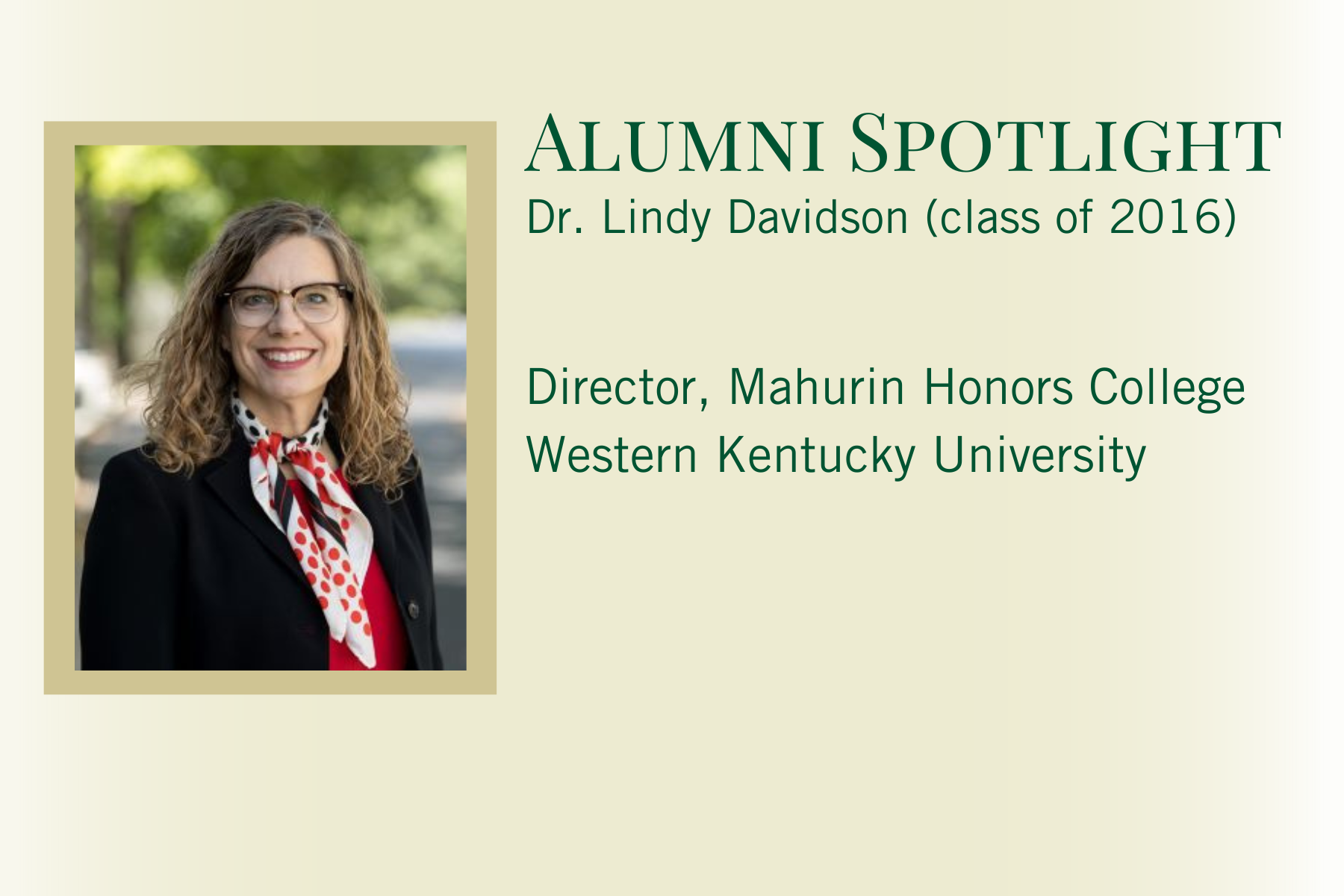
Q: Tell us about yourself, including what led you to pursue doctoral studies in communication
at USF as well as anything else you'd like to share.
My journey to USF started in 2002 when I was pregnant with my first son. He was diagnosed
with an illness that landed me in the hospital for the final 7 weeks of my pregnancy
and then resulted in many hospitalizations and surgeries for him, including a kidney
transplant. That experience exposed the gaps in communication between healthcare providers,
patients, and their families, and I was compelled to do something to address it. Ten
years and two more kids later, I started my PhD at USF, which came highly recommended
as a top health communication program.
Q: Who were important mentors during your doctoral studies and how did they mentor/support
you?
Before I applied to the program, I met with Lori Roscoe, who became my committee chair,
and asked, "Am I crazy to do this?" She had also gone back to school to get a PhD
with small children, and she gave me a playbook to follow. In summary, she told me
to focus on school when I was at school, and to enjoy being with my family when I
was with my family. But as soon as I put the kids to bed, I had to go back to schoolwork.
I did that for four years, and with the mentorship of her and my committee, including
Ambar Basu, Jane Jorgenson, and Sara Green, I was the first to finish in my cohort.
Throughout my time in the PhD program, I felt support from the entire community of
faculty and graduate students. Chris McRae helped me get my first publication; Art
Bochner and Carolyn Ellis spilled untold amounts of ink helping me improve my writing;
my fellow grad students supported me through my dissertation project on pediatric
palliative care; MA student Kyle Romano and I taught a class together on communication
and disability; and fellow cohort member Krystal Bresnahan helped me find focused
time to write when I was nearing the finish line. Honestly, this PhD was a group effort.
Q: What are your key responsibilities as Director of the Mahurin Honors College at
Western Kentucky University? How did your time in our doctoral program as well in
the USF Judy Genshaft Honors College help prepare your current position?
My role as director of the Mahurin Honors College at WKU is to lead a team of faculty
and staff as we provide interdisciplinary curriculum and experiential learning opportunities
for high achieving students. The communication field lends well to honors because
communication scholarship is so connected to other disciplines. I began as a visiting
faculty in the Judy Genshaft Honors College upon completing my PhD in 2016, and over
nine years, I was part of a growing faculty and college curriculum that included medical
humanities, sustainability, and community engagement. I began leading study abroad
programs to the Dominican Republic, England, and Panama. Additionally, our honors
team helped design an 85,000 square foot building that opened in 2023. Throughout
my first four years in the honors college, I reflected the spirit of collaboration
I experienced in the USF Communication Department, and I believe it was that approach
that led to my promotion to Associate Dean in 2020. Through another five years in
the AD role, I had the opportunity to encourage the kind of supportive community that
allowed me to flourish as a PhD student. Leaving USF was difficult for me, but when
a position leading an honors college in my home state came open, I knew it was right.
Here at WKU, I have a hard-working team that enjoys being together, so I get to continue
that momentum towards collaboration and meaningful growth as we develop new curriculum
and opportunities for honors students.
Q: What advice would you give to COM graduate students today, including those who
want to pursue careers within and outside of the academe?
Never underestimate the power of showing up. Use your ethnography skills to attend
to the spaces you find yourself in, and treat every scenario like an opportunity to
learn something new or meet someone new. I got my job in honors at USF because I showed
up to a dissertation defense for a cohort member the day after finding out the posted
position in honors, the one I had applied for, had been filled. Turns out, my cohort
member's external committee member was the Assistant Dean in honors. With a big push
from a fellow grad student, I talked with the Assistant Dean about the position and
got an interview for a visiting line. After they hired me for the temporary line,
I continued to show up in adverse circumstances, develop programming, and collaborate
with my colleagues. There are no guarantees that working like this will net the results
you want, but I've never regretted supporting students or collaborating with colleagues.
I feel like today's work environment is increasingly depersonalized, so when someone
shows up with and for others, that person stands out. Also, I brought cookies to that
dissertation defense, so maybe I should say, "Never underestimate the power of showing
up with cookies!"
Dr. Josie Boumis
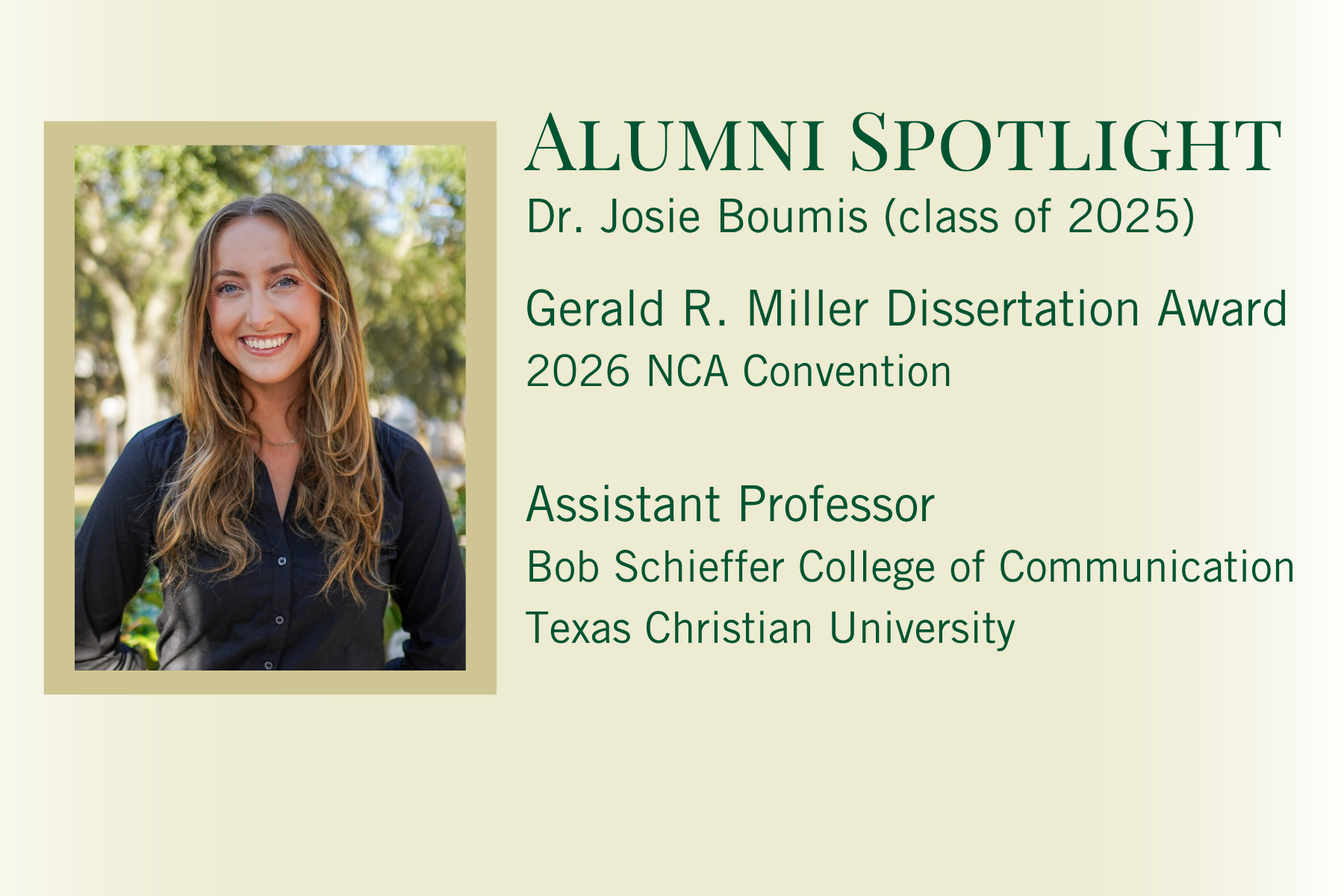
Josephine (Josie) Boumis (PhD, University of South Florida, 2025) is an assistant professor of communication at Texas Christian University. Her work draws on interpersonal, heath, and family theoretical frameworks to investigate the important role that communication plays in shaping our relationships and how we navigate challenges we face in life. Specifically, she examines how concepts such as resilience and social support are communicatively built in relationships and impact our physical, relational, or mental wellbeing. She utilizes quantitative methods, along with qualitative and mixed methods, to understand how these concepts influence our perceptions of others, impact the ways we experience hardships, reflect issues of inequity, and can have beneficial or detrimental repercussions.
Josie's dissertation, entitled “Redefining Resilience through the Typology of Distorted Resilience”, was one of three recipients of the 2026 NCA Association-wide G.R. Miller Outstanding Doctoral Dissertation Awards. The award selection committee wrote the following:
"This dissertation makes an important conceptual contribution to communication and mental health scholarship by challenging idealized understandings of resilience. Boumis moves beyond framing resilience as an individual capacity, instead examining how structural inequities, stigma and communicative barriers shape opportunities to enact resilience. The introduction of disenfranchised resilience offers a compelling framework for understanding how material and discursive inequities constrain resilience. Through a creative methodological approach, the dissertation advances an important and timely perspective with potential applications across diverse communication contexts and populations."