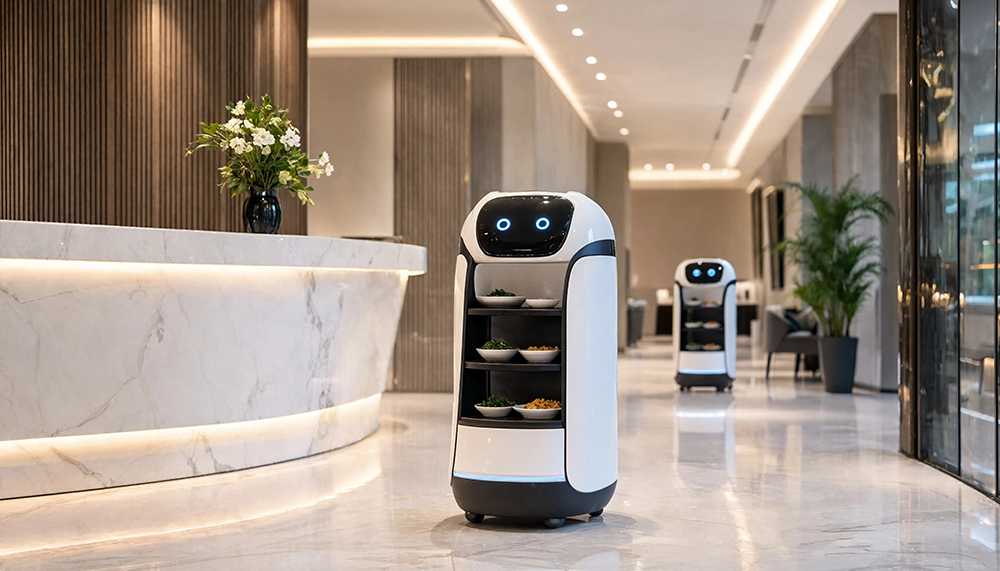
TAMPA -- The next time you walk into a restaurant to a robot server, its appearance or voice may not be what matters most.
A new study by the University of South Florida, published in the International Journal of Hospitality Management, reveals that what makes hospitality workers feel comfortable working alongside robots has less to do with how they look and sound and more to do with their ability to think, recognize, and interact with people.

Trishna G. Mistry
“Our findings suggest that a robot’s ability to ‘get’ people matters when employees consider it as a coworker,” said Trishna G. Mistry, the study’s co-author and associate professor at the School of Hospitality and Sport Management in the Muma College of Business. Seden Dogan, assistant professor of instruction at USF, also co-authored the study.
The research surveyed over 900 U.S. hospitality workers across three different studies, testing three traits that are often built into a robot's “humanness”: physical appearance, cognitive and emotional capabilities, and voice.
The results showed that employees responded positively to robots that show cognitive and emotional capabilities — the ability to understand emotions and interact socially. The employees saw these robots as more effective, motivating, and worth working with.
Robot designs often include humanlike features intended to make interactions feel more natural.
Human-like bodies helped robots seem more capable, but appearance alone did not win employees over. And human-like voices? They made no measurable difference at all, according to the study, titled "Humanizing service robots: A multidimensional framework of anthropomorphism in employee-robot collaboration."
These findings are relevant as robots are taking a growing role in hospitality, one of Florida’s biggest employment sectors. Service robots are rapidly entering hotel lobbies, restaurants, and back-of-house operations.
“Our findings give companies and robot designers a roadmap for spending wisely,” said Mistry. The study suggests that companies may benefit more from developing robots that recognize emotions, respond appropriately to social situations, and effectively navigate workplace problems than their physical aesthetics.
The study offers a new perspective on human-robot collaboration: The best robot may not be the one that looks the most human, but the one that understands humans the most.