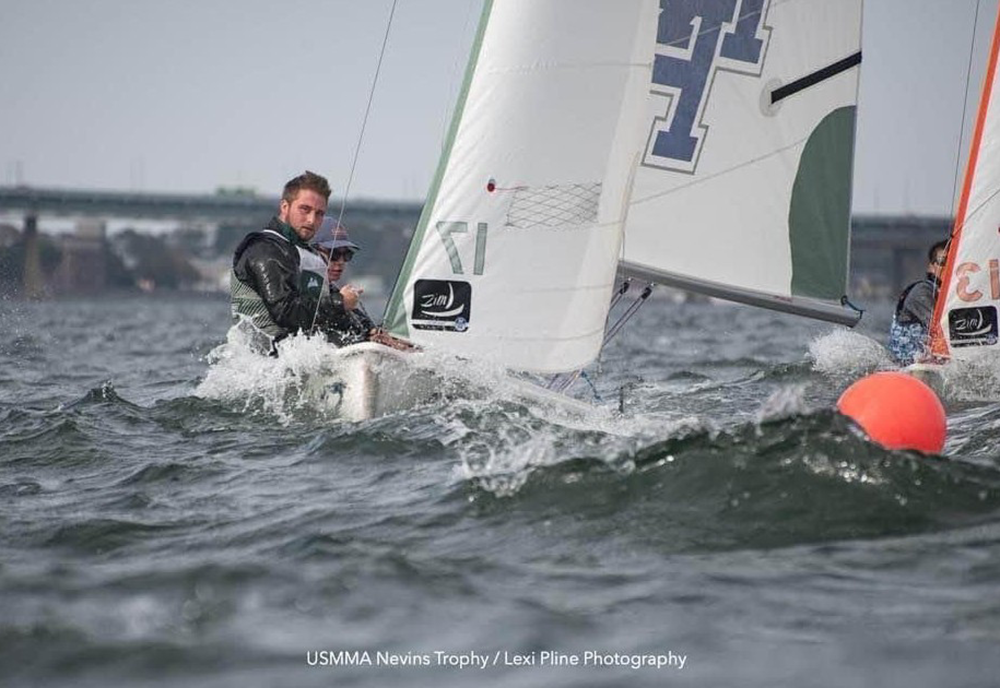
Every good sailor knows that you can’t control the winds, but you can certainly adjust your sails. That’s an adage Luke King lives by. King, a recent graduate of USF, grew up near the water in Sarasota and began sailing when he was eight years old. Diagnosed with comprehensive intellectual disabilities in elementary school caused by a series of severe epileptic seizures, it was hard for him to follow directions or understand concepts by reading or being verbally told how to do things, but sailing came naturally.
“I learn better by doing and seeing and using my hands rather than being shown or told how to do something,” King said. “I also learned that sometimes life is unpredictable and you can't predict what's going to happen. You just go with the best that you got and do the best you can.”
After graduating from high school, King set a course for college. He had watched both his brothers go away for higher education, and he was determined to go, as well. He heard about the USF College of Education’s UMatter program from a high school advisor, and he and his parents thought it sounded like a perfect fit. After an interview with the program team, he was offered a spot in the program, which only accepts a small cohort of 10 students per year.
“I ended up getting the offer to come here to USF and start my college journey with UMatter on campus in St. Pete,” King said. “That was probably the best news I've ever heard.”
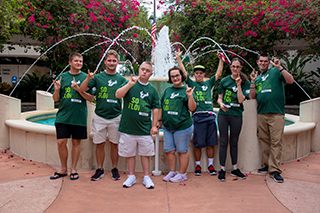
Luke King with his UMatter peers
The Eileen Hoffman Hafer UMatter Program was established at USF in August 2020 by Professor Lyman Dukes and Alumna Danie Roberts-Dahm as a Florida Postsecondary Comprehensive Transition Program (FPCTP). The first student enrollment began in August 2021. The program expands opportunities for young adults like King with intellectual disabilities (ID) by providing a comprehensive college experience focused on academic success, career readiness and independent living.
“UMatter came from our belief that students with ID should have local access to an authentic college experience that prepares them for employment, independence and full participation in campus and community life,” Dukes said.
Through UMatter, students are supported in their studies by academic mentors who assist them with homework, test prep and developing good study habits.
“The mentors make such an impact on students like me,” King said. “They make sure that they are ready to succeed in class and that they are working on the habits that they need to achieve their goals.”
Social support is another element to the UMatter Program. Peer mentors work with students to help them get out and meet people and join organizations on campus, encouraging them to find events using bulletin board notices and the campus event calendar, Bulls Connect.
“It can be really hard,” King said. “I went through it, and I’ve always been really social. But there are clubs out there that align with our interests and goals, and that is what helps students find their passion.”
Another facet of the program teaches independent living. Residential mentors help students work on daily living skills like doing laundry once or twice a week, keeping their rooms clean and eating healthy food.
“UMatter really helped me focus not just on my studies and my future, but it also helped me with my life, my independence, and feeling confident because I know how to take care of myself.”
Dukes said that King is a great example of success in the program – he even managed to earn a coveted spot as a USF Ambassador, join the sailing team and teach sailing to kids back home at the Sarasota Sailing Squadron, where he had learned to sail.
“As he became more independent, he became better connected to campus and exhibited confidence as a leader,” Dukes said. “His work as an Ambassador and his public representation of UMatter, as well as the post-program employment experiences he had, all highlight so well the kind of outcome UMatter works toward.”
The final aim of the program is employment readiness. After graduating in 2025 with a certificate in business, King tried out a couple of jobs, but nothing seemed like anything he truly enjoyed doing, so he used some tools like reflection and list-making, which he’d learned in UMatter, to try to clarify what he really wanted to do. He decided where he really wanted to be was back at USF. So, he wrote a pitch for a brand-new position: UMatter Program Advisor. That position would be someone who could support recruitment, speak authentically about the UMatter experience, help with peer mentors, represent the program on campus and in the community, and contribute to student-facing initiatives. He submitted the proposal, it was considered and approved, and just a few months later, he was back at USF – but this time as an employee.
“Luke did a great job helping us see the need for a position that could represent UMatter from the student and alumni perspective,” Dukes said. “We knew Luke was the right person because he had already demonstrated those qualities as a student and after UMatter. He brings credibility because he is able to speak from lived experience, with maturity, professionalism, and a unique sense of how UMatter can help students grow and achieve their goals.”
King says he’s excited to help guide students with ID to success, no matter what storms they may encounter.
“In sailing, things are unpredictable,” King said. “It has taught me to be patient and understand that there are some things we can control, and some things we can’t. You have to stay focused, learn from your failures, and be able to control the adjustment of your sails to the direction that you're heading. UMatter helped me find my passion and my joy, which is wanting to be able to make a difference with people. I appreciate everything that it has done for me.”