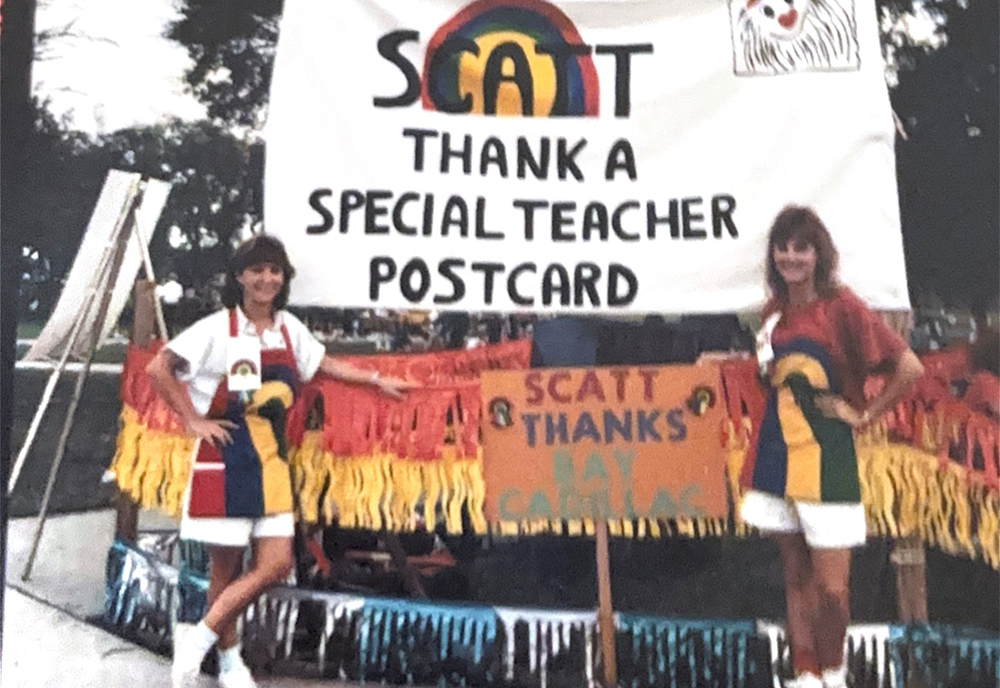
From the days of mimeographs and cursive writing to the era of the internet and artificial intelligence, the teaching profession has seen vast changes over the past 50 years. And though its structure, members, leadership and focus have evolved, the Suncoast Area Teacher Training Honors Program (SCATT) has managed to endure by adapting to the times and the needs of its membership.
Conceptualized in 1981 by Marcia Mann, former associate dean of the College of Education, with the blessing of former dean William Katzenmeyer, SCATT began as an honors organization for future educators. It was designed to complement students' coursework, offering professional development, leadership training, community-engaged service learning, collaborative experiences and opportunities for inquiry. SCATT aims to help future teachers develop the knowledge, skills and confidence needed to become effective educators and leaders in the profession.
Mark Thompson, Ph.D., earned an undergraduate degree in secondary education from USF’s College of Education in 1995, and then a master’s degree in educational leadership in 1999. He was first a member of SCATT, then worked as a student assistant in the SCATT office. He says SCATT helped him be a better teacher in a myriad of ways, including instilling a positive mindset about his future career, as well as teaching strong communication skills. Those skills really came into play when, after five years in the classroom, he was hired by the State of Florida to do professional development for teachers at low-performing high schools.
“I was doing workshops in high-stakes situations where faculty were feeling really stressed,” Thompson said. “The skills I learned in SCATT were a godsend because they allowed me to reduce the anxiety levels and bring everyone’s talents to bear. I used those skills pretty much all day, every day, for 20 years.”
After Mann resigned as director in 1990, the program fell under the guidance of the assistant director Joyce Swarzman, who had been with the program since its inception. Over its first 20 years, the program grew into a group of more than 300 students, with enough funding from the Florida Legislature to provide not only top-notch experiences for members, but also a fully staffed office. In a time when there were more graduates than there were teaching jobs, SCATT graduates were sought-after by local high school principals.
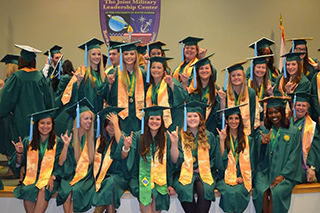
“The fact that we had principals coming to meet SCATT graduates signaled to us, as students, that were doing something consequential in SCATT,” Thompson said. “We needed less hand holding and were more likely to take leadership roles. SCATT puts the spirit and the mindset into the work, and when we have both of those things, it's pretty powerful.”
Over time, the program’s numbers waxed and waned, once falling to only three members. But under the leadership of Jessica Beagle, assistant director of professional learning at the David C. Anchin Center, things started to pick up. According to the incoming SCATT Director, Brianna Connors, Ph.D., Beagle reawakened something in the programs, despite its total loss of state funding.
“She took time to look at what the program used to be, and what she wanted it to be now,” Connors said. “What she was hearing from her students was that there was very little opportunity for them to be there for one another, and they just didn't have that sense of connection. She knew she wanted dedicated, passionate students to have a place to be supported so that those teachers with that fire in them could make it through their courses and into the classrooms to better serve their students.”
As Connors takes the helm in August, she seeks to continue to grow the program and nurture the flame that is once again burning, so she will strive to ensure that future educators in the program feel supported.
“I've worked in school settings both internationally and domestically, and although the dynamics of those school structures differ wildly, what doesn’t vary is the importance of connection within an educational community,” Connors said. “That's what keeps teachers strong. You have to feed the teachers in order for them to be able to provide for the students. You can't pour from an empty cup. So, I want them to know what it feels like to feel fulfilled, feel the support of one another.”
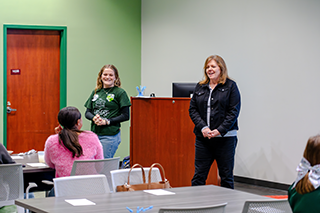
Reese Kantrowitz and Dean Jenifer Jasinski Schneider at an AI workshop for SCATT
The newest SCATT President, Reese Kantrowitz, is a junior majoring in special education. In addition to community and connection, she wants to be sure that, through the professional development opportunities provided by the program, students learn relevant and cutting-edge information from new and veteran educators, as well as experts on new technologies that can be helpful for teachers.
“We’re keeping the history of SCATT and expanding on it by making it modern,” Kantrowitz said. “I hope that when our graduates walk into their classrooms, they know that they have enough knowledge and tools in their back pockets to think, ‘I can do this.’”