Rena (Antinori) Ezzell always knew she wanted to be an educator, and she began her practicum early.
“My mother said that even when I was little girl, I talked about wanting to be a schoolteacher,” she said. “My father set a blackboard up in our garage, and I would have my friends over and play school.”
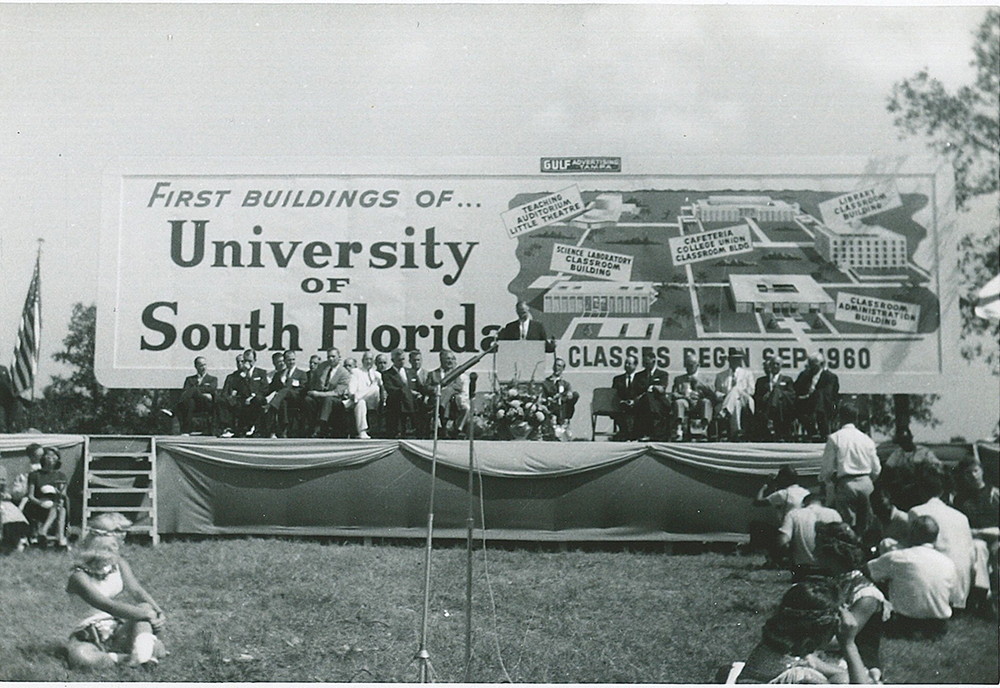
When she graduated from high school in 1960, it was time to go to college to make her dream a reality. Ezzell says she also knew exactly where she wanted to go. She set her sights on the University of South Florida, which was set to open that year and was not too far from her home in Seminole Heights.
“I was a homebody and didn’t want to go away to school,” she recalls. “I dropped my application in the mail the day that they began taking them, and I was accepted right away. My student number was 0000005.”
Ezzell, a member of the inaugural class of USF’s College of Education, marvels at the many changes that USF has undergone over the years since the university opened its doors to students in September 1960.

Rena (Antinori) Ezzell
Ezzell arrived at a campus so new that it only had a handful of buildings, including Administration, the library, University Center and one building that housed classrooms for all of the programs. She said it was certainly not the manicured, sprawling campus of today.
“There was a lot of sand blowing around, and maybe a palm tree here and there,” she said. “I never would have dreamed it would become so enormous. It’s like I’m in another universe when I visit – the administration building is the only landmark I recognize.”
With only 325 people in her graduating class, and a fraction of that number in her elementary education program, she made friends easily and found lots of camaraderie among the future educators.
“Everybody knew each other, so I didn’t feel lost like I might have at a big university,” she said. “We hung out, supported each other and studied at the library together, which was a totally different experience then. Students today will never know what it was like to use the card catalogue.”
“We didn’t have sports or fraternities or sororities,” she recalls. “But we did have social clubs, and I joined TRI SIS (sister), which later became Alpha Delta Pi sorority.”
Every female student who has ever navigated the University of South Florida campus during the hottest months owes Ezzell and a group of other students a moment of thanks. In the early days, women were not allowed to wear Bermuda shorts on campus, despite the sub-tropical climate. Ezzell was part of a group that staged a protest.
“We put on our Bermuda shorts underneath trench coats, and we marched to the front door of the Administration building and took our coats off in protest.”
The women were heard, and they were allowed to wear shorts going forward.
While at USF, Ezzell made a lifelong friend in Phyllis Marshall, for whom the University Center was renamed in 1994. Though a friend for life, Marshall, who became director of the University Center, almost derailed Ezzell’s career in education by hiring her to be the assistant director.
“My professors were so upset,” Ezzell said. “But I took the job and did that until 1968, when I took my first job as a teacher.”
Ezzell also served as president of the Alumni Association in 1970, and even presented the first game ball to USF’s first basketball coach, Don Williams, in 1970.
“I remember (first USF president) Dr. Allen saying that USF would never have sports because we were focused solely on academics, but that certainly changed.”
Ezzell taught kindergarten and first grade for 30 years, first in Tampa Catholic schools. When she and her husband, fellow USF graduate John Ezzell, moved their young family to Fort Myers in 1976, she taught in public and private schools there until her retirement in 1995.
Ezzell’s memories of her time at USF in the College of Education are happy ones.
“A university is a reflection of life in general,” she said. “I wish students today could see how simple things were then.”
Ezzell says she wants current students in the College of Education to know that they are very special people to be called to such an important profession.
“The rewards are unimaginable. Knowing you can make a difference in a child’s life is an awesome responsibility.”