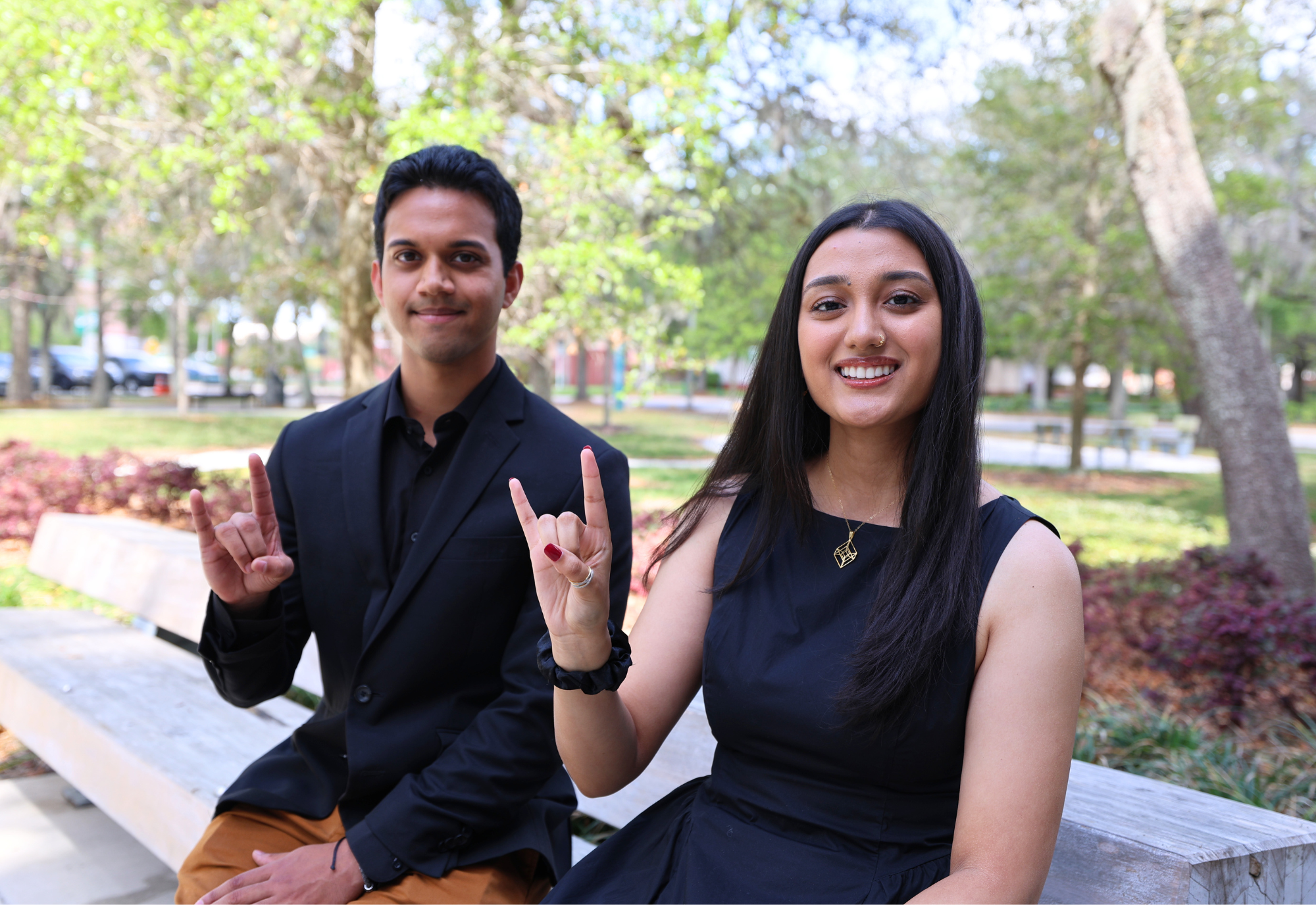
The Barry Goldwater Scholarship and Excellence in Education Foundation have selected
two University of South Florida students as Goldwater Scholars for the 2026-27 academic
year.
Bellini College of Artificial Intelligence, Cybersecurity and Computing student Caleb
Fernandes and USF College of Arts and Sciences student Diya Upadhyaya — both third-year
students in the Judy Genshaft Honors College — were awarded the honor, which is considered
the nation’s highest for undergraduate research in science, technology, engineering,
and mathematics.
Both plan to pursue doctoral degrees and careers in research. Fernandes aims to use
applied artificial intelligence and machine learning to improve efforts like energy
infrastructure planning and health care implementation. Upadhyaya studies biomathematics
and plans to use computational modeling of disease biology to inform clinical interventions
and innovation.
Fernandes’ and Upadhyaya’s Goldwater nominations were supported by USF’s Office of National Scholars, which mentors and supports high-achieving students and alumni as they pursue prestigious,
nationally competitive scholarships and fellowships. Given their extensive contributions
as undergraduate researchers, both students were inducted into the international research
honor society, Sigma Xi, as second-year students.
Understanding Economic and Socio-Technical Systems
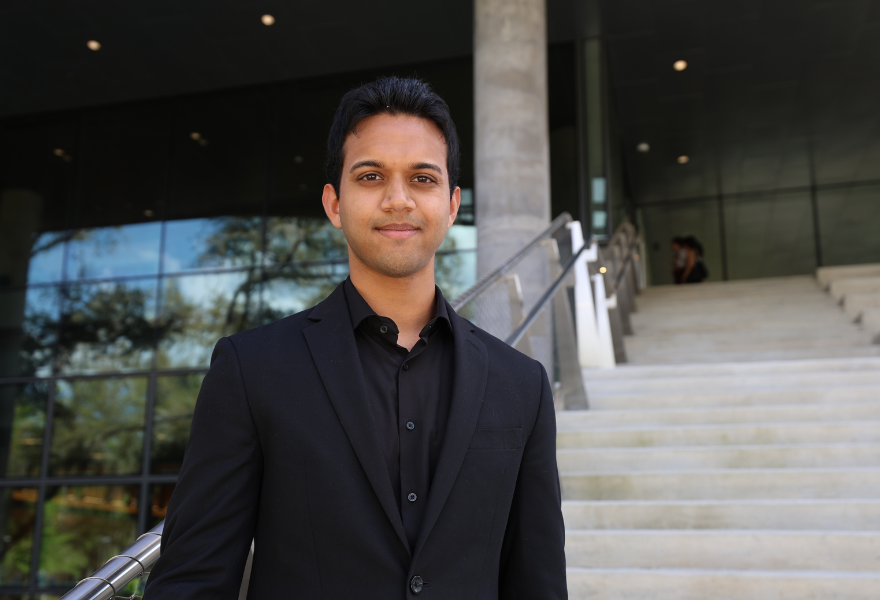
Fernandes initially majored in finance because of his interest in day trading. However,
his drive to understand the patterns in financial data and make societal development
more sustainable led him to change his major to computer science, with minors in mathematics
and geographic information systems. After conversations with USF Office of National
Scholars Director and Department of Physics faculty member Sayandeb Basu, Fernandes
began to see the value of training in fundamental areas of science.
During his time at USF, Fernandes has maintained a perfect 4.0 GPA while holding concurrent
research positions in computer science and geospatial information systems. His work
has been accepted at multiple professional and undergraduate research conferences,
including the Gulf Coast Undergraduate Research Symposium at Rice University, where
he received a first prize in the economics panel for his computational work on predicting
disparities in electric vehicle adoption and infrastructure using machine learning
and GIS across the U.S. National Highway System. The project also led Fernandes to
forge a collaboration between his mentors, Professors Seungbae Kim and Ran Tao, who
worked together to support his project.
Fernandes spent considerable time learning fundamentals of complex social systems
with the Office of National Scholars before pursuing a Research Experience for Undergraduates
at James Madison University in network science. At the same time, he also completed
Santa Fe Institute’s online complexity course, which offers a theory-and-applications-based
overview of complexity science, further preparing him to apply for the Goldwater Scholarship.
In addition to his extensive record of conference presentations, Fernandes has contributed
to one published article with two others forthcoming from his study with Kim on graph
machine learning. He aspires to devote his career to combining machine learning, network
science, and big data to illuminate complexities in the organization of economic and
socio-technical systems.
Improving The Treatment of Disease Worldwide
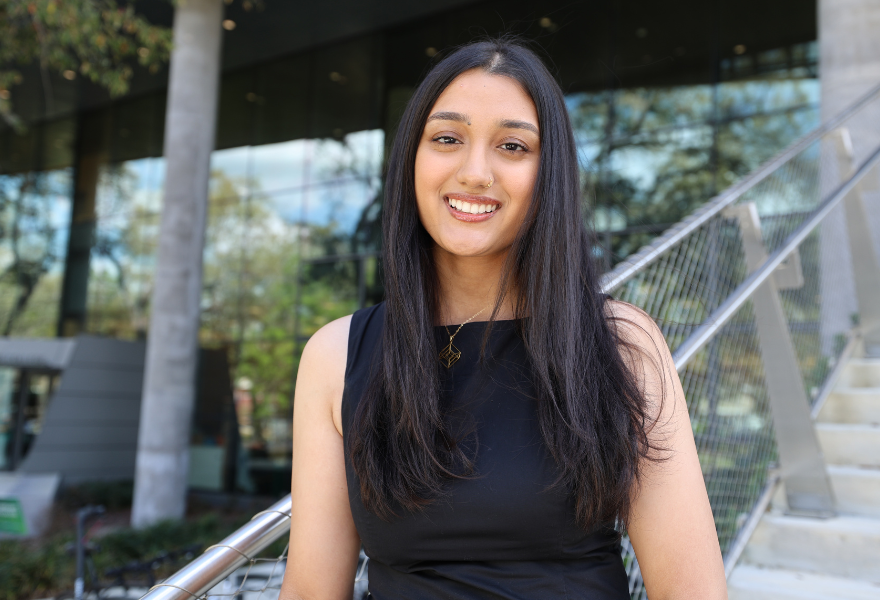
Upadhyaya majors in applied mathematics and biomedical sciences. As a first-year student,
she joined the Moffit Cancer Center’s Department of Integrated Mathematical Oncology
(IMO) to study mathematical models for quantitative personalized oncology as a Summer
Program for the Advancement of Research Knowledge intern.
Upadhyaya continues to work at the IMO department and is the only undergraduate to
have been invited twice to IMO’s annual workshops – hackathons designed to ideate
innovations in biomarker estimation, biopsies, and potential cures. These workshops
exposed Upadhyaya to a spectrum of problems in cancer research and inspired her biophysics
study with USF’s Dr. Ghanim Ullah, focusing on the dynamics of ion channels in PIEZO1
— a mechanical channel that converts force into cellular signals — and its role in
astrocytic function.
Seeking training in advanced biostatistical methods, Upadhyaya applied and was selected
to the Directed Research for Undergraduates in Mathematics and Statistics (DRUMS)
Research Experience for Undergraduates program. She learned advanced parameter estimation
techniques while developing a model to analyze time-series data on heart rate and
blood pressure collected during the Valsalva maneuver, a clinical test used to identify
autonomic dysfunction.
Upadhyaya’s research mentors lauded her high-level computational skills in recommendation
letters for the Goldwater Scholarship – a notable achievement given that Upadhyaya
was raised in rural Sebring, Florida, without direct access to technology such as
laptops or coding classes. As the president of the Bioinformatics Club at USF, she
is also working on a new initiative with Girls Who Code to expose young women to the
fundamentals of biological modeling.
Upadhyaya has published on bioRxiv, a preprint server for biology, and worked on studies
with Ullah and DRUMS, that are nearing publication. She has presented her work at
the Moffitt Symposia, the 2025 Annual Biophysical Society Meeting, the American Mathematical
Association Joint Meeting, and in the Applied Physics section of the Gulf Coast Undergraduate
Research Symposium. She intends for her future work to improve the treatment of disease
worldwide.
USF’s Goldwater Legacy
The Goldwater Scholarship is the premier undergraduate award for students pursuing
research careers in STEM fields. From a competitive pool of 1,485 applicants nominated
by 482 academic institutions, 454 Goldwater Scholars were selected nationally for
the 2026 awards.
One of the nation’s leading academic research institutions, USF’s research funding
has increased by 37% over the past three years. This research impact has extended
to its students, as the university has produced at least one Goldwater Scholar every
year since 2018. Previous scholars have gone on to be selected for other prestigious
graduate fellowships, including the National Science Foundation Graduate Research
Fellowship, the Knight-Hennessy Scholars Program, and the Gates Cambridge Scholarship.
"Caleb and Diya's success once again affirms the value of long-term engagement with
ONS. They were talented and hungry, but much of their journey through research experiences
and what next steps they could take was shaped through conversations in the office,”
said Basu.