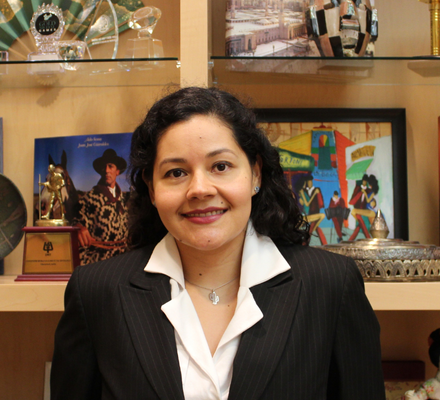
Katia Aldana Campos - Engineer III Water at Mott MacDonald
Building a Career in Sustainable Water
When Katia Aldana Campos reflects on her journey, one theme flows through every chapter of her story: water. From her early days studying civil engineering in Colombia to her current role as an Engineering Designer III Water, Katia has built a career focused on protecting one of the planet’s most essential—and finite—resources.
A 2024 graduate of the Patel College of Global Sustainability (PCGS), Katia credits the college’s applied, real-world approach with helping her transform academic knowledge into professional impact.
A Global Foundation in Engineering and Water Management
Katia’s academic path spans continents. She earned her bachelor’s degree in civil engineering in Colombia and later completed a master’s degree in Canada, focusing on water treatment. After nearly a decade working on water quality and management projects in Colombia, she began looking for a program that would deepen her expertise while expanding her global perspective.
That search led her to PCGS, where she enrolled in the master’s program in sustainability with a concentration in water management in January 2023.
Water and sustainability are inseparable. Clean water sources are diminishing, demand is increasing, and water reuse will play a critical role in the future.
Katia Aldana Campos
Learning Sustainability by Doing It
At the Patel College, Katia found more than coursework; she found hands-on experience. One of the defining moments of her graduate journey was her work as a Graduate Assistant on the Clean Air Tampa Bay project, an applied initiative led by Dr. Kebreab Ghebremichael and Dr. Pradeep Haldar, PCGS faculty, in partnership with the Tampa Bay Regional Planning Council and funded by the U.S. Environmental Protection Agency.
Unlike traditional academic assignments, this project required real deliverables. Katia worked on greenhouse gas emissions inventories across sectors such as transportation, energy, and water treatment using professional tools. “This wasn’t a class project,” she says. “It was work that would be used by regional planners and submitted as part of a federal grant.”
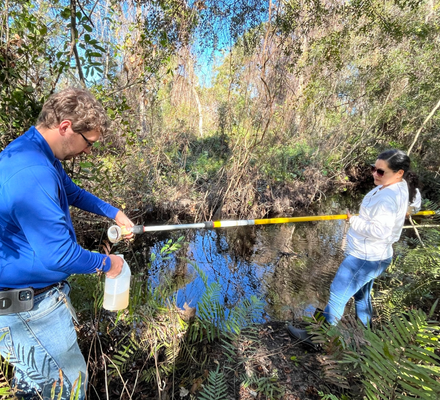
Katia taking a water sample at a sample point alongside a Hillsborough County Inspector
When asked what she gained most from her time at PCGS, Katia doesn’t hesitate. “The Clean Air Tampa Bay project,” she says. “It gave me real experience, confidence, and a professional network.”
In addition to her graduate assistantship, Katia completed an internship with Hillsborough County, where she worked alongside wastewater treatment plant professionals, inspectors, and infrastructure managers. The experience gave her firsthand exposure to how sustainability principles are implemented at the municipal level.
PCGS coursework also helped her navigate the complexity of U.S. environmental regulations. “Understanding how federal, state, and local standards interact was critical,” Katia notes. “Those frameworks directly apply to the projects I work on today.”
Landing Her Role—and Advancing as an Engineer
After graduating in December 2024, Katia transitioned into her current role as an Engineering Designer III Water. “A graduate degree shows commitment, discipline, and the ability to think critically,” she says. She was recruited through Handshake, the university’s career platform, underscoring the importance of university-industry connections.
Katia encourages students to take full advantage of university career platforms, particularly Handshake, when searching for jobs and internships.
“Handshake was key for me. Companies there already know you’re a student or recent graduate, and many of them are actively looking to hire from the university. LinkedIn is great for networking, but Handshake helped me get directly in front of recruiters who wanted to work with students like me.”
Her advice is simple: use every available resource, stay active on career platforms, and don’t underestimate tools designed to connect students with employers.
The Power of Soft Skills in Sustainability Careers
While technical expertise is essential, Katia emphasizes that some of the most valuable skills she gained at PCGS were communication-focused. Graduate school strengthened her writing, presentation, and stakeholder engagement skills, capabilities she now uses daily.
“In sustainability roles, you’re constantly working across departments and with clients,” she explains. “You need to explain complex ideas, build consensus, and communicate clearly.”
Advice for Future Sustainability Professionals
For students considering a career in sustainability, Katia offers clear advice: have a plan. She encourages students to understand how sustainability connects to their original discipline and to be strategic about where they want to work.
She also urges students—especially international students—to start searching early for internships and applied projects, noting that U.S. recruitment timelines often move a year in advance.
Katia’s story reflects the Patel College’s mission in action: preparing students not just to study sustainability, but to lead it through applied learning, community partnerships, and real-world impact.