FROM CLASSROOM TO CAMPUS IMPACT: HOW WILLIAM MCMAHON IS ADVANCING SUSTAINABILITY AT THE UNIVERSITY OF NORTH FLORIDA
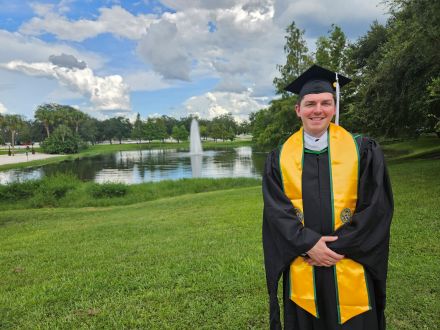
When William McMahon graduated from the Patel College of Global Sustainability (PCGS) in 2024 with a Master of Arts in Global Sustainability, he stepped into a field defined by complexity, collaboration, and constant evolution. Just months later, he would make history at the University of North Florida (UNF) as the first Assistant Director of Campus Sustainability, a role created in November 2024 to advance sustainability across the institution.
Today, McMahon sits at the intersection of strategy, data, and student engagement, helping shape how a large public university measures and reduces its environmental footprint while preparing the next generation of sustainability leaders.
A PATH SHAPED BY CURIOSITY AND SYSTEMS THINKING
McMahon’s sustainability journey began long before graduate school. He earned his undergraduate degree in Environmental Studies and Geography from Bishop’s University, a broad foundation that exposed him to the interconnectedness of natural and human systems. That perspective deepened when he began working with the Florida Department of Environmental Protection, supporting sustainability initiatives across facilities through best management practices.
It was there that McMahon realized he wanted to build deeper expertise and greater impact.
“Sustainability is incredibly broad,” he explains. “I wanted the academic foundation to understand how systems work together and how to turn that knowledge into action.”
That search led him to the Patel College of Global Sustainability.
APPLYING PCGS LEARNING TO REAL-WORLD SOLUTIONS
At PCGS, McMahon concentrated in Climate Mitigation under Dr. Thomas Henry Culhane, whose courses on the food-energy-water nexus and urban sustainability left a lasting impression. Through hands-on learning, McMahon explored how composting, biodigesters, and circular systems can address multiple challenges at once—knowledge he now applies directly in his work.
His Graduate Certificate in Sustainable Business further strengthened his approach. Courses in sustainability economics and finance emphasized the importance of the triple bottom line: people, planet, and profit.
Long-term sustainability solutions have to make financial sense. That’s critical when working with departments across campus.
William McMahon
Assistant Director of Campus Sustainability at UNF
This blend of systems thinking, applied research, and financial literacy has become central to his leadership at UNF.
BUILDING UNF’S SUSTAINABILITY INFRASTRUCTURE
As Assistant Director of Campus Sustainability, McMahon leads university-wide efforts to better track and reduce waste, water, and energy use. He chairs UNF’s Sustainability Committee, a presidential action committee composed of 15 stakeholders from across campus tasked with advancing measurable sustainability goals.
One of his major priorities is data-driven decision-making. By leveraging technologies such as EnergyCAP for utility monitoring and Kamstrup for water tracking, McMahon and his team can identify inefficiencies, detect leaks, and reduce consumption building by building—saving thousands of gallons of water in the process.
On the dining side, UNF partners with Chartwells, which uses WasteNOT 2.0 to track pre-consumer food waste. In 2024 alone, 1.8 tons of food waste were diverted and turned into compost for the campus garden, a tangible example of circular systems in action.
ENGAGING STUDENTS WHERE LEARNING COMES ALIVE
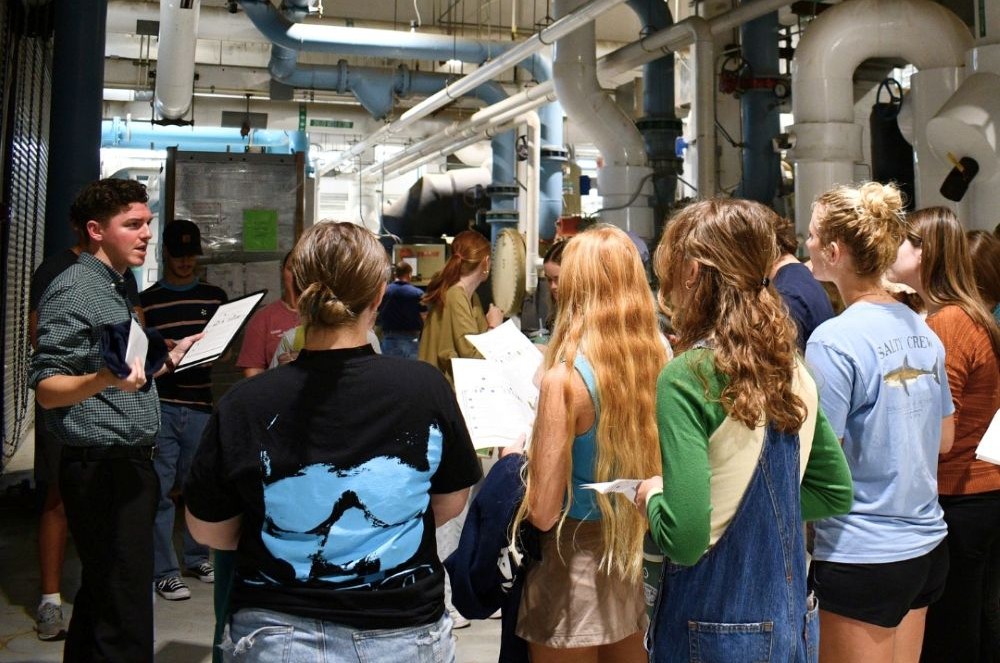
For McMahon, success isn’t measured by data alone; it’s also about student engagement. One of his proudest achievements has been launching sustainability-focused student tours of UNF’s central energy plant. Attendance nearly tripled from the first tour in Spring 2025 to the next in Fall 2025, signaling growing student interest in applied sustainability and in sustainable technologies within HVAC systems.
UNF’s campus offers unique opportunities for experiential learning, including hundreds of acres of conservation land and numerous renewable energy installations, such as the JEA-UNF Sustainable Solutions Lab. McMahon is actively expanding student-facing programs that connect classroom learning to real-world settings, spanning biodiversity and conservation to renewable energy systems.
TURNING RESEARCH INTO DECISION-MAKING
McMahon also applies research skills honed at PCGS to complex stakeholder challenges. One example is UNF’s plastic reduction initiative. With limited plastic recycling markets in Northeast Florida, his team explored transitioning certain products from plastic to aluminum packaging.
Rather than relying on assumptions, the UNF Sustainability Committee led a study comparing student purchasing behavior between plastic and aluminum beverage containers. The results revealed that convenience—not sustainability—was the primary driver of student choice. That insight now serves as a roadmap for future pilots and reinforces the importance of data-informed sustainability decisions.
PREPARED BY PATEL COLLEGE, SUPPORTED BEYOND GRADUATION
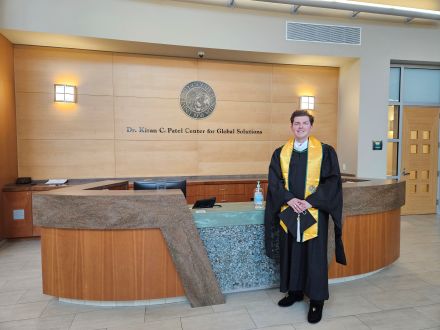
McMahon credits PCGS with preparing him not only academically, but professionally. Field trips, applied projects at Rosebud Continuum, and an internship with the Florida Wildlife Corridor for his internship capstone helped him gain experience working with diverse stakeholders—an essential skill in his current role.
“The faculty are exceptional,” he says. “Professors like Dr. Culhane, Dr. Dorsey, Dr. Gebremichael, and Dr. Bandy don’t just teach theory—they show you how sustainability works in practice.”
Even after graduation, McMahon remains closely connected to PCGS faculty and staff, reflecting the college’s commitment to supporting students well beyond commencement.
ADVICE FOR THE NEXT GENERATION
For current PCGS students, McMahon offers clear advice: stay curious.
“Sustainability is still an emerging field,” he says. “Opportunities are constantly evolving. What you think you want to do at the beginning may change—and that’s okay. Follow your interests, stay open, and you’ll find the path that’s most fulfilling for you.”
From graduate student to campus leader, William McMahon’s journey reflects the power of applied learning, systems thinking, and a strong academic foundation—hallmarks of the Patel College of Global Sustainability experience.