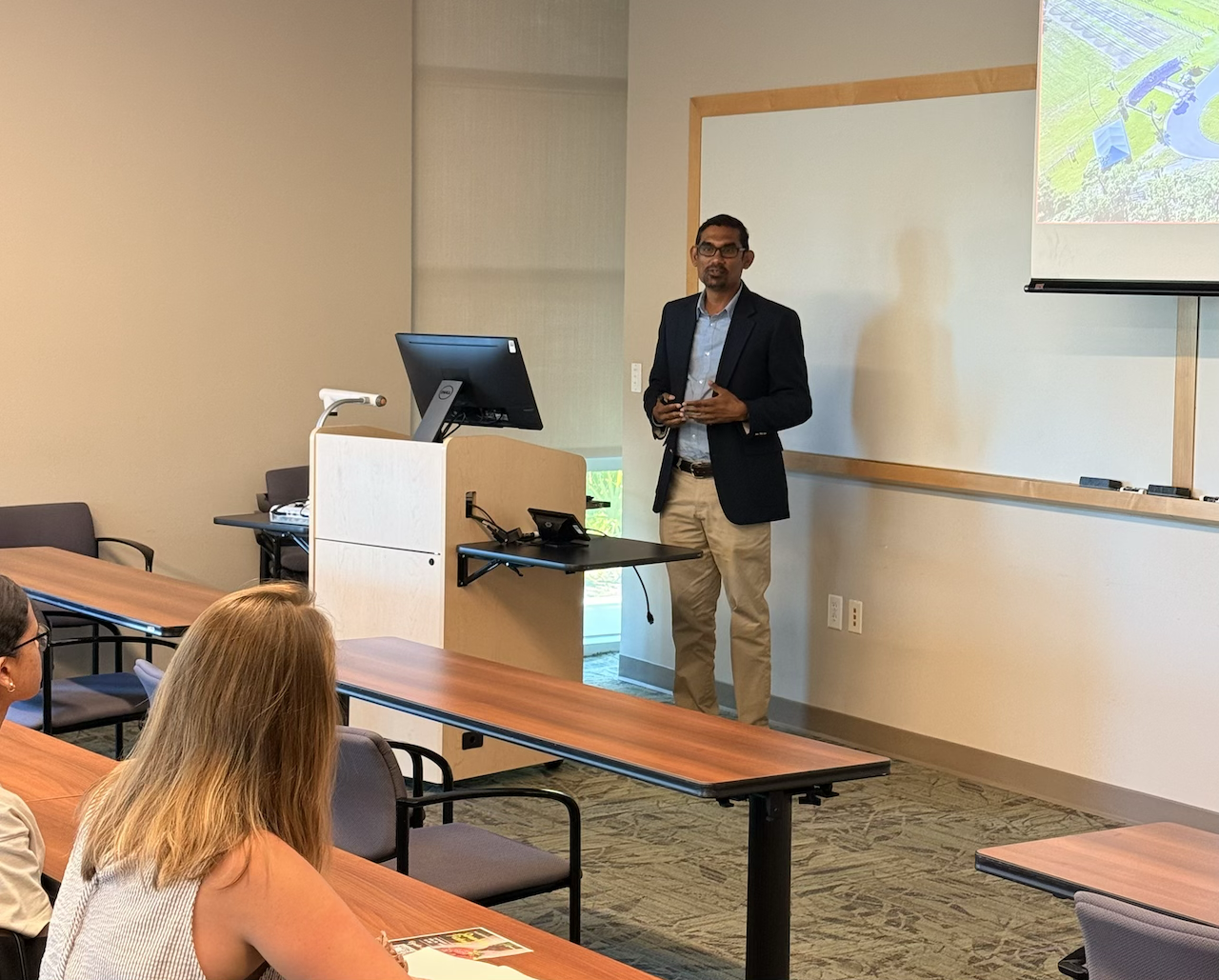
Ramdeo Seepaul delivers presentation to USF students, faculty and guests.
Sustainability Speaker Series Featuring Dr. Ramdeo “Andy” Seepaul
Sustainable agriculture is not about luck. It is about intentional decisions. That was the core message delivered by Dr. Ramdeo “Andy” Seepaul during the Patel College of Global Sustainability’s Sustainability Speaker Series. In his presentation, “Science, Stewardship, and Climate-Smart Agriculture for a Changing World,” Dr. Seepaul challenged students to rethink sustainability as a deliberate balance between environmental stewardship, economic viability, and community well-being.
Dr. Seepaul serves as Executive Director of the FAMU Brooksville Agricultural & Environmental Research Station and leads applied research, education, and community engagement initiatives focused on climate-smart agriculture, soil and water conservation, emerging crops, and workforce development. Born and raised in Guyana, where his early life was shaped by rural agriculture and family ties to farm labor, he brings both lived experience and scientific expertise to the conversation.
Sustainability Is a Management Strategy
Throughout the lecture, Dr. Seepaul emphasized that sustainability requires measurable
outcomes and strategic planning.
“Sustainability is about management,” he explained, underscoring that profitable farm
income, environmental protection, and quality of life must be considered together.
He described sustainable agriculture as the balance of “planet, profit, and people.” Farmers, he noted, will not adopt conservation practices if they are not economically viable. At the same time, maximizing production without regard for environmental consequences can lead to nutrient loss, water contamination, and long-term instability.
Rather than maximizing inputs, he encouraged optimizing them—applying nutrients at the right rate, time, source, and place to reduce environmental impact while maintaining productivity.
Florida at a Tipping Point
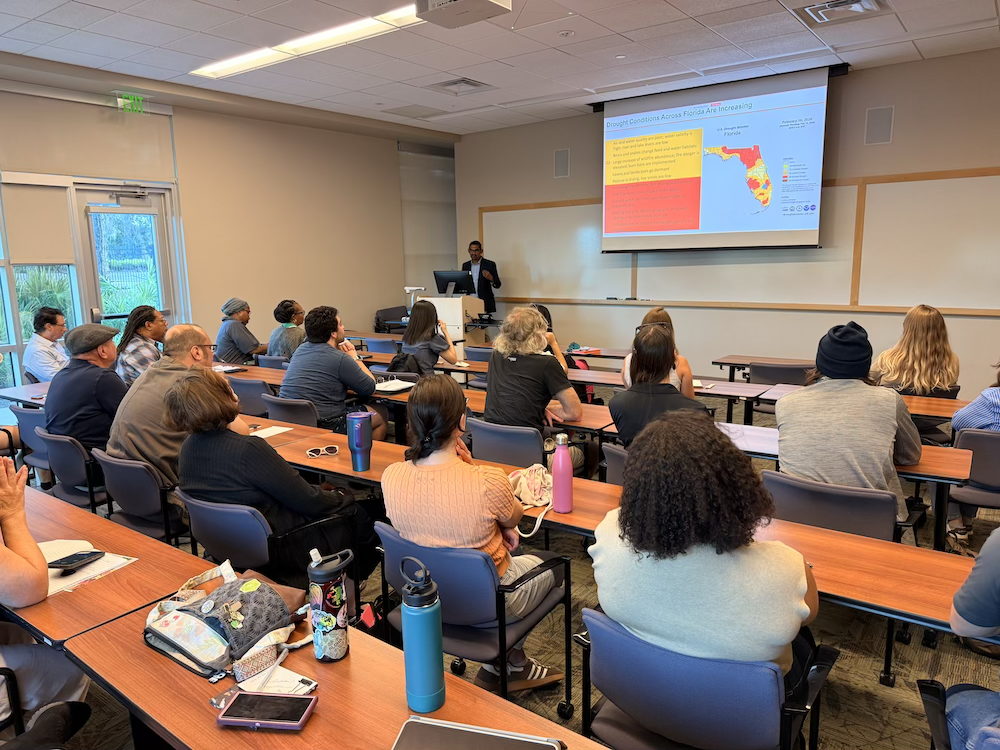
Ramdeo Seepaul discussed the challenges unique to Florida
Dr. Seepaul described Florida as a frontline state, facing intensifying pressures from climate change, drought, rising temperatures, land development, and water quality degradation.
He shared data showing increasing temperatures over the past century, current drought conditions, nutrient impairment in freshwater springs, and projected agricultural land loss due to population growth and sea-level rise.
Florida agriculture produces more than 300 commodities and represents a major economic sector, yet its sandy soils, high nutrient runoff, and vulnerability to extreme weather make sustainable management essential.
“The choices we make now will determine whether agriculture stays productive and profitable,” he said.
Soil Health as the Foundation
A central theme of the presentation was soil health.
Dr. Seepaul contrasted uncovered fields experiencing nutrient loss with diversified systems that maintain continuous soil cover. Practices such as cover cropping, crop rotation, reduced tillage, intercropping, and maintaining living roots year-round build organic matter, reduce runoff, and improve resilience.
“Soil is a living organism that we need to take care of,” he reminded the audience.
He also highlighted precision agriculture tools, circular nutrient systems, integrated
crop-livestock systems, and nature-based solutions such as riparian buffers and perennial
plantings as practical pathways toward climate-smart agriculture.
Rethinking Food Security
Dr. Seepaul discussed global research on national food self-sufficiency, noting that producing high quantities of calories does not guarantee nutritional balance.
He explained that while the United States is strong in meat, dairy, and staple production, it is comparatively weaker in fruits and vegetables, critical components of nutritional security.
“We need to diversify, not just intensify,” he urged, calling for expanded investment in fruit and vegetable production and regional capacity building.
A Role for Every Discipline
Dr. Seepaul closed with a reflection on what inspired his career in agriculture, describing food production as one of the most selfless and noble professions.
He encouraged students from all fields—data science, engineering, policy, natural resources, and beyond—to see their place in building resilient food systems.
There is a seat for you at the sustainable agriculture table
Dr. Ramdeo Seepaul
Executive Director of Brooksville Agricultural & Environmental Research Station (BAERS) at Florida A&M University
For the PCGS community, the Sustainability Speaker Series reinforced a clear takeaway: sustainable agriculture is not reactive. It is intentional, data-driven, and deeply connected to the future of Florida and the world.
Couldn’t make it to the event? We’ve got you covered.
The full recording of Dr. Seepaul’s talk is available for students and community members who want to learn more about sustainable agriculture, climate resilience, and food system innovation.