Spring 2026



Business for Good
Interview with Metropolitan Ministries CEO

Cloning the Past for the Future
Inside bringing back the dire wolf


When an empathetic chatbot can make things worse

After a service failure, customers expect empathy. When a human employee understands a customer’s frustration and shows they share that feeling, it can calm tensions and rebuild trust. But new research suggests that when a chatbot tries the same tactic, it can backfire.
- What really drives retailers’ online supplier choices
- Look smarter: Share your backup plan early
- How healthy food samples influence what you buy
- Reviving legends: Hologram AI concertgoers value ethics over innovation
Why “10” beats “Ten” in winning consumer trust

When it comes to numbers, how you write them can shape what people believe. New research co-authored by Anand Kumar, professor of marketing at the University of South Florida, finds that consumers respond more positively to numbers written as digits, like “10 grams of protein”, than to the same information spelled out as “ten grams of protein.”

Complex disclosures can backfire, even for sophisticated investors
Financial disclosures are meant to level the playing field. But when information becomes
too complex, even sophisticated investors can strategically tune out.

More university voices published in elite business journals
For decades, publishing in top business journals often seemed reserved for a small
circle of elite universities. A new study suggests that circle is widening.
For nearly a decade, researchers from the University of South Florida Muma College of Business and the Tampa Bay Partnership have taken a data-driven approach to identifying regional trends. This annual snapshot acts as a mirror and a compass, showing where Tampa Bay ranks among its metropolitan peers in various socio-economic, educational and quality of life metrics.
A few report highlights:

Artificial Intelligence Adoption
Tampa Bay ranks third among its 19 peer regions in AI adoption, surpassing major tech
hubs with nearly 13% of businesses utilizing AI.

Housing Affordability
Roughly 3 out of 5 renters spend 30% or more of their income on housing. Additionally,
half of households spend more than $1,500 each month on housing.

Wages
Wages increased at a faster pace than the U.S. overall, with average wages rising
5.14% to $66,671.
University Research and Innovation
University research and development spending increased to $467.2 million in the region.

Transportation
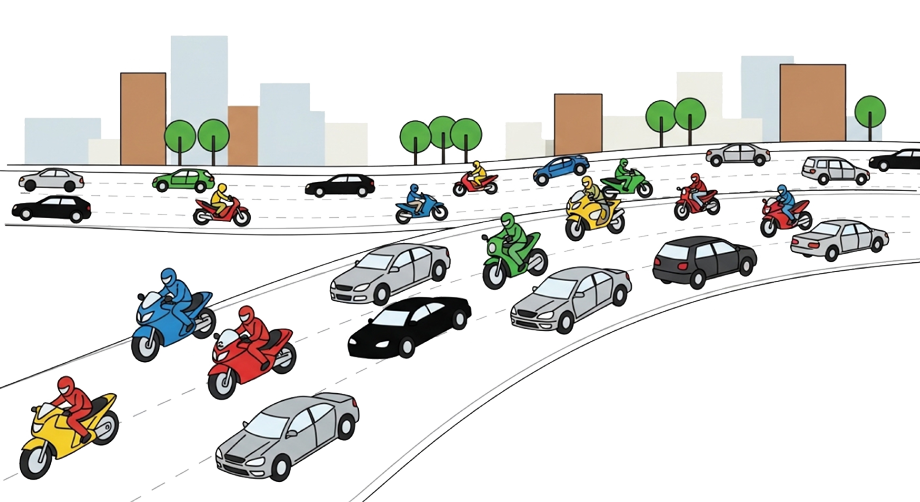
Tampa Bay residents spend an average 29.26 minutes commuting to work, a 30-second
decrease.
Sources: 2026 Tampa Bay E-Insights Report, produced by the Muma College of Business, and the 2026 Regional Competitiveness Report, produced by the Tampa Bay Partnership.
Researchers launch beta version of Regional Insights Dashboard
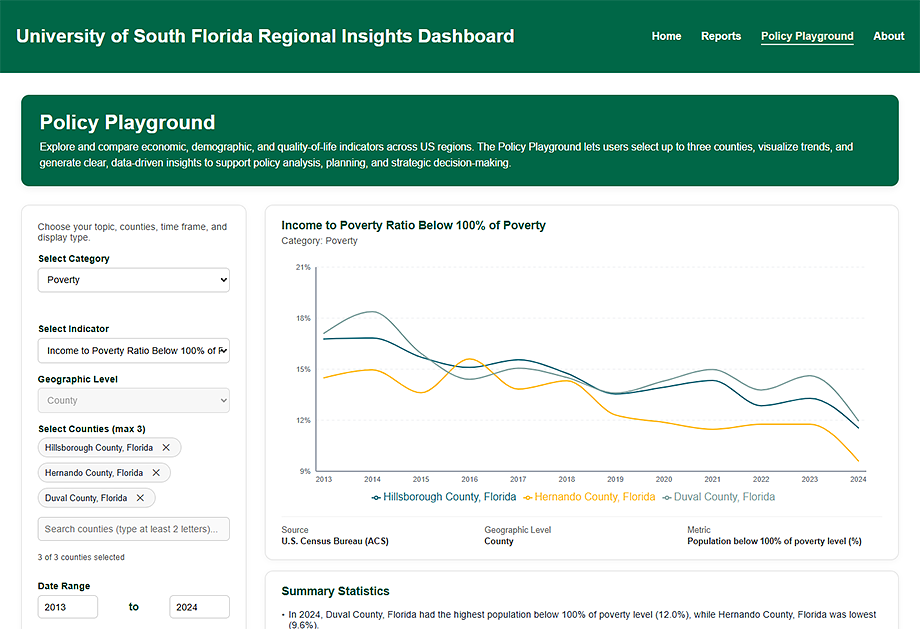
A new interactive tool is now available to help researchers and community leaders make more informed decisions on policy and regional planning.
Economics researchers at the University of South Florida released a new regional insights dashboard that allows policymakers, researchers, business leaders and residents to compare 24 economic, demographic and quality-of-life metrics across more than 600 counties across the United States.
The dashboard's "Policy Playground" tool lets users select up to three counties, visualize trends, and generate clear, data-driven insights to support policy analysis, planning and strategic decision-making.
"The Regional Insights Dashboard brings together trusted national and local data, interactive visualizations, and peer comparisons so users can compare key measures of economic performance, population change, and community wellbeing across the nation," said Manish Agrawal, who collaborated with Shivendu Shivendu and a team of graduate assistants to develop the dashboard.
The dashboard is available for free public use during this final testing phase, and additional features including searches by Metropolitan Statistical Area and expanded metrics will launch in fall 2026.
To explore the dashboard and its Policy Playground tool, visit usf.to/regional-insights.

R&D: The key to breaking through plateaus for tech firms
IT firms face greater growth swings, but sustained R&D investment can serve as a powerful safeguard against revenue stalls.

When live streams get too big, viewers go quiet
On live-streaming platforms, growth alone isn’t enough. Strong, well-matched moderation helps sustain meaningful participation as audiences expand.

Industry pros love AI concierges, while hotel guests have reservations
Are guests willing to adopt the conveniences of conversational AI assistants, or do they prefer the one-on-one interaction with a human concierge?

Training AI to think like a hacker, before the hack happens
Artificial intelligence now powers many cyber defense tools, from malware detection to intrusion monitoring. But attackers have learned how to manipulate those systems, subtly altering malicious code to slip past AI defenses. A new framework aims to close that gap.

Marketing automation can open doors, but it doesn’t always close the deal
For many business-to-business firms, automated lead nurturing promises a smarter path to sales. The technology tracks prospects’ online behavior and automatically delivers tailored content, with the goal of warming up leads before a salesperson ever makes contact.

Can generative AI elevate hospitality without eroding the human touch?
Hotels, restaurants and destinations are experimenting with generative AI, from automated marketing copy to personalized travel recommendations. But in an industry built on human connection, the stakes are high.