

When the University of South Florida Muma College of Business entered a partnership with cybersecurity company KnowBe4 Inc. in 2019, leaders from the college and the company didn’t specifically know where their new union was going.
Then Dean Moez Limayem and KnowBe4 founder and CEO Stu Sjouwerman — now USF president and KnowBe4 executive chairman, respectively — had an eye on building a relationship that would benefit students, fuel the fast-rising cybersecurity industry and tackle daily challenges. But they left the specifics of how to get there to a research team led by USF professor Matt Mullarkey and KnowBe4’s Chief Learning Officer John Just, who let the practical challenges and big questions facing the emerging sector be their guide.
Six years later, the results are significant. The team built a productive cybersecurity credential program for students that gives them added skills to bring to future employers, as well as groundbreaking research findings that challenged the conventional wisdom on how to best combat hackers. Even as university industry collaborations gain popularity but remain a rarity across the American business landscape, the USF/KnowBe4 partnership has been a game-changer for both organizations.
“These partnerships happen when there is a win for students; a win for faculty, which is really a win for knowledge contribution; and a win for the organization,” Mullarkey said. “You have to have all three and you have to do it over a timeline, three to five years, because it doesn’t happen in a semester.”
While often touted as a force multiplier in American innovation, academic-industry research partnerships can be complex collaborations.
Nationwide, industry-sponsored research at universities is a relatively small, but increasing segment of academic research. Of the nearly $109 billion in American university research and development expenditures in 2023, $6.2 billion came from industry-sponsored projects and an increase of more than 9% over the previous year, according to the most recent federal survey of research activity.
These partnerships happen when there is a win for students; a win for faculty, which is really a win for knowledge contribution; and a win for the organization. You have to have all three and you have to do it over a timeline, three to five years, because it doesn’t happen in a semester.
Matt Mullarkey
USF professorof instruction
As a research university, USF has long had research ties to regional industries, especially concentrated in engineering and medicine where such collaborations have been key in developing new technologies, participating in clinical trials or aimed at workforce development.
In 1996, USF joined with the University of Central Florida in the founding of the Florida High Tech Corridor, later adding University of Florida as a partner, for the purpose of connecting industry to academic researchers in tech-driven research and development projects.
Now, a new era of academic-industry research is adding new facets to those partnerships following national calls within higher education to add real-world relevance to business while maintaining the rigorous standards of academic research.
Muma College of Business researchers have delved deep into the inner workings of companies and tested time honored practices using scientific methods that go far beyond case studies or what a consultant might produce. Their findings have led companies to think differently about their businesses and put a spotlight on new service lines for their customers.
But academic research, effective because it is methodical, highly regulated when involving human subjects, and subject to peer review, doesn’t exactly move at the speed of business. Return on investment is uncertain for industry and for academics, for whom years of effort can wither at the point of publication when peer reviewers and journal editors take years to accept the research or, even worse, reject a submitted article.
Munir Mandviwalla, who joined the Muma College of Business from Temple University last year as a professor, distinguished research fellow and director of the School of Information Systems, has built a career in industry academic collaborations with more $10 million in research projects with companies such as Lockheed Martin, NBCUniversal, Pfizer, Microsoft, SAP, Walmart and IBM.
There’s a unique niche for academic researchers to play in the business world, Mandviwalla said, but the relationships are different in their demands and expectations on both sides of the partnership.
“We have to convince them (CEOs) we can actually solve a problem in their interest, because normally they would just go to a consultant,” Mandviwalla said. “We can only take on extremely difficult problems that the consultants would charge too much for or would run away from.”
Before arriving at USF, Mandviwalla was collaborating with a colleague at the University of Georgia and Kyndryl, the world’s largest IT infrastructure services provider in developing and analyzing a framework for the IBM-spinoff to modernize its systems. This spring, the partners published in the journal IEEE Software how Kyndryl was able to rapidly modernize its practices to become more competitive, a massive undertaking considering the company employs 73,000 people, serves more than 4,000 major customers (including most of the Fortune 100), and works across more than 60 countries as it generates roughly $15 billion in annual revenue.
For Mandviwalla, helping a company of that scale gain valuable perspective is the rewarding part of the partnership.
A Jabil collaboration matches the moment
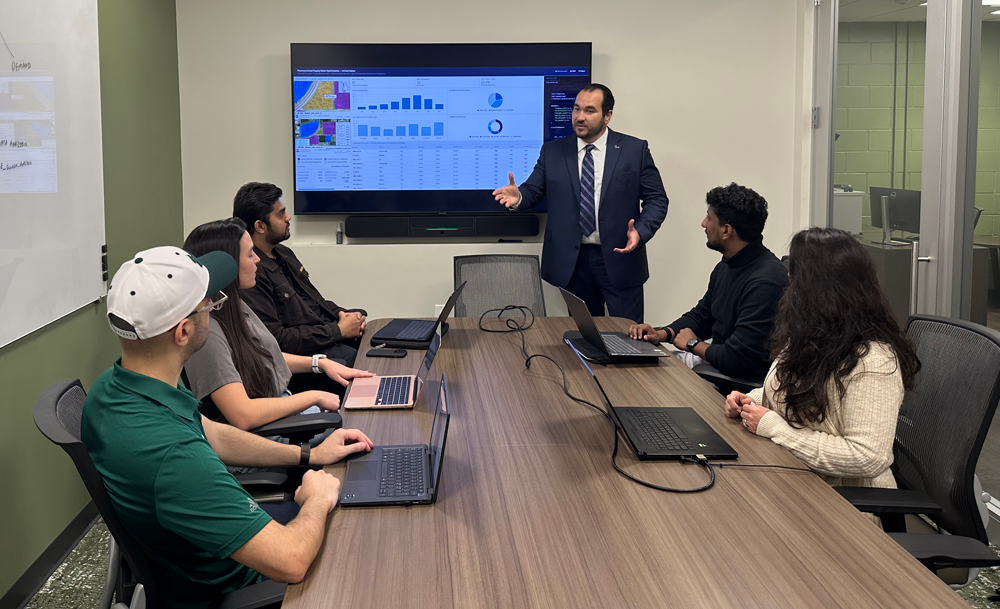
Assistant professor Seçkin Özkul leads a working session with graduate research assistants
at the USF Supply Chain Innovation Lab, translating data-driven insights into actionable
next steps for an industry-sponsored project with Jabil.
Photo by Ravi Teja Modupalli
In 2019, USF partnered with global technology firm Jabil to establish an innovation institute designed to advance both academic inquiry and industry-facing solutions.
Seçkin Özkul, assistant professor of supply chain management and founding director of the Supply Chain Innovation Lab, soon began collaborating with Jabil on a research initiative focused on developing a scalable framework for end-to-end supply chain visibility across the company’s global operations. The project was further strengthened through matching funds provided by the Florida High Tech Corridor, amplifying Jabil’s investment and enabling expanded research and implementation efforts.
The initiative aimed to move beyond static analytics by developing a dynamic decision-support approach, one that enables stakeholders across the supply chain to monitor, interpret, and respond to real-time shifts in supply and demand conditions.
“How can you design a system where every node in the supply chain has visibility into what is happening, so decisions can be made proactively rather than reactively?” Özkul said. “In supply chains, uncertainty translates directly into cost, so improving visibility is fundamental to improving performance.”
The timing proved especially significant. Shortly after the project began, the COVID-19 pandemic disrupted global supply chains, exposing structural vulnerabilities in highly optimized, just-in-time systems and accelerating the need for more adaptive and resilient planning approaches.
“Organizations lacked visibility and were reacting under pressure, often at significant cost,” Özkul said. “What we demonstrated is that with the right data and coordination mechanisms, you can begin to see what is happening and respond more effectively. That was a critical outcome of this work.”
Özkul emphasized that the ultimate value of the collaboration lies not only in theoretical insight, but in its practical application.
“Theoretical insights are valuable,” he said, “but they are not sufficient on their own. Industry partners expect actionable, implementable solutions, and they expect them in real time.”
For Michal Wierzchowski, Jabil’s vice president of operations and digital transformation, the research partnership with the business college was an opportunity to partner in research that would help build the company’s future through its workforce.
More recently, Jabil and the business college worked on incorporating artificial intelligence into training programs for the company’s sales trainees, modernizing legacy processes of training manuals and digital documentation into a chatbot that guides new employees through the learning curve of onboarding.
The team built a large language model from Jabil’s training data to create a guided work environment that improves the employee experience.
The end result is a highly-attuned system that’s adaptable to the learning styles of different generations in the workforce, is capable of testing the effectiveness of training process, and produces insights for Jabil on how to continually improve employee skills in a complex environment.
“The benefits of working with academics that I see is in the future workforce,” Wierzchowski said. “We’re looking at how we can capture 15 to 20 years of knowledge that’s in the brains of our employees and digitize it so the next generation can take advantage of it.”
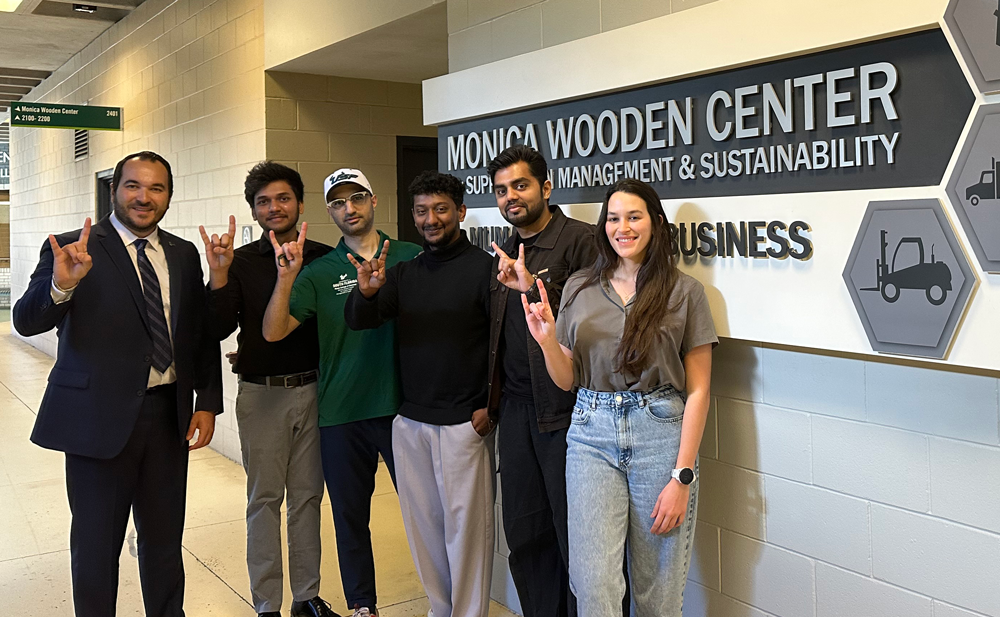
Seçkin Özkul with graduate research assistants from the USF Supply Chain Innovation
Lab at the Monica Wooden Center for Supply Chain Management & Sustainability, advancing
industry-focused research and experiential learning.
Photo by Christine Taylor
KnowBe4 partnership breaks new ground
Over the lifespan of the USF-KnowBe4 partnership, the collaboration has taken a variety of activities and research pursuits. But key to its foundation was KnowBe4 providing USF faculty access to the company’s software and platform, said Mullarkey and Dezhi Yin, associate professor of information systems, who joined the research team.
As USF created a new cyber resiliency certificate for students, the access to the inner workings of the cybersecurity platform also allowed the two organizations to think about the challenges of cybersecurity practices and how the academic research process might provide insights that ultimately gave the company a competitive edge.
“This collaboration is interesting in that we are taking advantage of the platform provided by KnowBe4, but not asking KnowBe4 to conduct the experiment or recruit participants from their networks,” Yin said. “The participants are our own students.”
But because a project like this had never been tried before, both partners had to remain flexible in exploring the challenges in cybersecurity that provided KnowBe4 with unprecedented insights while providing the academics with a research topic that would produce new knowledge in the field.
“Every semester I designed and executed a new field experiment, which is often called A/B testing in the industry. I kept pivoting until the third or fourth year, when the right research problem without a clear answer suddenly came into view,” Yin said. “Then it was a success.”
For Just, who had started his IT career at Pennsylvania State University and went on to earn a master’s degree from USF and a doctoral degree at Nova Southeastern University, delving into an open-ended research question was a familiar place to be.
“There was a multipronged approach from the start,” he said, adding that the initial conversations began with best practice in the field and what cybersecurity practitioners wanted to know to be better at combating hackers and other cyber criminals. What are practitioners wanting to know? What are the assumptions they are making that need to be validated? How do we build a model and how do we field test that model?
“When you talk about a rarity of things in business, that’s a rarity,” Just continued. “To see a field study being done in cybersecurity, it’s usually case-study oriented. The quantitative component brought into this very strong research methodology from a field test evolved into multiple field tests, so you learn things and test multiple hypothesis.”
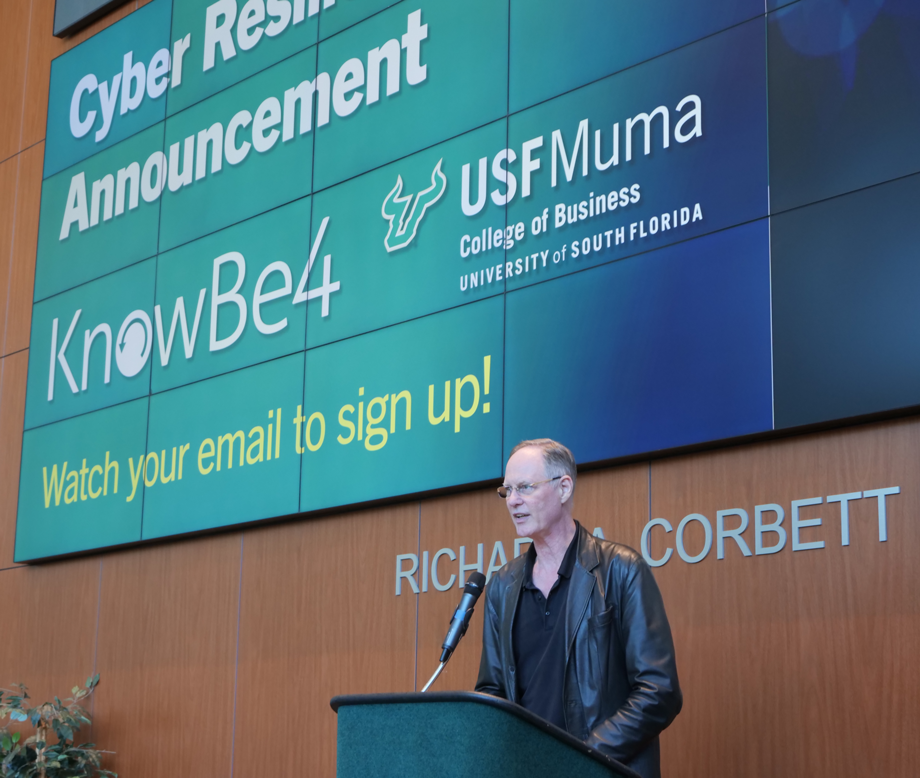
In February 2024, Stu Sjouwerman, founder and CEO of KnowBe4, announced a free Cyber
Resiliency Certificate Program for USF business students, the first university students
in the nation to go through the training.
Photo by Elizabeth L. Brown
Over time, one question became apparent to the research team: What was the best way to train employees who failed random spot checks on how to avoid email phishing attacks.
In November, the research team published their findings in the MIS Quarterly and it challenged one of the most routine practices in employee cybersecurity training, no small matter considering some 3.4 billion spam emails sent daily worldwide and federal officials have identified phishing as the initial entry vector for nearly one-fifth of all data breaches.
Instead, the research pointed to this surprising finding: Routinely testing employees’ cybersecurity compliance by sending dummy phishing emails and offering just-in-time training to those who don’t follow protocol and click on a suspicious link, isn’t as effective as it might seem. If on-the-spot training triggers a defensive emotional response in those employees, it could limit learning and present challenges for preventing future attacks.
A better approach that led to greater security resilience, the team discovered, was training everyone after a phishing simulation is over, not just those who clicked, to keep the entire employee pool on the alert.
