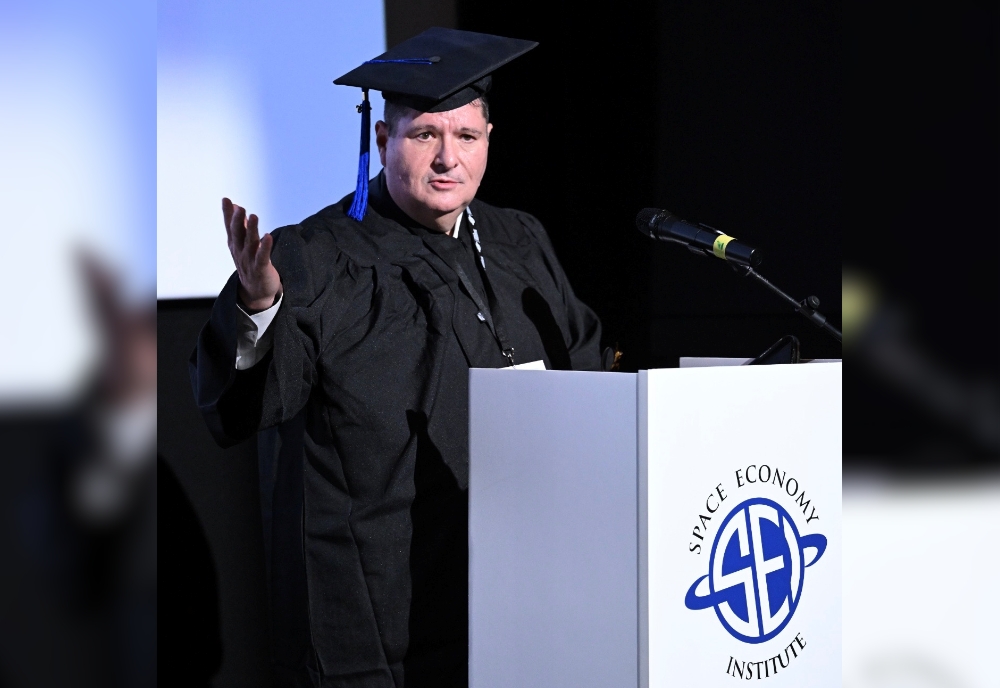
TAMPA — A University of South Florida School of Management faculty member delivered a keynote address at an international space summit in Rome in January and is expanding one of the nation’s few business school courses dedicated to the commercial space economy.
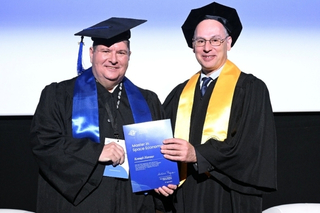
Kenneth Hamner, assistant professor of instruction in the Nault Center for Entrepreneurship within the Muma College of Business, spoke at the Space Economy Summit 2026, hosted by the Space Economy Institute at The Space Moderno in Rome. He also served as an alumni speaker at a graduation ceremony and received a master's degree in space economy during the summit.
“The space industry is likely to disrupt a number of key industries on Earth,” Hamner said during his keynote.
The summit is an international forum focused on space policy, technological innovation and the social impact of the space economy, drawing launch providers, satellite companies, investors and global industry leaders. Organizers describe the Space Economy Institute as one of the world’s leading knowledge centers in the sector.
In his remarks, Hamner called the new space economy “perhaps humankind’s most consequential frontier” and pointed to its potential to transform telecommunications, energy innovation, Earth observation and resource mining.
He emphasized the economic return of space investment, citing a NASA estimate that every $1 spent on space research generates approximately $40 in economic growth on Earth. “Every dollar spent on space is spent right here on Earth,” he said.
Hamner, an attorney for more than 20 years and managing member of The Entrepreneur Law Center, has worked with entrepreneurs, startups and high-growth companies. He previously worked in public accounting and consulting at Arthur Andersen and Ernst & Young and served as a startup chief financial officer before entering academia.
At USF, he teaches undergraduate and graduate courses including New Space Economy, intellectual property, artificial intelligence, business plan development and principles of entrepreneurship.
His Rome experience is directly informing his course, “New Space Economy: Entrepreneurship, Business Models, Tech and Opportunities,” offered to undergraduates in summer 2026. The course explores the history of the space industry, emerging business models, product and process innovation, the global value chain and career opportunities in the sector.
Students interested in taking one of Hamner’s courses during the summer or fall should schedule an appointment with their academic adviser to have it added to their registration.
“The new space economy is a fast-growing sector of the entrepreneurial ecosystem, particularly in Florida,” Hamner said. “The connections will be very valuable…which can only benefit our students.”
Florida is home to NASA operations as well as private companies such as SpaceX and Blue Origin, positioning the state as a growing hub for commercial space activity. Hamner said public-private partnerships and companies such as SpaceX, Planet Labs and Blue Origin are accelerating innovation in areas ranging from satellite internet to future energy technologies.
Through a cooperation agreement between his law firm and the Space Economy Institute, Hamner has developed international relationships with leaders in both the private and public space sectors. He said those connections will help bridge global space policy and commercial insights directly into the Tampa classroom.
As commercial space activity expands, Hamner said he hopes to play a role in preparing the next generation of space entrepreneurs.
“There are very few, if any, industries that hold such promise and opportunity,” he said.