

Yeran Gamage (left) trains with a fellow member of the Bulls Boxing club [Photo courtesy of Yeran Gamage]
By Paul Guzzo, University Communications and Marketing
In boxing, you don’t last long if you only know how to defend — or only how to attack.
Fighters train not only to throw punches, but to recognize what a punch looks like when it’s coming at them.
Cybersecurity works the same way.
Some specialists play offense, actively probing for weaknesses, while others focus on defense, building protections to block the next hit.
Yeran Gamage understands that balance firsthand, both inside and outside the ring — as the founder and president of the University of South Florida’s boxing club and a student graduating from the inaugural class of the Bellini College of Artificial Intelligence, Cybersecurity and Computing.
Gamage will next head to Charlotte, North Carolina to work for Wells Fargo as a cloud security engineer, helping protect online systems and customer data.
“My career aspirations right now are to do AI security at a big scale,” said Gamage, who’s graduating with a bachelor’s degree in cybersecurity. “I wanted to go into this so I have the opportunity to protect people — or people who use AI, or even AI itself.”
He’s already started doing just that.
To gain real‑world experience during his final months at USF, Gamage independently searched for and uncovered security flaws — known as Common Vulnerabilities and Exposures, or CVEs — in two open‑source AI tools. He analyzed code, tested potential weaknesses in controlled environments and reported what he found directly to developers so the issues could be fixed before being exploited.

Bulls Boxing is one of USF's largest student organizations
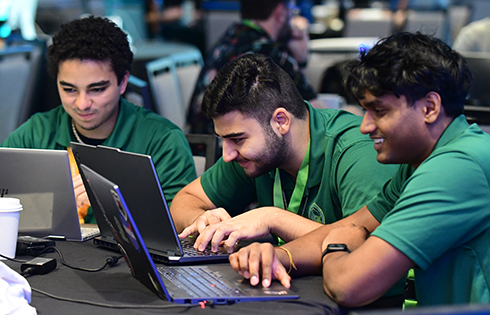
Yeran Gamage (right) with USF’s CyberHerd teammates
Once the fixes are released, the weaknesses are publicly disclosed, with Gamage credited for discovering them.
“If you were running this software, a hacker from anywhere could execute commands on your machine and access everything on it,” he said.
That instinct to protect didn’t begin in cybersecurity, but with medicine.
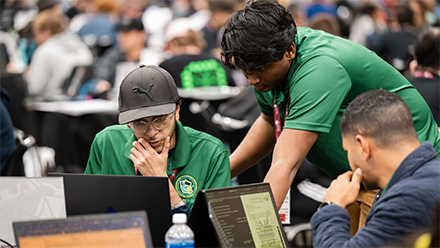
Yeran Gamage [middle] at a USF CyberHerd competion
“I initially wanted to become a doctor like my uncle,” Gamage said. “I started at USF as premed, but switched my freshman year after seeing how fast AI was growing. I felt like it was the future — and I liked helping people, so this was a way to do that where it was in my own hands.”
Around that same time, Gamage also discovered boxing after a friend in cybersecurity introduced him to the sport. When he and others realized USF did not have a boxing club, they started Bulls Boxing, with Gamage named president.
What began as a small group grew into one of the university’s largest student organizations, focused on making the sport accessible to beginners. The club offers structured training, sparring and mentorship in a supportive, safety-first environment that emphasizes discipline and community.
But Gamage’s primary focus remained cybersecurity, leading him to be selected as a member of USF’s CyberHerd team, which competes against other universities.

Yeran Gamage (middle left) founded and helped turn Bulls Boxing into one of USF's largest clubs
The team, Gamage said, helped further prepare him for real‑world cybersecurity jobs by mirroring how the field actually works. Teams tackle either offensive challenges, such as ethically hacking systems to find vulnerabilities, or defensive ones, such as safeguarding networks and data. They score points by rapidly identifying threats, prioritizing fixes, and communicating under pressure to protect or penetrate simulated systems. These roles also exist inside companies.
Gamage gravitated toward offense.
“You’re basically paid to test other people’s systems,” he said. “Hack it, then write a report on how to make it better.”
His impact across athletics and cybersecurity culminated in one of USF’s highest student honors. This spring, Gamage was named one of just 30 recipients of the Golden Bull Award, recognizing the university’s top undergraduate students for excellence in scholarship, leadership and service.
Now, Gamage is ready to apply the lessons from his time at USF to the challenges ahead.
“In boxing, the best defense is a solid understanding of offense,” Gamage said. “That's exactly how I approach AI security. You can't protect yourself from something you don't know how to break. Security can't be an afterthought. It has to be built into AI from the ground up.”