TAMPA — A woman struggling through sleepless nights and brain fog during menopause. A stroke survivor working to regain the confidence to walk across a room.
Those challenges may seem worlds apart, but they share something in common: They inspired University of South Florida faculty members to take years of research beyond the laboratory and into the world of entrepreneurship.
That journey recently brought two faculty-led ventures — Panthea and evergait — to the final pitch day of the Nault Center for Entrepreneurship’s Hafer THRIVE Pre-Seed Award Program, where faculty members and students receive funding opportunities, mentorship and support to help transform promising ideas into real-world solutions. Though neither venture won an award, both left with something equally valuable: a clearer path toward bringing their research to the people who need it most.
For Jasenka Zubcevic, an associate professor in the Department of Neurosurgery, Brain and Spine and the USF Microbiomes Institute, and Sophie Darch, an assistant professor in the Department of Molecular Medicine, that path began with years of research into the microbiome and how it communicates with the nervous system.
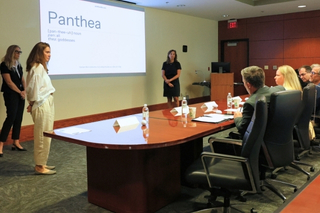
Their venture, Panthea, is developing a science-backed, nonhormonal approach to supporting women through menopause by targeting communication between the gut and the brain.
The idea grew from a realization that many women experience symptoms such as sleep disruption, mood changes, brain fog and cardiovascular challenges, yet available solutions often fail to reflect emerging scientific understanding of what is happening in the body.
“We felt there was a profound gap between what science was showing us and what was actually available to women,” the Panthea team said. “Women want and deserve support built for the biology they are actually living through.”
The venture combines expertise from multiple disciplines and institutions. Alongside Zubcevic and Darch, the team includes University of Minnesota researcher Manda Keller-Ross and Panthea CEO Monica Silvestre, a product leader whose experience spans global companies including Canva, Yelp and Pexels.
Together, they are working to translate years of scientific research into a product that could eventually improve the lives of millions of women.
The transition from researcher to entrepreneur has required a different way of thinking.
“Academic training pushes toward completeness: Qualify every claim, acknowledge every limitation, show your work,” the team said. “But in entrepreneurship, audiences need to understand what you are building and why it matters in minutes, not papers.”
That challenge became especially apparent during the THRIVE final pitch.
“Standing in front of entrepreneurs and judges, we had minutes to explain gut-brain signaling, the menopause market opportunity and our patent-pending mechanism,” the team said. “That kind of constraint sharpens your thinking.”
Across campus, Kyle Reed arrived at entrepreneurship from a different direction.
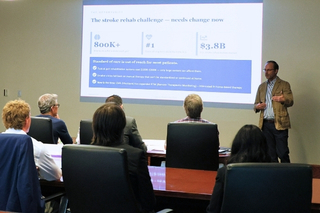
A professor in the Department of Mechanical and Aerospace Engineering and associate dean for undergraduate affairs in the College of Engineering, Reed has spent much of his career studying rehabilitation and human-device interaction. His motivation, however, has always been personal.
“One of my passions is to help people who have a disability learn how to regain motion, particularly in their own homes,” Reed said. “There’s a lot of time spent getting to the clinic, and a lot of people with disabilities require a second person to take them there. If you can get therapy in the home, you can get it more frequently, which is more effective and more efficient.”
That philosophy led to evergait, a portable rehabilitation technology designed to help stroke survivors and others with neurological walking impairments improve their gait from home. Unlike many rehabilitation systems that require specialized clinics or expensive robotic equipment, evergait is designed to be accessible and practical for everyday use.
Reed’s interest in rehabilitation stretches back to graduate school, but conversations with physical therapists, patients and families helped him understand the broader impact mobility can have on people’s lives.
“It’s not just a patient who has problems because of their impairment,” Reed said. “It’s their loved ones and caregivers who also have to deal with this. It takes a lot of time and effort when someone is not mobile and can’t care for themselves. My goal is to make rehabilitation as effective as possible so they’re able to live a more normal life.”
Like the Panthea team, Reed said THRIVE helped him think differently about how to communicate his work.
“I’ve been teaching for a long time and presenting at conferences, but one of the big differences with a pitch is that you have to make sure people are excited about the idea,” Reed said. “The pitch duration of six minutes is a very small amount of time to explain the why, what and how.”
For both ventures, the competition represented more than a chance to secure funding.
The program highlighted the broader support system available to faculty innovators through resources such as USF CONNECT and its Tampa Bay Technology Incubator, which help researchers navigate commercialization, mentorship opportunities and startup development.
For Panthea, those resources helped the team understand everything from investor engagement to manufacturing and market strategy. For Reed, they provided guidance from people who have already navigated the complex path from research discovery to startup venture.
“Working with all these groups is very important because they have the experience, and many of the people who are trying to commercialize things don’t,” Reed said.
While Panthea and evergait took different paths to the THRIVE pitch stage, both demonstrate how faculty expertise can evolve into solutions with the potential to improve lives beyond campus.
As the Nault Center for Entrepreneurship prepares to open applications for the next THRIVE cohort this fall, their experiences serve as a reminder that innovative ideas can come from any discipline, and that faculty members interested in exploring the commercial potential of their research do not have to navigate that journey alone.