By: Cassidy Delamarter, USF College of Education
From artificial intelligence-powered tools that support early childhood educators to immersive virtual reality experiences that prepare students for extreme weather events, faculty across the University of South Florida’s College of Education are launching innovative new research projects thanks to an internal investment in scholarship and discovery.
The college awarded funding to 10 faculty-led research projects through its Collaborative Research Excellence And Translational Efforts (CREATE) 2.0 Awards, Early Career Award Mini Grants and Effectiveness in Undergraduate Research Mini Grants. The awards represent a combined investment of $125,000 in research designed to address real-world challenges while supporting faculty innovation, student engagement and community impact.
"The breadth and quality of these projects reflect the innovative work happening across our college,” said Jenifer Jasinski Schneider, dean of the College of Education. “These investments help faculty pursue new ideas, build interdisciplinary collaborations, engage students in meaningful research experiences and ultimately generate solutions that improve education and communities."
The awards support projects at various stages of development, from pilot studies designed to generate future external funding opportunities to initiatives that expand undergraduate research experiences and mentorship.
CREATE 2.0
Four faculty-led teams received CREATE 2.0 Awards, each receiving $10,000 to pursue interdisciplinary projects that address pressing educational challenges through innovation and emerging technologies.
Data-to-Decision Insight
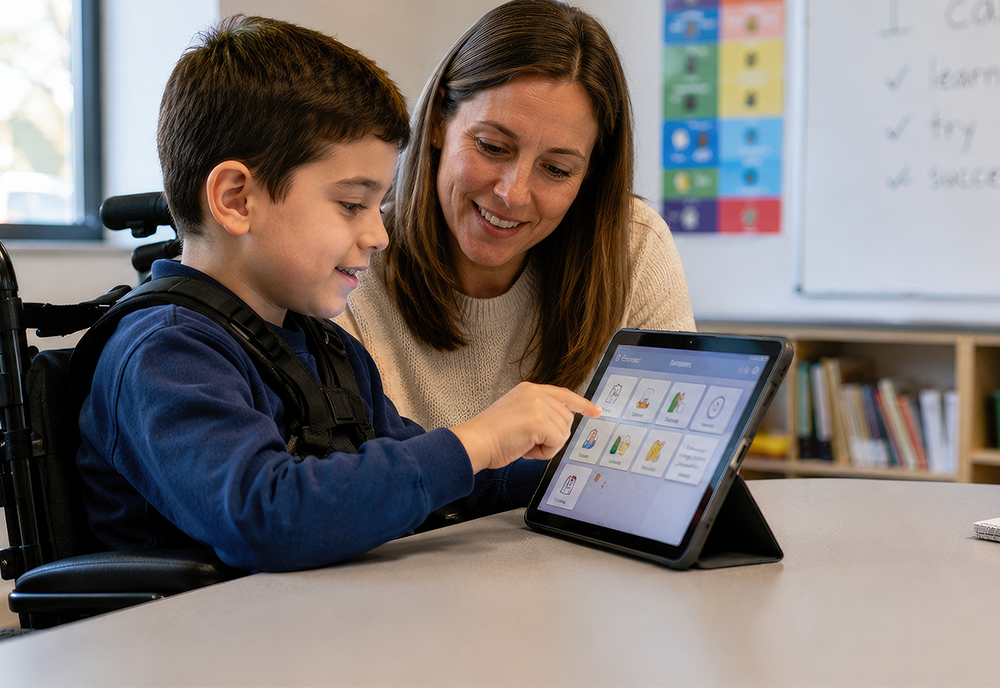
Among the recipients is an interdisciplinary team led by Qunshan Zheng, research assistant professor in the School Mental Health Collaborative, who is developing an artificial intelligence-supported decision-making system for early childhood educators. The project, dubbed Data-to-Decision (D2D) Insight, aims to help teachers transform student data into actionable instructional strategies, streamlining assessment, intervention planning and individualized support for young learners.
The team includes Education faculty Bo Pei, assistant professor of instructional technology; Nathaniel von der Embse, professor of school psychology; Lisa Fox, professor and department chair in the College of Behavioral & Community Sciences; Ken Christensen, professor and associate dean in the Bellini College of Artificial Intelligence, Cybersecurity & Computing; as well as Education alumna Marlee Strawn, an AI entrepreneur who founded Scholar Education.
Advancing AI Literacy
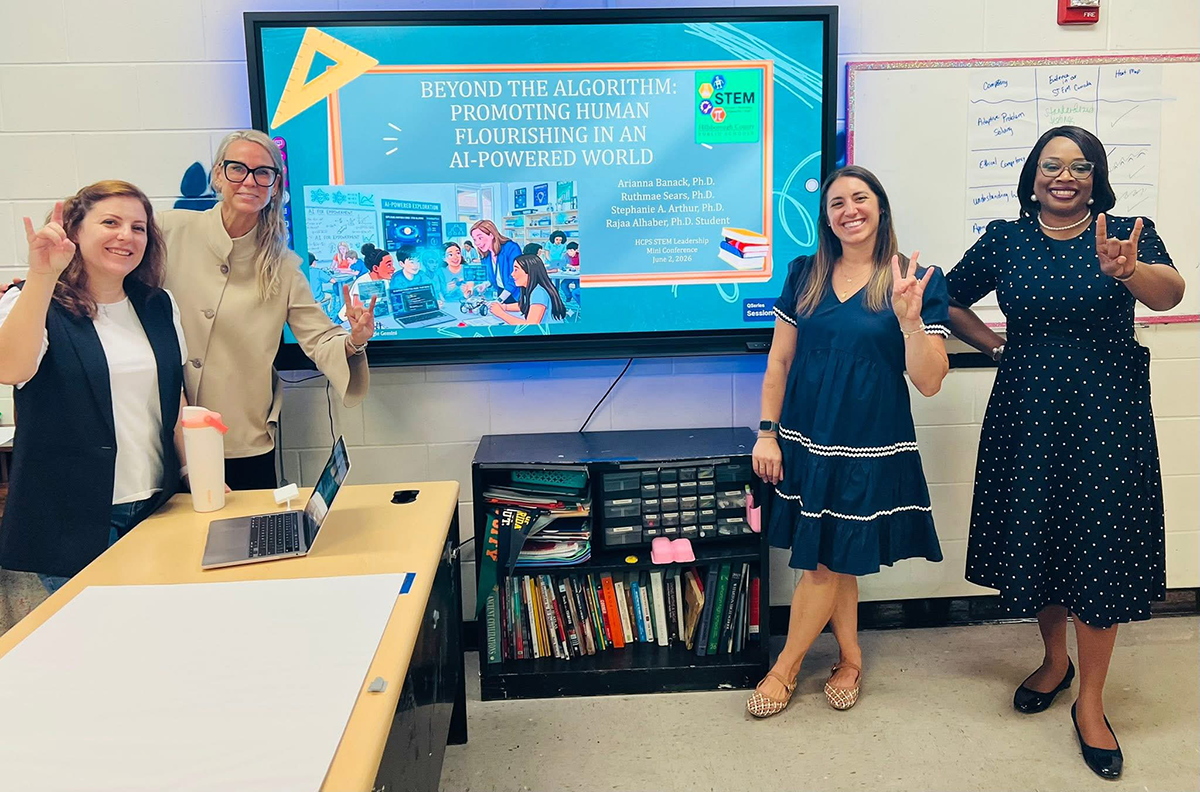
Arthur, Banack and Sears
Assistant Professor Arianna Banack, Professor Ruthmae Sears and Assistant Professor of Instruction Stephanie Arthur have partnered with Hillsborough County Public Schools, the 7th largest school district in the U.S., to explore how artificial intelligence literacy and human flourishing can be integrated across secondary education. The initiative will provide professional learning opportunities for teachers while gathering data to inform future large-scale research and funding proposals focused on AI literacy and human flourishing in education.
This pilot will gather feedback and data from teachers that the team will discuss with district leaders to refine training and scale as needed. “We’ve learned that teachers want more professional development on how to strengthen AI literacy and develop their confidence and comfort to use AI during instruction across secondary science and math content areas,” Banack said.
This summer, the team is applying to additional grants to expand these opportunities for teachers and plans to host two professional development sessions in August.
Project INQUIRY
Project INQUIRY is building a large language model-powered virtual reality environment where high school students investigate hurricanes using evolving, sometimes conflicting weather data while engaging with AI virtual agents to build, test and revise evidence-based explanations. The project teams inlcudes Assistant Professor Bo Pei, Associate Professor Alexandra Panos and Professor David Rosengrant on the St. Petersburg campus.
In partnership with USF's Advanced Visualization Center and the Tampa Metropolitan Area YMCA, the team is designing the virtual reality environment, hurricane scenarios, AI dialogue systems and infrastructure to track students' reasoning. Next steps include field testing with up to 60 students through community programs to inform further development.
"The potential impact of Project INQUIRY extends beyond hurricane and weather education," Pei said. "Hurricanes provide an authentic context for helping students develop transferable reasoning skills that can be applied to other complex, uncertain and information-rich situations."
Strengthening Instructional Resilience
Another initiative, led by Associate Professor Alexandra Panos, is focused on helping schools and communities recover from environmental crises such as hurricanes, flooding and extreme heat. The project will bring together educators and organizations to collaboratively create a framework to support and promote student well-being, instructional continuity and resilience.
The team includes Assistant Professor Arianna Banack, Associate Professor Mandie Dunn, Assistant Professor Lauren Evanovich and Assistant Professor Molly Hamm-Rodriguez.
“We hope and believe that better understanding and collaborating on recovery/resilience will result in teaching that better supports educators, communities, families and children in the midst of crisis," Panos said. "Versus current models that tend to prioritize untenable timelines or are disconnected from the experiences of people living through crisis, including families and children, as well as educators and school staff."
The first part of the project includes a needs assessment and focus groups dedicated to recovery conversations. The goal is to complete these by December 2026 and expand the research in some of Tampa Bay's most environmentally-vulnerable communities in 2027.
Investing in Emerging Scholars
Three faculty members received Early Career Award Mini Grants, each totaling $15,000, to support promising research trajectories and strengthen future external funding competitiveness.
Recipients include Assistant Professor Bo Pei, Assistant Professor Molly Hamm-Rodriguez and Assistant Professor Wenyu Guo. The awards provide early-career faculty with resources to advance innovative lines of inquiry while building research capacity within the college.
CULTIVATING AI-LITERATE EDUCATORS
Guo, whose research focuses on literacy education in schools, homes, communities and digital spaces for youth and their families, is leading a research team to cultivate AI-literate educators. The focus is on creating ethical, equitable and culturally responsive AI integration in K-12 literacy instruction.
Alongside Pei, Professor Sanghoon Park and Guliz Clare, a doctoral student specializing in education technology and AI education, Guo is conducting teacher interviews and hosting workshops to explore the challenges and ethical considerations teachers face. The project will continue until the end of Spring 2027, when Guo plans to use the findings to develop context-responsive lessons, instructional resources and assessments to support educators.
Youth and toursim zones
Hamm-Rodriguez received a New Researcher Mini-Grant for the project, "Youth Promise, Possibility and Precarity: Education and Employment in the Dominican Republic's Newest Expanding Tourism Zones." The research, conducted primarily Summer 2026 with follow-up field visits during the 2026–2027 academic year, will build on more than a decade of Hamm-Rodriguez's work in the Dominican Republic.
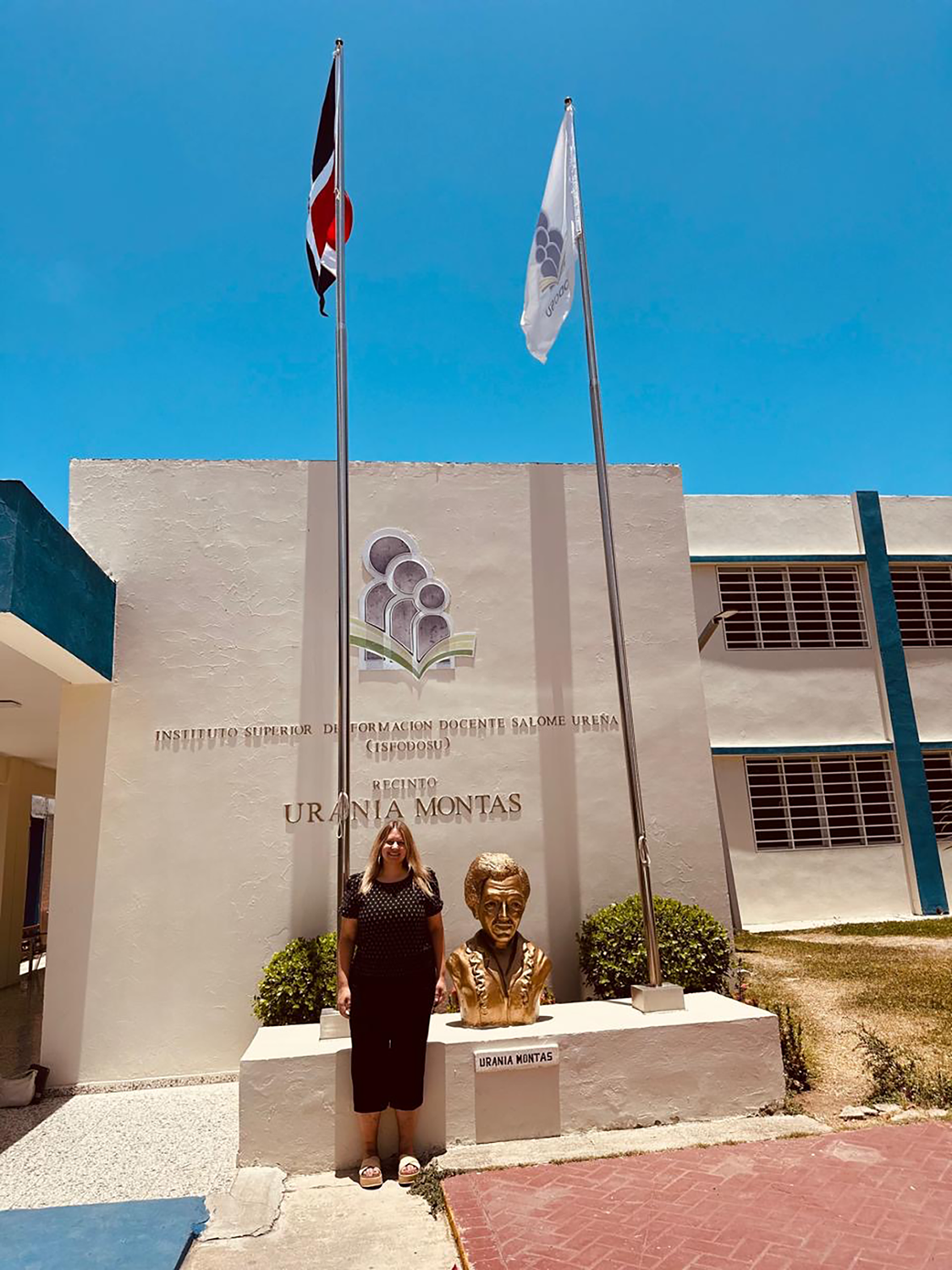
Hamm-Rodriguez in San Juan, Dominican Republic
"I chose the Dominican Republic because tourism is one of the country's primary focus areas for economic growth. Its dependence on tourism caused the country to reopen its doors to tourism very quickly during the COVID-19 pandemic, a dynamic I studied as a Fulbright Doctoral Dissertation Research Abroad Scholar in 2021," Hamm-Rodriguez said. "This longitudinal work across multiple geographic sites allows me to see the role that tourism has played in the country and in youth's future-making over time."
The study focuses on Montellano and Pedernales, two regions experiencing significant investment and tourism growth. The shift in geographic focus will allow her to study how youth understand experience the promises of tourism amid the active transformation of their communities.
The conclusions from this research will provide insight into other countries where tourism is also a main source of economic growth and to areas where tourism might expand in the future.
SEEING THE INVISIBLE
In collaboration with Hillsborough County Public Schools, Project MicroScape is a one-year initiative led by Bo Pei's VISTA Lab. With research mentorship from Distinguished University Professor Dana Zeidler, a leading scholar in socioscientific issues, Pei and the team are developing an immersive virtual reality learning environment designed to strengthen middle school students' casual reasoning and evidence-based environmental decision making.
The team is working with district science educators to integrate the project into an existing middle school microplastics curriculum, where students will use the virtual environment to trace microplastics through the Tampa Bay ecosystem and examine how sources, transport pathways and biological impacts are connected.
"Microplastics provide an especially meaningful context because students must understand how particles move from everyday products into streets, waterways, wildlife and food webs, even though these processes are difficult to observe directly within a classroom" Pei said.
The module will be piloted across multiple middle school science classrooms to examine students' casual explanations and evidence-based mitigation recommendations, as well as how different prompt types influence students' reasoning and revision processes.
Expanding Undergraduate Research Opportunities
Three additional projects received funding through the Effectiveness in Undergraduate Research Mini Grants program, which supports faculty-led initiatives that engage undergraduate students in authentic research experiences.
Teacher Candidates
Janet Outlaw, assistant professor of instruction and director of undergraduate research, is dedicating her project to providing opportunities to students to engage with and explore research in elementary literacy.
The project will support and provide mentorship to a cohort of up to 30 undergraduate elementary teacher candidates. Each student will collaborate with faculty and partnership schools to conduct practitioner research and improve instructional practices. The program officially begins this Fall and students will share their findings at the Spring 2027 OneUSF Undergraduate Research Conference.
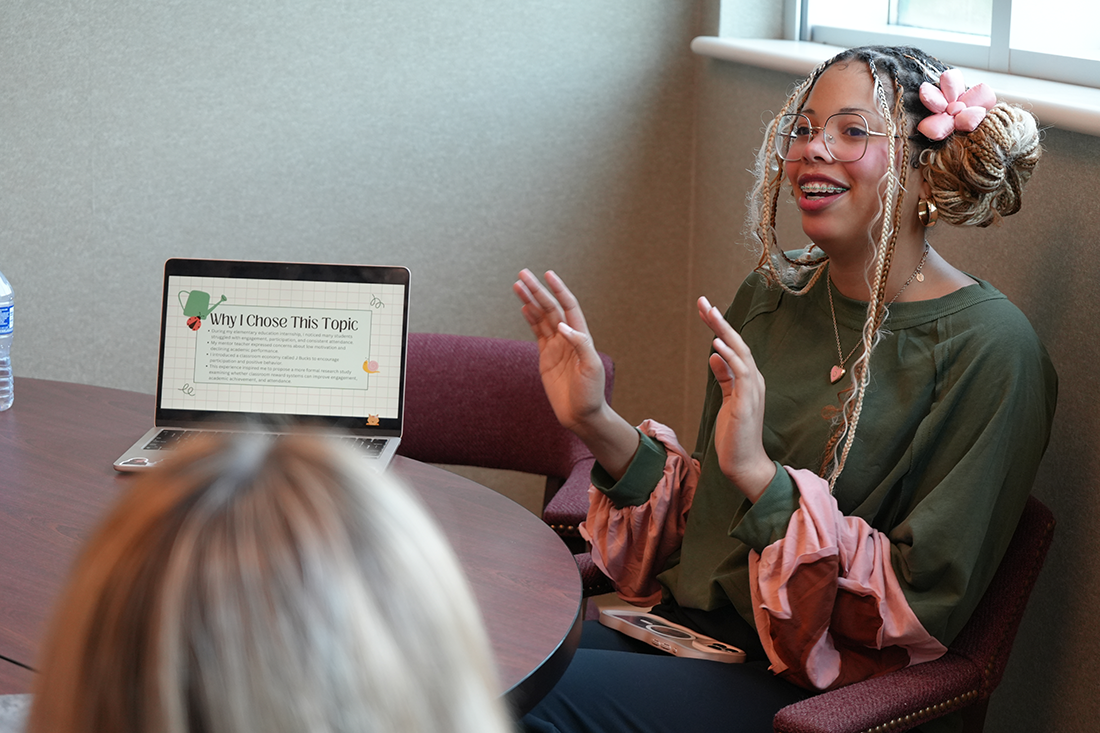
Undergraduate Khalia Jones presenting her research on the effects of classroom reward systems in a similar program Outlaw ran during Summer 2026
Exercise addiction
Professor Marcus Kilpatrick's interdisciplinary mentorship project provides Exercise Science students with hands-on experience conducting research related to maladaptive exercise behaviors and eating disorder risk factors. Students will participate in all stages of the research process, from study design to data analysis and dissemination.
In collaboration with the USF Department of Psychology, Kilpatrick and his students will work on the project throughout the fall and spring. After it concludes in May 2027, the findings will be presented at the American College of Sports Medicine's annual research meeting.
The study will explore how aerobic exercise that varies on both duration and intensity is experienced differently for individuals who score very highly on a scale of problematic and addictive exercise versus a group of students who have a very healthy approach and relationship with exercise. Kilpatrick will analyze if the durations and intensities produce different psychological responses.
"The results of the study will inform clinical practice that helps individuals struggling with exercise addiction and can also contribute to discussions related to optimizing exercise prescriptions so that the experience can be positive and incorporated into a daily routine," Kilpatrick said. "I am excited about the collaboration with psychology and I hope to leverage this mentoring experience into a more systematic approach within our expanding undergraduate program."
Menopause
Professor Bill Campbell's project immerses undergraduate researchers in women's health research focused on the menopausal transition. Students will contribute to survey-based and intervention studies while gaining experience in research design, data analysis, scientific writing and national conference presentations. The first phase of the project focused on conducting a menopause fitness survey. The second phase, which is collecting weight-loss intervention data, is now underway.

Campbell and his undergraduate studies presented the menopause fitness survey research at the OneUSF Undergraduate Research Conference in April 2026.
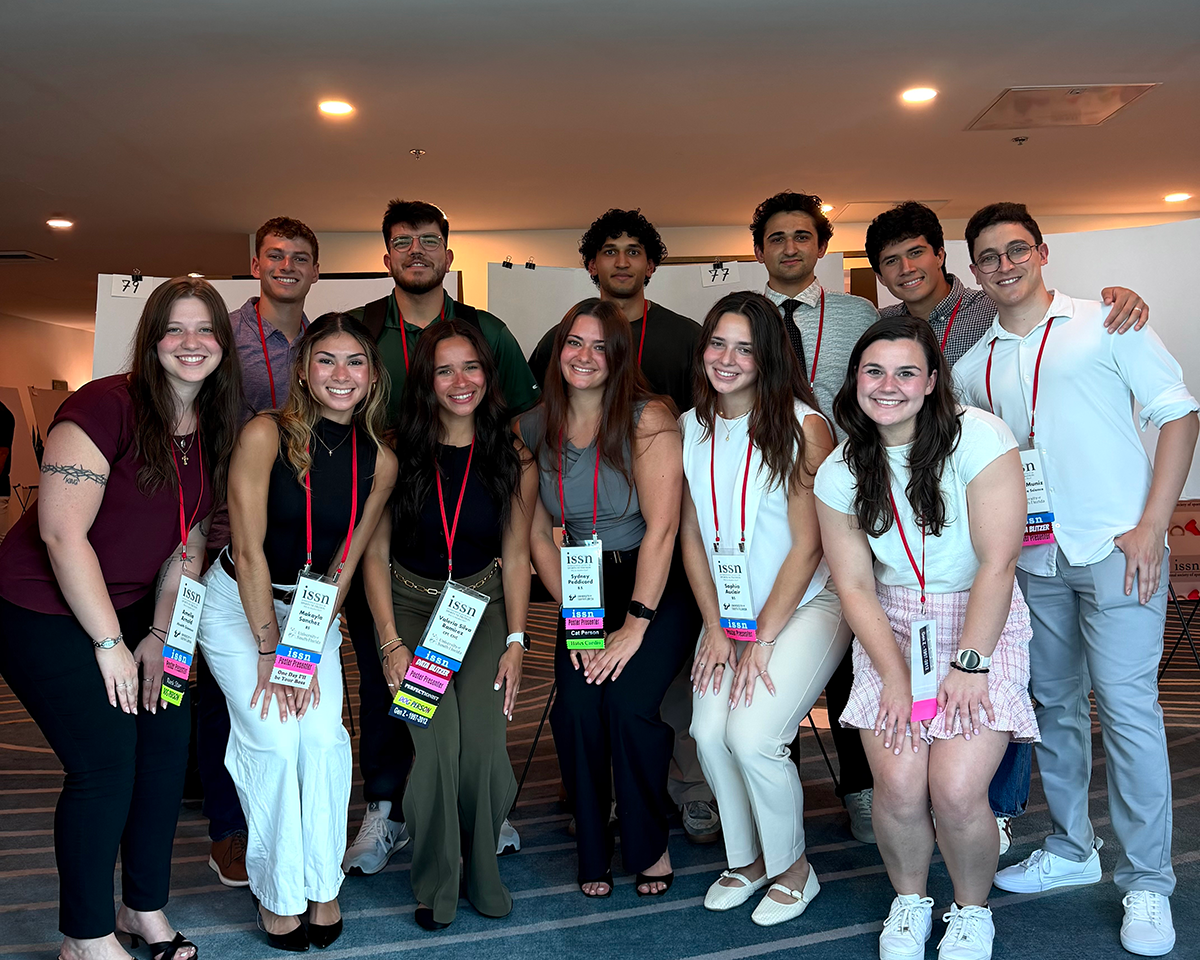
His students also presented at the International Society of Sports Nutrition Annual Conference in Fort Lauderdale in June.
“Women enter the menopausal transition with limited awareness of the physiological
and hormonal changes that occur, and this lack of education remains understudied,
particularly among women who embrace a fitness-oriented lifestyle,” Campbell said.
“My lab’s research is designed to comprehensively document demographic characteristics,
body composition and weight-loss resistance, fitness behaviors, nutritional practices,
and hormone therapy use among resistance-trained women navigating the menopause transition.”