By Anna Mayor, University Communications and Marketing and USF Health
As a sophomore wide receiver who had just joined the USF football team, Jaden Alexis didn’t expect a routine play to turn into a career-defining moment.
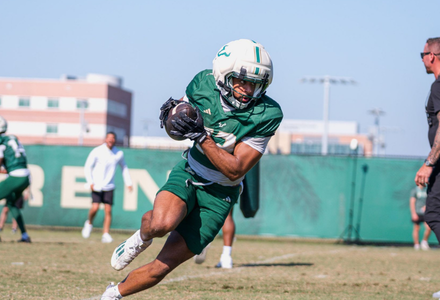
USF Bulls football wide reciever Jaden Alexis [Photo by USF Athletics]
During preseason football camp, Alexis had just sprinted up the sideline after catching a pass when a split-second collision changed everything.
He could see his teammate approaching from the side for the tackle, but his right
foot was already firmly planted into the ground. The force of the hit jerked his knee
inward while his body continued moving forward.
That’s when both he and his teammates heard the loud pop.
"The entire sideline heard it,” Alexis said. "It sounded like an explosion.”
That popping sound was his right anterior cruciate ligament (ACL) ripping apart. The
ACL connects the thigh bone to the shin bone and is one of the most common knee injuries.
While movements that involve sudden jumping or stopping, such as those exerted by
athletes, may increase the risk of experiencing the injury, nearly 75-80 percent of
ACL injuries happen in non-contact situations such as sudden decelerations, improper
landing or awkward pivoting. That’s according to Dr. Nathan Schilaty, associate professor in the USF Health Morsani College of Medicine Department of Neurosurgery, Brain and Spine and USF Department of Medical Engineering.
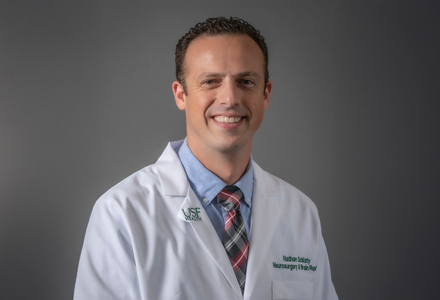
USF Health associate professor Dr. Nathan Schilaty [Photo by USF Health]
When an individual experiences an ACL tear, they often hear a popping sound followed
by swelling around the knee and inability to move it properly. Corrective surgery
can cost between $20,000 and $40,000 and results in about a yearlong recovery period.
After his yearlong recovery, Alexis, who expects to earn his MBA from the Muma College of Business this fall, sustained two additional ACL injuries throughout his football career.
His second ACL tear occurred in his left knee in 2024, with an additional partial
tear in 2025 to the same knee.
"You can go from being this high-level player to having to learn to walk again in two months,” Alexis said. “ACL injuries are very mentally impacting. It’s a lot of having to regain trust in yourself, in your body and in your knee.”
Experiencing a second ACL injury is a common occurrence for those who have already had one, according to Schilaty.
Schilaty and John Templeton, assistant professor in the Bellini College of Artificial Intelligence, Cybersecurity and Computing, hope to one day help athletes avoid ACL injuries through artificial intelligence and wearable technology designed to identify risks before they happen.
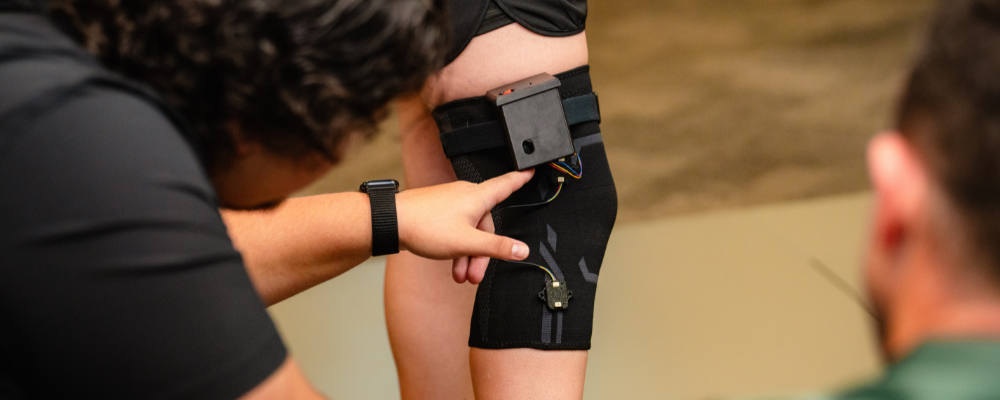
USF researchers are developing an AI-powered wearable that detects risky movement patterns and delivers real-time feedback to reduce ACL injury risk. [Photo by Ryan Rossy, USF Health]
Using a decade of research across human motion analysis, cadaveric testing (using
donated human knees for experiments) and computer modeling, they are developing an
AI-powered wearable that could identify risky movement patterns and provide real-time
feedback to help athletes avoid injury.
The work builds on findings published earlier this year in Scientific Reports, a Nature Portfolio journal, where Schilaty, Templeton and colleagues used machine
learning models to identify biomechanical factors that consistently signaled elevated
ACL injury risk.
“That's the gap that we're trying to close. Allowing someone to be aware when they're doing something poorly that leads to high risk. The point is to get it ahead of time and have that threshold set low enough that as they approach that risky region, they are able to start modifying the behavior.”
Dr. Nathan Schilaty

John Templeton, assistant professor in the Bellini College of Artificial Intelligence, Cybersecurity and Computing [Photo courtesy of John Templeton]
Machine learning models can examine the patterns of biomechanical variables at once, identifying factors that may signal elevated injury risk.
“It's able to identify and pick up patterns that we would not necessarily think of on our own,” Templeton said.
Schilaty and Templeton tested multiple machine learning models and identified a core
group of features that consistently predicted injury across different algorithms.
These features will help determine what sensors are included in future wearable devices.
In their study, models have demonstrated 86 percent accuracy distinguishing pre-rupture
conditions from actual ACL rupture, and 90 percent accuracy in identifying conditions
immediately preceding rupture events.
They envision using this feedback to develop a wearable sleeve or sensor system that helps detect high-risk movement patterns and delivers immediate feedback, such as through haptic vibration alerts, allowing athletes to self-correct without constant supervision from athletic trainers.

The knee sleeve combines AI, motion analysis and biomechanics. [Photo by Ryan Rossy, USF Health]
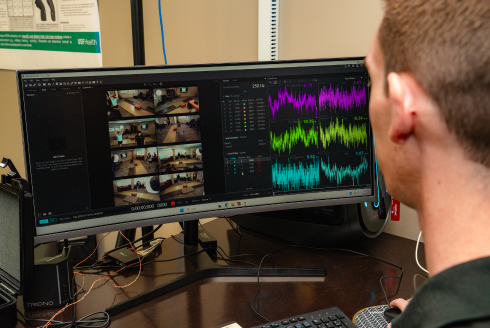
The data helps alert the wearer when engaging in risky movement. [Photo by Ryan Rossy, USF Health]
Their next step is to secure funding to expand testing and advance commercialization. Excite Medical has licensed the technology from USF, potentially accelerating its path to market.
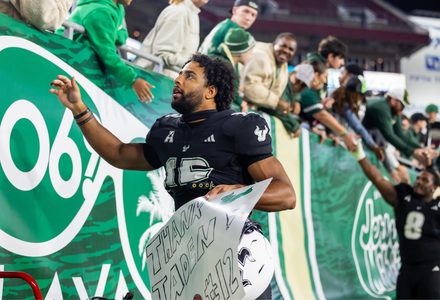
Jaden Alexis greets USF Bulls football fans post-game. [Photo by USF Athletics]
Schilaty emphasizes that the goal is not to predict injuries with absolute certainty, but to identify movement patterns that place athletes at greater risk of an ACL tear, enabling intervention before an injury occurs.
"What we do know is what's risky," Schilaty said. "We are trying to move someone away from that risk as far as possible."
For athletes like Alexis, who’ll be back on the USF football field this fall, the idea of an early warning system is one he wishes had existed sooner.
"If everyone's in tune with what the player is at risk for and not at risk for, I think it would help crack down on that number just a little bit," Alexis said. "It would make all the difference."