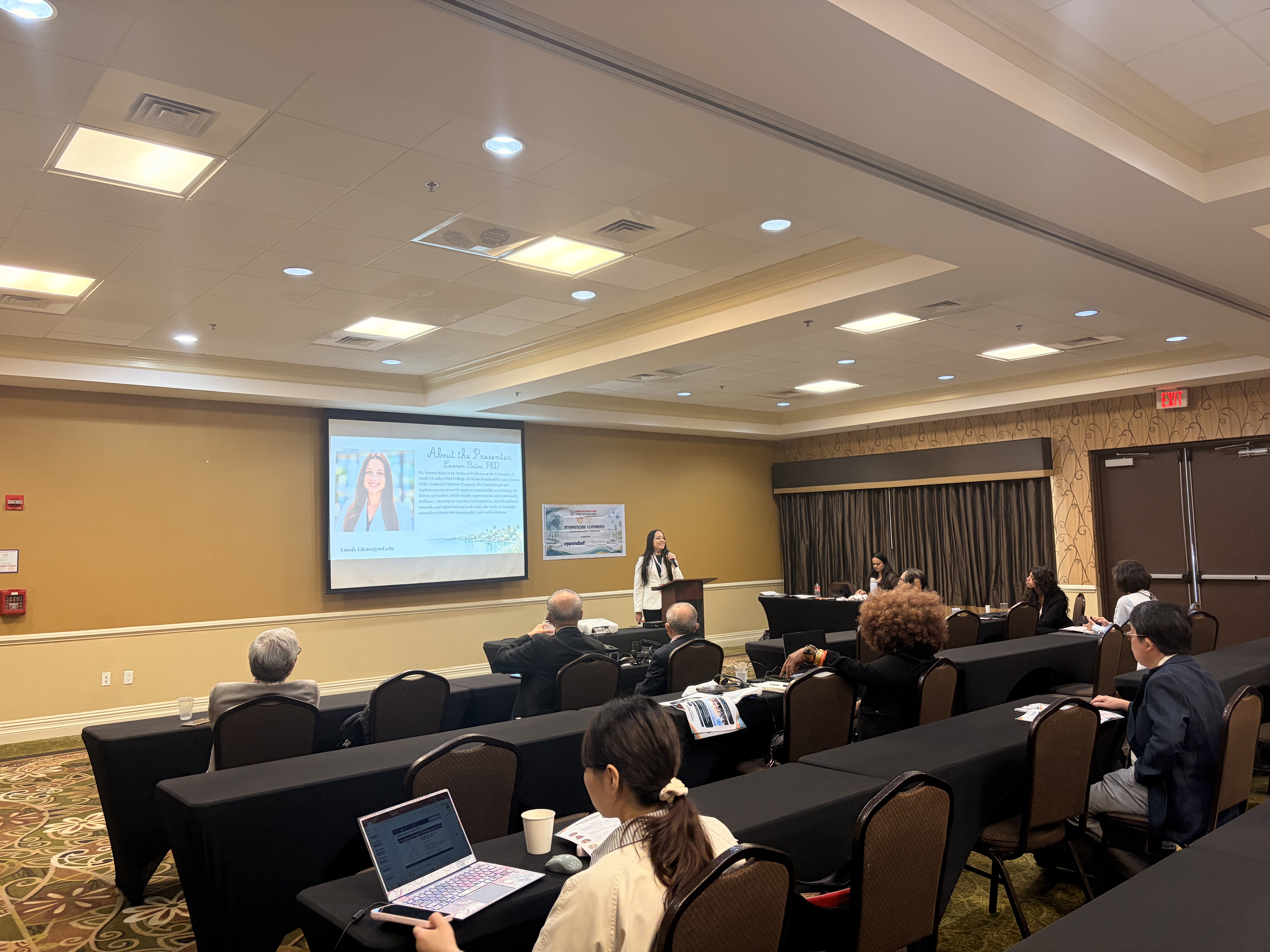
Students in Dr. Lauren Bates’s Sustainability Lab at the University of South Florida’s
Patel College of Global Sustainability, joined researchers, clinicians, students,
and public-health professionals at the Ninth International Symposium on Public Health in Orlando for a full day of presentations, poster discussions, networking, and interdisciplinary
exchange.
Representing a lab of undergraduate, master’s, and professional student researchers,
the Bates Lab contributed work spanning sustainable food systems, environmental access,
water perceptions, nutrition, menstrual health, and the hidden work involved in healthy
eating. The team’s projects illustrated a central message of the conference: public
health is inseparable from the environmental, social, economic, and behavioral conditions
that shape everyday life.
At the closing session, Dr. Bates emphasized how meaningful it was for students to
participate in a multidisciplinary public-health setting and to meet researchers and
community partners whose perspectives could inform future collaborations.
“We’re so excited to represent the University of South Florida’s Patel College of
Global Sustainability at this conference today,” Bates said. “It was so wonderful
to expose my students to the variety and multidisciplinary aspects of public health,
and to network and meet connections and find like-minded researchers and community
activists to inspire their work.”
Student Research: Sustainability in Everyday Public Health
The Bates Lab’s poster presentations demonstrated how sustainability research can
address health concerns that are often treated as separate issues: food access, gendered
labor, environmental inequality, water quality, health behavior, and access to nature.
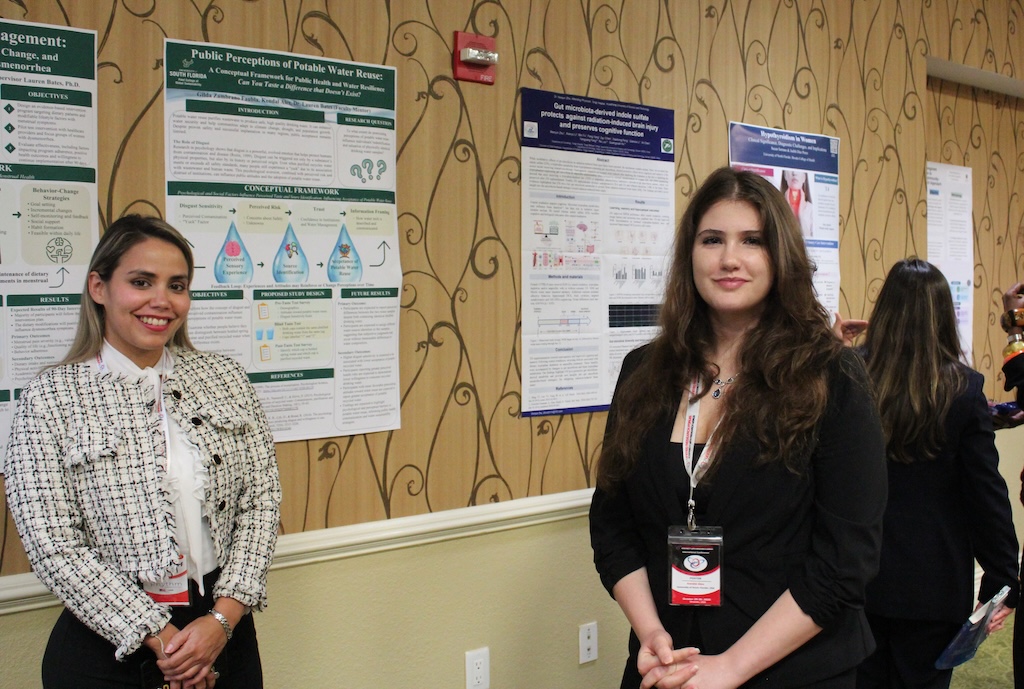
Gilda Zambrano and Kendal Alex: Public Perceptions of Potable Water Reuse
Gilda Zambrano and Kendal Alex presented research centered on water and disgust - an important behavioral and public-health intersection. Their work considers how
perceptions of cleanliness, contamination, disgust, and safety may influence people’s
willingness to engage with water-related practices and interventions. The project
is especially relevant to sustainability and public health because water decisions
are not driven solely by infrastructure or scientific evidence. They are also shaped
by trust, sensory reactions, cultural expectations, and individual perceptions of
risk. Understanding disgust responses can help researchers better communicate about
water reuse, conservation, drinking-water safety, and other environmental-health practices.
Dr. Bates described related ongoing work in the lab examining perceptions of conventional
water and recycled wastewater. The project is in the Institutional Review Board process
and is designed as a blinded comparison: participants receive water samples from the
same distilled-water source but are given different descriptions of the water. The
purpose is to better understand how labeling, perception, and disgust may shape public
acceptance independent of actual water quality.
This work reflects a core sustainability challenge: even when a solution is safe and
technically viable, it may fail if the public does not trust it or feel comfortable
adopting it.
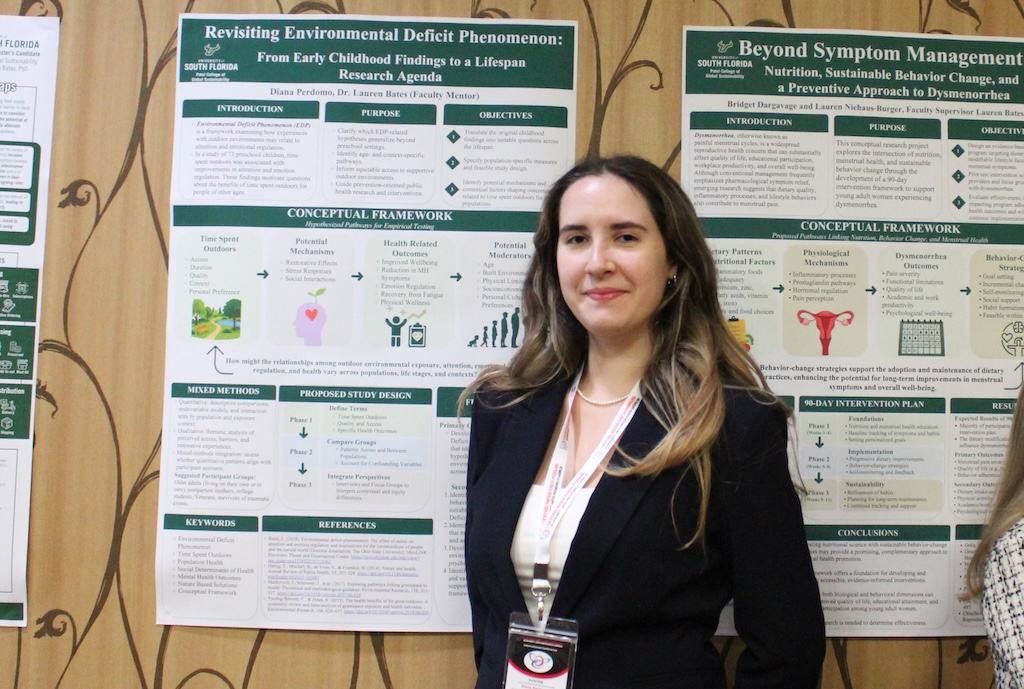
Diana Perdomo: Revisiting Environmental Deficit Phenomenon
Diana Perdomo presented on the environmental deficit phenomenon, a concept describing the consequences of inadequate access to healthy, restorative,
and usable outdoor environments. Her project explores how environmental deficit can
disproportionately affect specific populations, including lower-income communities,
older adults, veterans, children, and people living in dense housing or communities
without safe and accessible green space. Rather than treating time outdoors as a simple
individual choice, the research highlights the structural barriers that can limit
access to nature.
For many people, especially those living in apartments, working long hours, managing
caregiving responsibilities, lacking transportation, or facing mobility and safety
barriers, “just go outside” is not an equitable public-health recommendation. Environmental
deficit can reflect unequal access to parks, yards, shade, walkable neighborhoods,
green infrastructure, and opportunities for recreation.
The presentation also connected environmental access to children’s development and
contemporary concerns about screen time. Perdomo discussed how children may have fewer
opportunities for unstructured outdoor play, exploration, boredom, and interaction
with natural environments. These experiences can be meaningful for attention, creativity,
physical activity, and well-being.
Perdomo’s work points toward the need for better urban planning, environmental policy,
institutional practices, and community-level interventions that ensure access to quality
outdoor environments is not limited by income, age, disability, neighborhood, or housing
conditions.
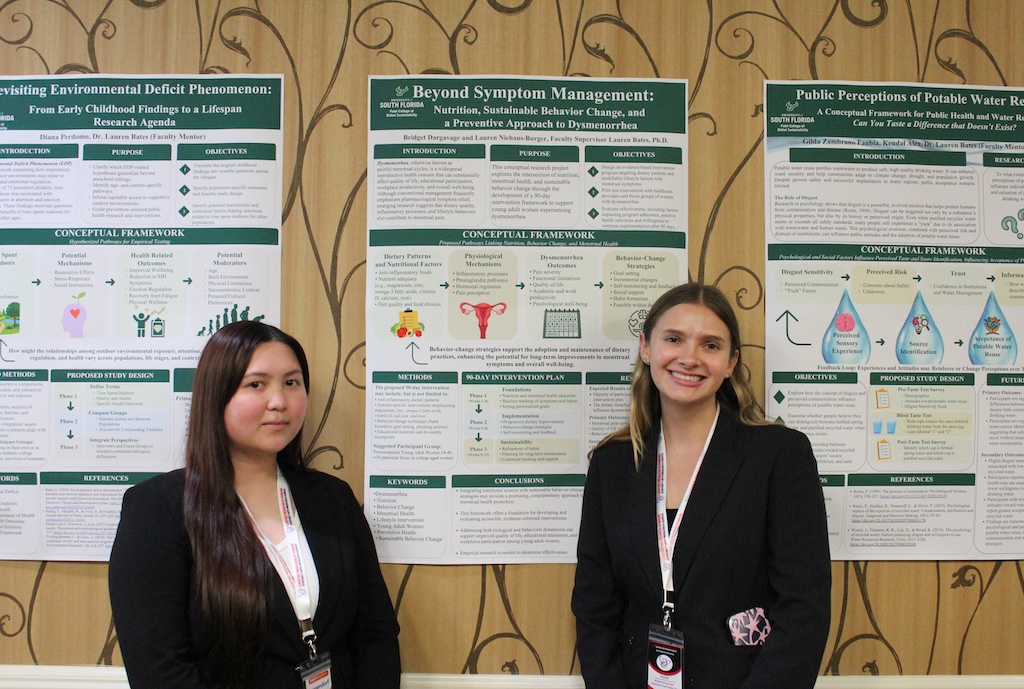
Bridget Dargavage and Lauren Neihaus-Burger: Nutrition, Sustainable Behavior Change, and a Preventive
Approach to Dysmenorrhea
Bridget and Lauren Neihaus-Burger presented a project linking nutrition, sustainable behavior change, and a preventive approach to dysmenorrhea.
The presentation examined how dietary choices and health behaviors may be incorporated
into preventive strategies for menstrual health. Rather than framing dysmenorrhea
only as a condition to be managed after symptoms appear, the project considers opportunities
to support people through sustainable, practical, and health-promoting behavior changes.
Their work recognizes that nutrition guidance must be realistic, accessible, and sensitive
to the daily conditions that shape food choices. Healthy behavior change cannot rely
only on knowledge or willpower; it must account for affordability, time, food environments,
cultural norms, stress, and access to supportive resources.
This perspective closely aligned with the conference’s broader discussions about food
systems and public health. Speakers repeatedly noted that people’s diets are influenced
by food prices, marketing, availability, convenience, and the structural conditions
that determine whether healthier choices are truly accessible. By connecting nutrition
and menstrual health, Bridget and Lauren’s project expanded the conversation beyond
treatment alone and toward prevention, education, and sustainable long-term well-being.
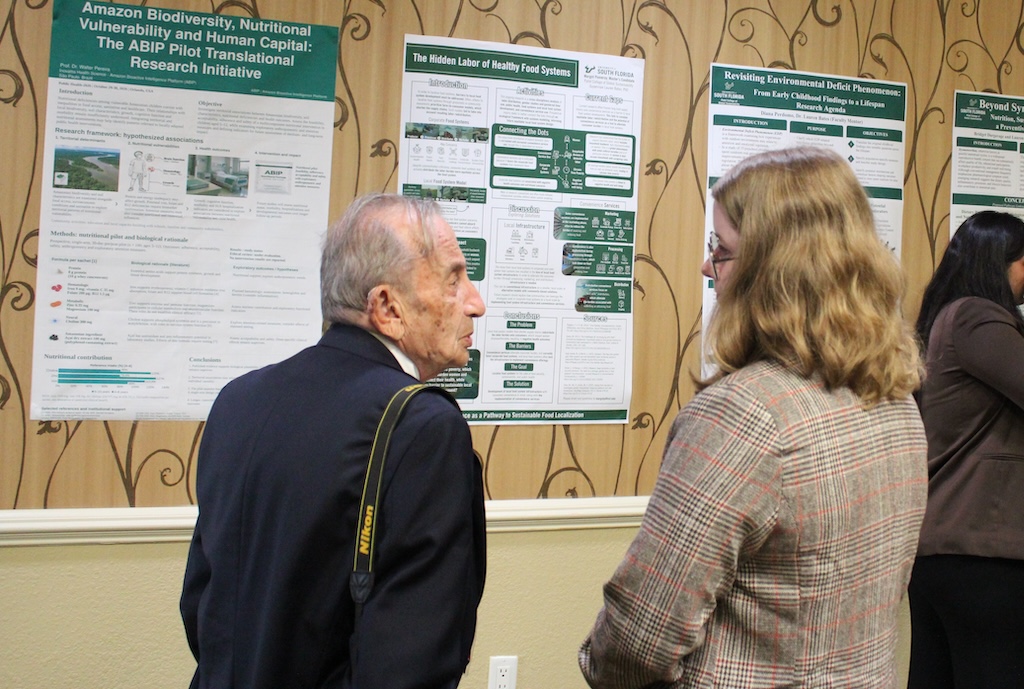
Margot Pomeroy: The Hidden Labor of Healthy Foods
Margot Pomeroy presented on the hidden labor of healthy foods, addressing the often-overlooked work required to make healthy eating possible. Healthy
food is frequently discussed as though it is simply a matter of choosing the “right”
option. However, preparing nutritious meals requires substantial time and labor: planning
meals, budgeting, grocery shopping, traveling to stores, comparing labels, washing
produce, cutting ingredients, cooking, storing leftovers, cleaning dishes, and managing
food waste.
This labor often falls disproportionately on women and caregivers, creating an additional
public-health and equity concern. A recommendation to “eat healthier” can unintentionally
ignore the unequal burden of time, transportation, money, kitchen access, food knowledge,
and household responsibility.
Margot’s presentation invited audiences to think more critically about nutrition messaging.
Sustainable health behavior requires more than telling people what they should eat
- it requires acknowledging what it takes to make those choices possible. Policies,
programs, workplaces, schools, health systems, and food environments can either ease
or intensify the work of healthy eating.
The project reinforced a central theme of the Bates Sustainabilty Lab’s work: sustainability
solutions must be designed around people’s real lives.
Dr. Lauren Bates: Gut Health, Agriculture, and Public Health
Dr. Bates delivered the lab’s larger oral presentation, connecting gut health, agriculture, soil health, water, food systems, and public health. The talk addressed the disruption of the gut microbiome, often referred to as dysbiosis, and the ways microbiome disturbance has been associated in emerging literature with
a range of health outcomes. The presentation also explored how regenerative agriculture
may contribute to healthier environmental conditions. Conventional practices can deplete
soil nutrients and soil microbial diversity, while regenerative approaches aim to
restore soil health through strategies such as crop rotation, cover crops, and practices
that improve resilience.
Bates connected these issues through the food-water-energy nexus, placing health at the center. Her presentation explained why sustainability is a
public-health issue rather than simply an environmental concern. Food production affects
nutrition and exposure pathways; water quality affects disease risk; energy systems
affect climate and community conditions; and all of these systems influence health.
The talk also addressed coastal water salinity, sea-level rise, stormwater runoff,
waterborne disease, vector-borne disease, and the public-health implications of changing
environmental conditions in Florida. Changes in salinity and water access can affect
agriculture, drinking water, land use, and health risks - including concerns relevant
to kidney health and maternal health.
Importantly, Bates emphasized that farmers’ adoption of regenerative practices cannot
be explained by education alone. Financial barriers, debt, razor-thin operating margins,
insurance requirements, and the risks of changing production systems can make transition
difficult even when farmers recognize the potential benefits.
The solution, she argued, must include implementation support and financial structures
that make sustainable practices feasible -not simply asking farmers to “do the right
thing” without addressing the costs and risks they bear.
Learning Across Disciplines
The symposium offered students an opportunity to engage with research beyond the Sustainability
Lab’s own projects. Sessions addressed emergency-department sepsis diagnosis, multi-marker
approaches to infectious disease, machine learning in clinical decision-making, placental
biology and medication safety during pregnancy, cancer imaging, whole-body diffusion
MRI, cervical-cancer biomarkers, health-care worker stress and burnout, transplant-acquired
allergies, rapid infectious-disease testing, and disparities in breast-cancer care.
The group also attended a global-health panel that emphasized the One Health framework: the understanding that human health is intertwined with animal, plant,
and environmental health. Panelists discussed surveillance, cross-sector partnerships,
workforce development, food affordability, nutrition education, marketing, and policy.
For Bate's Sustainability Lab students, the conference created space to see their
sustainability work in direct conversation with medicine, public health, technology,
global health, and health equity. As the lab continues its work on sustainability,
health behavior, environmental equity, food systems, water perceptions, and community
well-being, the symposium reinforced a clear takeaway: public health is not just about treating illness - it is about building the social,
environmental, and economic conditions that allow people to thrive.