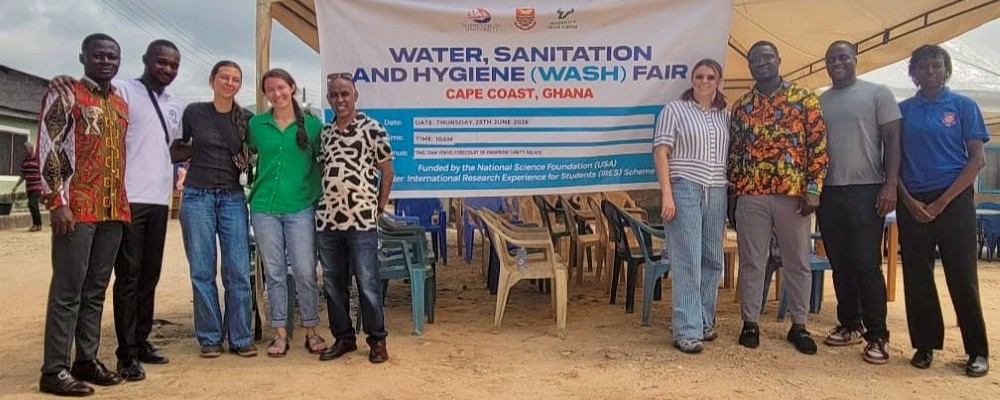
Graduate student gains hands-on research experience addressing water quality, sanitation, and sea level rise in coastal communities
For Cassidy Ezzi, studying water sustainability at the University of South Florida’s Patel College of Global Sustainability (PCGS) is closely connected to the work she hopes to pursue throughout her career. This summer, that connection took her thousands of miles from the classroom to Cape Coast, Ghana, where she spent five weeks conducting field research on water quality, sanitation, and the impacts of sealevel rise on coastal communities.
Cassidy is a graduate student in the Master of Science in Global Sustainability program with a concentration in Water Sustainability. She also works as a senior analyst for a consulting firm, where her work includes water and wastewater projects. When she learned about the opportunity to participate in the Ghana Project, she saw a chance to bring together her academic studies, professional experience, and long-standing interest in fieldwork.
“When I saw the opportunity, I realized it was an ideal way to bring together my academic work and professional goals while gaining the kind of on the ground field experience that will shape my career”
Cassidy Ezzi
The timing was particularly meaningful. Cassidy joined the final year of the three-year project, an NSF-funded international research initiative focused on water, sanitation and education in Cape Coast, Ghana. The multidisciplinary project brings together students and faculty from USF, Shippensburg University and the University of Cape Coast (UCC) to investigate sustainability challenges affecting coastal communities.
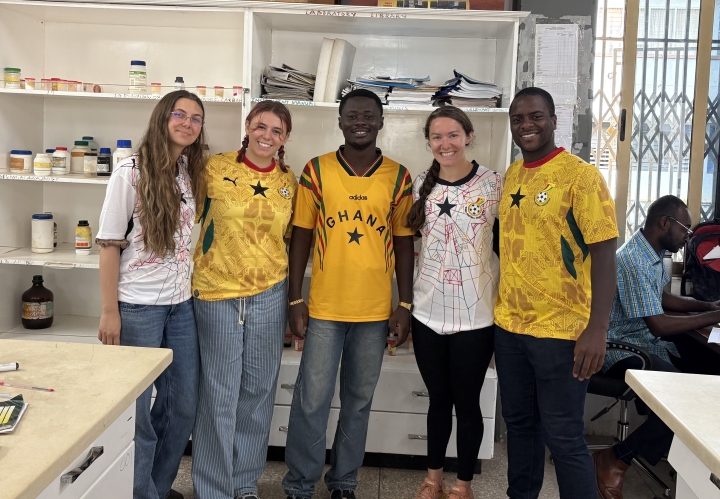
Notably, working alongside UCC students became one of the most meaningful parts of the experience. The cultural and professional exchange, including learning how the locals approach water challenges, sharing methods, and collaborating in the field, deepened her understanding of sustainability in a global context. Cassidy formed personal and professional relationships with the UCC students that she will carry with her for years to come.
The project is co-led by Dr. Kebreab Ghebremichael, Associate Dean for Academic Affairs at the Patel College of Global Sustainability, Professor of Instruction and director of the Water Sustainability concentration. His expertise in water and wastewater treatment has been instrumental in designing the project’s research framework and providing students with opportunities to apply their academic knowledge to real-world water sustainability challenges.
Building a Career at the Intersection of Water and Resilience
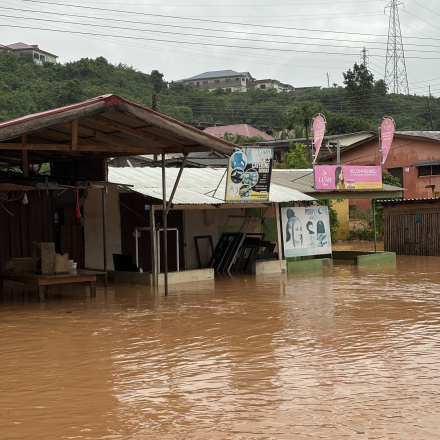
Cassidy’s path to sustainability began with emergency management. She earned a bachelor’s degree and another master’s degree in emergency management and previously worked in disaster response and recovery, including responding to the aftermath of hurricanes, tornadoes and floods.
That experience helped shape her interest in mitigation and resilience, finding ways to reduce risks and strengthen communities before disasters and environmental challenges escalate.
International fieldwork experience has also been a goal for several years. Cassidy had planned to participate in an opportunity in Guatemala in 2020, but the COVID-19 pandemic disrupted those plans. When the Ghana Project opportunity became available through PCGS, she knew she wanted to pursue it.
Taking Water Research into the Field
In Ghana, Cassidy and the research team traveled through local communities collecting water samples from previously identified wells. They conducted field measurements on the water, including temperature and specific conductivity, before bringing samples back to the University’s laboratory for further analysis.
There, the team tested samples for substances including phosphate, nitrate, and sulfate, and performed microbial testing on water samples from selected wells. Because the project was in its third year, researchers were able to use findings from previous years to help determine where additional microbial testing was needed.
Their research extended beyond the wells themselves.
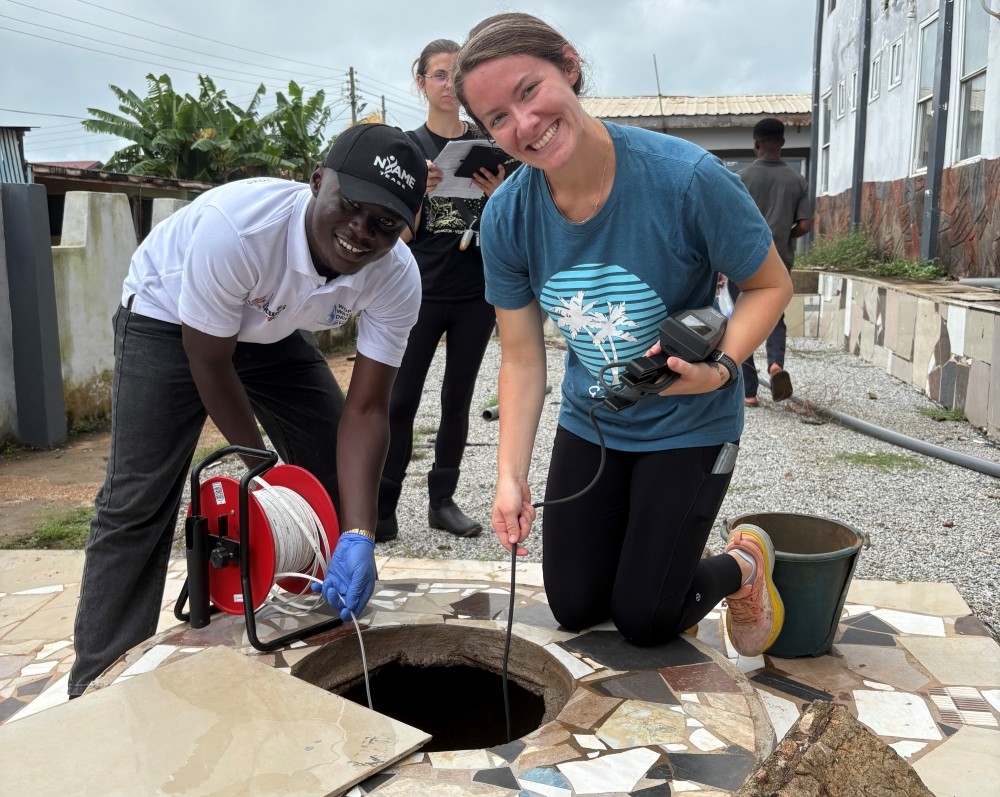
The team examined sanitation conditions, including the locations of septic tanks in relation to wells and whether potential leakage could contribute to groundwater contamination.
The team also worked with local high school students at Ghana National College, introducing them to foundational waterquality concepts and field-testing techniques, and involving them in portions of the sampling process. For Cassidy, this outreach underscored the importance of building community capacity and inspiring the next generation of scientists.
For Cassidy, the experience transformed concepts she had studied at PCGS into something tangible.
“We talk a lot about sealevel rise and climate change,” she said. “But seeing firsthand how sealevel rise directly affects drinking water in a coastal community was incredibly impactful.”
Turning Research into Recommendations
Although the five weeks of fieldwork in Ghana have concluded, Cassidy’s work on the project continues.
As part of the project’s final phase, she is working with engineering student Lily Gorham on a report that will develop policy recommendations for local communities, with the goal of identifying changes that could improve water and sanitation practices.
That next step reflects an important part of sustainability research: moving beyond identifying a challenge to considering how research can inform practical solutions.
For Cassidy, the project also reinforced the value of understanding environmental challenges within the communities experiencing them. Collecting samples and analyzing data were important components of the experience, but so was learning how residents live with and adapt to the water and sanitation challenges the researchers were studying.
A Global Perspective on Sustainability
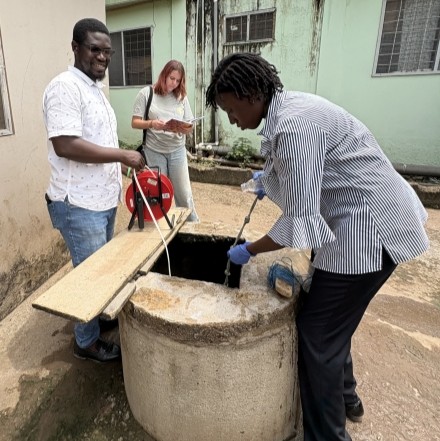
Living and working in Ghana gave Cassidy something that cannot be fully replicated in a classroom or laboratory: the opportunity to experience sustainability challenges from a local perspective.
“Getting in the village and just immersing myself in the culture was so great,” she said. “Being able to see these challenges from a local’s perspective was really helpful for me.”
The experience also highlighted the role universities can play in connecting graduate education with meaningful international research.
For Cassidy, having access to this opportunity through the Patel College of Global Sustainability has been one of the most valuable aspects of her graduate education.
“Having the opportunity and really immersing ourselves in their culture was a really big opportunity,” she said. “The fact that we’re able to do that through the college is huge.”
As she continues her studies in Water Sustainability and builds a career focused on water and wastewater resilience, Cassidy returns from Ghana with more than research experience. She has seen firsthand how climate change, infrastructure, sanitation, and water security intersect, and how solutions require both technical knowledge and an understanding of the communities they are intended to serve.
Click here to see what happened in 2025 with the Ghana Project.