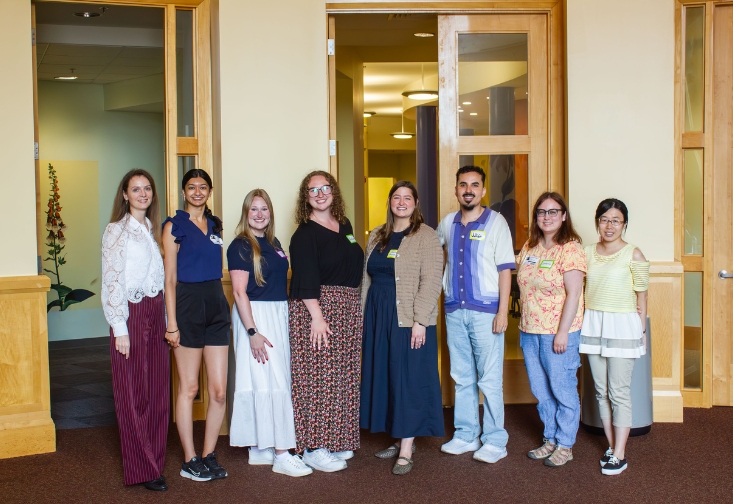
Natalia Babenko, a doctoral student in the School of Aging Studies, has been selected for the inaugural Entrepreneurship and Science Communication for Aging and Aging-Related Research (ESCAAR) Fellowship at the University of Maryland School of Graduate Studies.
ESCAAR is a competitive, 10-month training program designed for early-career researchers whose work focuses on aging and age-related issues. Supported by the National Institute on Aging (NIA) through its Research and Entrepreneurial Development Immersion (REDI) program, the fellowship helps researchers move their work beyond traditional academic settings by strengthening skills in science communication, entrepreneurship, innovation and research translation.
“I am excited to be part of the first ESCAAR cohort. This fellowship provides an opportunity to think beyond traditional academic publications and explore how my dissertation research can be translated into tangible outcomes that can reach broader populations of caregivers and cancer survivors and inform policy," Babenko said.
This inaugural ESCAAR cohort includes four doctoral students and four postdoctoral scholars from institutions and research organizations across the United States. The cohort launched in July 2026 and will continue through April 2027.
The fellowship began with an intensive two-and-a-half-day Summer Institute at the University of Maryland, Baltimore, where fellows participated in collaborative workshops; discussions with experts in aging, innovation and science communication; networking activities; and mentorship. Fellows also began developing strategies for communicating their research to audiences and stakeholders beyond academia.
Babenko’s doctoral dissertation research, conducted under the mentorship of William E. Haley, PhD, distiguished university professor in the School of Aging Studies, and Judith Rijnhart, PhD, MSc, assistant professor in the Department of Epidemiology, focuses on mental health and resilience among older cancer survivors who also serve as family caregivers, with particular attention to the role of social connection and engagement.
"My work focuses on a unique and often overlooked population: cancer survivors who are also caregivers, and the mental health and psychological challenges they face while navigating both roles. Through ESCAAR, I want to learn how to translate these findings into scalable, population-based policies and interventions that actually reach cancer survivors and caregivers,” she said.
Following the Summer Institute, Babenko will continue working on an individual ESCAAR project while participating in monthly online workshops, mentoring and collaborative learning. Throughout the fellowship, she will develop a portfolio focused on communicating and translating her research for audiences beyond academia. The program will culminate in an April 2027 showcase at the University of Maryland, Baltimore, where fellows will present their projects to researchers, industry representatives, and community stakeholders and receive feedback on potential dissemination and entrepreneurial pathways.