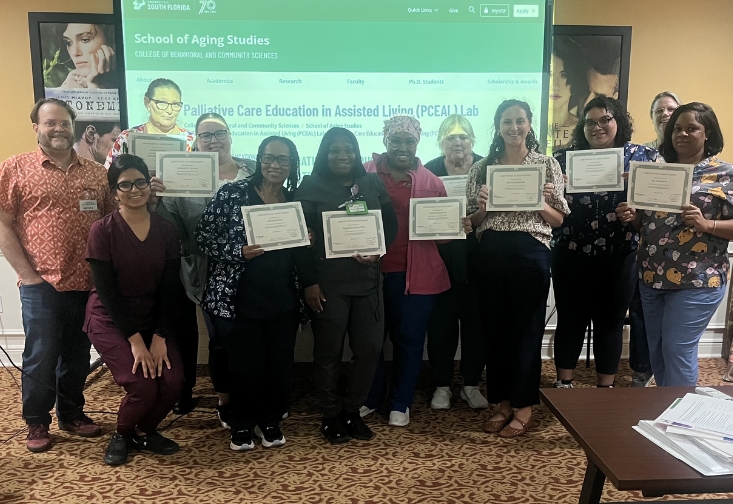
Researchers from the Palliative Care Education in Assisted Living (PCEAL) Lab recently partnered with Empath Health to provide specialized palliative care training for staff at Sun Towers retirement and assisted living community in Sun City Center.
The training, held in April, is part of an ongoing National Institute on Aging-funded research study led by Principal Investigator Debra Dobbs, PhD, professor and director of the School of Aging Studies, focused on improving dementia care and end-of-life outcomes for residents of assisted living communities.
The Preparing Assisted Living Staff to Provide Palliative Care to Residents With Dementia: Palliative Care Education in Assisted Living for Dementia Care Providers (PCEAL-DCP) study examines how palliative care education can improve outcomes for residents with dementia, their families and assisted living staff. The intervention consists of four weekly 90-minute training sessions for licensed nurses, administrators and dementia care coordinators, equipping participants with the knowledge and skills needed to provide high-quality, person-centered palliative care.
Housed within the College of Behavioral and Community Sciences, the PCEAL Lab is dedicated to improving the quality of end-of-life care for individuals living in assisted living communities. The lab develops and implements evidence-based interventions, educates providers caring for residents with life-limiting illnesses and dementia, and serves as a resource for assisted living communities seeking tools and educational materials to enhance palliative and end-of-life care.