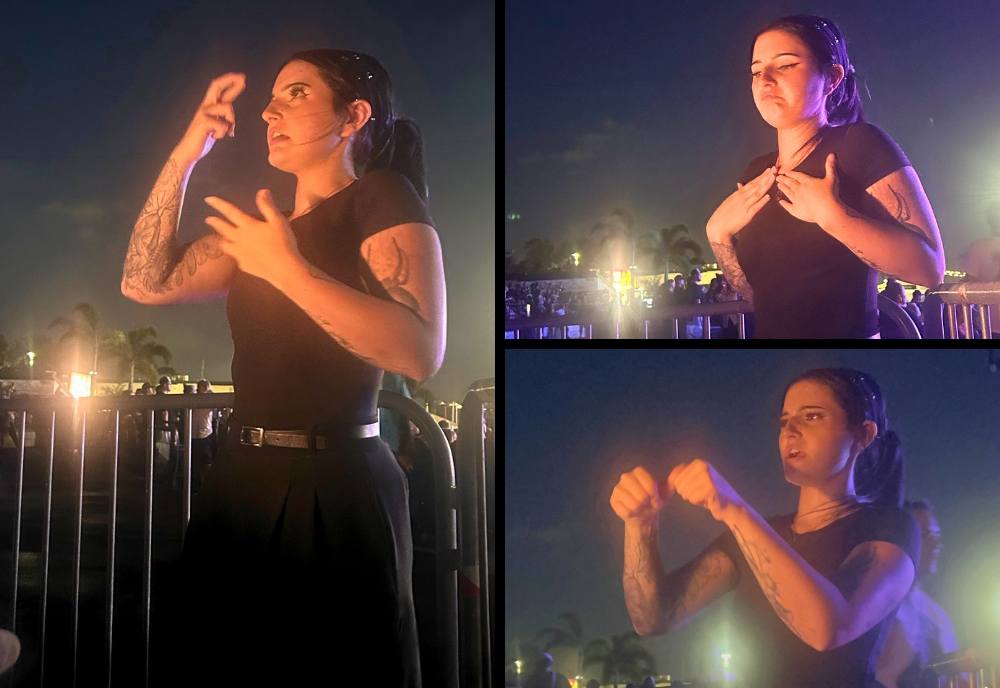
Interpreting a concert brought Carly Missildine back to the moment that first sparked her interest in American Sign Language interpreting.
An avid concertgoer, Missildine first saw an ASL interpreter at a concert in 2019 during an AJR performance at USF's Yuengling Center.
"It was my first time ever seeing an ASL interpreter, and I was so fascinated," Missildine said. "I knew that's something I would want to do one day. I'm so grateful that day came."
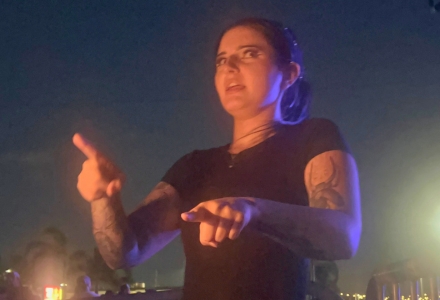
From concertgoer to concert interpreter
Missildine, a senior completing her final semester in American Sign Language (ASL) and internship, recently had the opportunity to interpret a concert through one of two new contracts secured by Hands On USF (HOUSF). The partnerships with MIDFLORIDA Credit Union Amphitheatre and ZooTampa are expanding interpreting services for the Tampa Bay Deaf community while creating new experiential learning opportunities for student interns.
Both HOUSF contracts began in May 2026 and are ongoing. Through the partnerships, HOUSF provides ASL interpreting services while giving student interns opportunities to interpret alongside experienced mentors. Interns receive hours toward their internship or practicum requirements for participating.
At MIDFLORIDA Credit Union Amphitheatre, interpreting services are provided for shows and performances when requested by patrons. The setting gives students exposure to concert interpreting, an experience they may not encounter through a traditional internship or practicum.
Despite being familiar with the concert environment, stepping into it as an interpreter initially brought some nerves for Missildine.
"I worried about if I'd remember the interpretations I made, would I do a good job for my client, or would I freeze up completely," she said. "This was such a familiar environment for me, but the idea of interpreting here felt so intimidating. However, in the moment I never felt more comfortable interpreting in my life."
The assignment also challenged Missildine to think differently about the role of an interpreter. Rather than interpreting lyrics word for word, she said interpreters work to communicate the emotion and meaning of the music while engaging with the Deaf person experiencing the performance.
Music is something so personal. It's a cultural experience no matter what genre it is. It's bridging a gap between the cultures of hearing people and Deaf people while creating equal access.
Carly Missildine
Working in a large public venue also introduced Missildine to aspects of professional interpreting that can be difficult to replicate in a classroom. She learned how interpreters may need to interact with people unfamiliar with their role and how to remain aware of cameras and social media while working.
Her mentors also reinforced an important lesson: The Deaf person and their experience should remain at the center of the work.
"This isn't about us, it's about them, it's for them," Missildine said. "I'm not interested in interpreting concerts for clout or going viral. I'm doing it for them and to share our love of music together."
Expanding accessibility beyond concerts
HOUSF's separate partnership with ZooTampa creates additional opportunities to provide ASL interpreting for tours, animal encounters, educational programs, safari expeditions and other experiences. Services are provided based on patron requests.
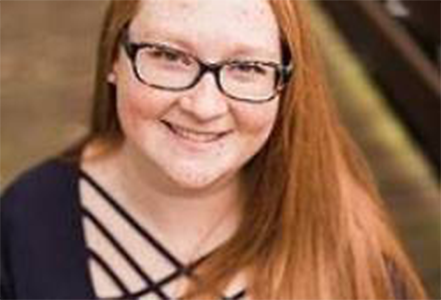
Haley Eyster, director of Hands On USF
Accessibility efforts at the zoo extend beyond individual interpreting requests. Haley Eyster, BA, NIC, director of HOUSF, said ZooTampa has been working with her and a Deaf colleague to identify ways to make the site more accessible. Their feedback includes areas such as broadcast announcements, encounters and the zoo's app.
The partnership developed after ZooTampa contacted HOUSF about providing off-campus interpreting services. The timing was particularly meaningful because Eyster and M. Adelaida Restrepo, PhD, CCC-SLP, professor and chair of the Department of Communication Sciences and Disorders, had discussed reaching out to the zoo just one month earlier as a potential way to create opportunities for student interns and support the greater Tampa Bay Deaf community.
MIDFLORIDA Credit Union Amphitheatre also approached HOUSF with an interest in supporting student interns while providing interpreting services to the community.
Turning classroom skills into real-world experience
As requests come in, HOUSF hopes to make the opportunities available across its student intern cohort, allowing several students to rotate through the experiences when their schedules permit.
Paid professional interpreters serve as mentors during each assignment, working alongside interns to provide supervision and support. Students receive feedback following the experience, giving them an opportunity to learn directly from working professionals.
"They do this to give back to both the Deaf Community and Interpreting Community," Eyster said. "I cannot express how much that means and how honored I feel to have such a great team of interpreters that is willing to do this."
Experiential learning is at the heart of HOUSF's approach. The in-house internship was established to give students real-world opportunities without requiring them to independently seek external placements, and the two new contracts broaden the types of settings students can experience before graduation.
"Classes can only give you so much, but there is value in experiential learning," Eyster said. "Adding these two contracts will further that experience as these types of interpreting are not often offered to interns. This will allow the students to grow and hone skills that they can use in a variety of settings upon graduating."
Missildine's concert assignment offered a glimpse of where those experiences could lead after graduation.
"What I experienced that night with my mentors and client was so unique, and I look back on it with such fondness," she said. "I would gladly do it again, a thousand times over."