Faculty Affairs
New Faculty
Fall 2026
Electrical and Computer Engineering

Guarav Narang
Dr. Narang worked as a Postdoctoral researcher at Arizona State University (ASU) during 2025-2026. He received his PhD in Computer Engineering from Washington State University (WSU) in 2025, advised by Prof Partha Pande and Prof Jana Doppa. Prior to his PhD, Dr. Narang gained six years of industry experience. He worked as a Design Engineer II at Synopsys (2018–2021), and as a Senior Design Engineer at STMicroelectronics (2015–2018). His research interests are hardware design for AI/ML, neuromorphic computing, and advanced packaging.
Industrial and Management Systems Engineering

Vittorio Giammarino
Dr. Vittorio Giammarino joins the University of South Florida as an Assistant Professor in the Department of Industrial and Management Systems Engineering. Prior to joining USF, he was a Postdoctoral Research Associate in the Department of Computer Science at Purdue University. He received his Ph.D. in Systems Engineering from Boston University, his M.Sc. in Systems and Control from TU Delft, and his B.Sc. in Automation Engineering from the University of Bologna and Tongji University.
Dr. Giammarino’s research focuses on reinforcement learning and policy learning for sequential decision-making, with applications to robotics and autonomous systems. His work develops learning methods that enable intelligent systems to make decisions efficiently, safely, and reliably by incorporating physical structure, control-theoretic principles, and domain knowledge when available.
His work has been published in leading venues across machine learning, robotics, and control, including NeurIPS, ICLR, IEEE International Conference on Robotics and Automation (ICRA), IEEE Conference on Decision and Control (CDC), Transactions on Machine Learning Research (TMLR), and IEEE Transactions on Intelligent Transportation Systems. He is an Associate Editor for the IEEE International Conference on Robotics and Automation (ICRA).
Mechanical and Aerospace Engineering
Zachary Ayers
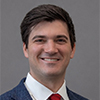
Dr. Zachary M. Ayers is an assistant professor in the Department of Mechanical and Aerospace Engineering at the University of South Florida, where he leads the IMPACT Lab research group. His work focuses on advanced combustion technologies for high-speed propulsion, with expertise in laser diagnostics, pressure-gain combustion, and rotating detonation engines. He uses cycle and trajectory modeling to identify critical operating conditions and applies simulations and experiments to understand and manipulate the combustion processes that affect performance. He leads USF’s effort on a NASA University Leadership Initiative aimed at integrating rotating detonation engine technology into a combined-cycle engine for supersonic commercial flight.
Prior to joining USF, he served as a Principal Research Engineer at the RTX Technology Research Center, working alongside Pratt & Whitney and Raytheon teams to develop propulsion technologies for supersonic and hypersonic flight. Dr. Ayers earned his M.S. and Ph.D. in Mechanical Engineering from Purdue University (2023) as a NASA Space Technology Graduate Research fellow and received a B.S. in Mechanical Engineering from the University of Alabama (2017). He has authored twelve journal and conference papers, is credited with 11 RTX trade secrets, serves on the AIAA Pressure-Gain Combustion Technical Committee, and reviews manuscripts for AIAA conferences and journals.

Mohammed Hossein Doranehgard
Before joining the Department of Mechanical & Aerospace Engineering at USF as Assistant Research Professor, Dr. Doranehgard was a Postdoctoral Researcher at USF and at a joint program between Johns Hopkins University and Morgan State University, and prior to that a Visiting Scholar at Texas A&M University. He earned his Ph.D. in Mechanical Engineering from the Hong Kong University of Science and Technology, one M.S. in Petroleum Engineering from the University of Alberta, and one M.S. in Mechanical Engineering from Iran University of Science and Technology, along with a B.S. in Mechanical Engineering from Shahid Chamran University.
Dr. Doranehgard is recognized among the Top 2% of Scientists in the World according to the Elsevier, Stanford University list, and has authored more than 90 peer reviewed journal papers with over 5,700 citations. His research spans computational fluid dynamics, nonlinear dynamics, thermoacoustic instability, thermofluids and AI/ML, energy conversion and storage, and transport in porous media. This breadth of expertise helps him to teach across the thermal-science curriculum, collaborate widely, and pursue diverse funding opportunities.
He has also contributed extensively to the scholarly community as Guest Editor for several prestigious journals, including Physics of Fluids, Energy, the International Journal of Thermofluids, Engineering Analysis with Boundary Elements, RSC Advances, the International Journal of Hydrogen Energy, Sustainable Energy Technologies and Assessments, the Journal of Energy Resources Technology, the Journal of Thermal Analysis and Calorimetry, and two special issues of the Journal of the Taiwan Institute of Chemical Engineers.
Dr. Doranehgard is passionate about mentoring the next generation of engineers and researchers, and is excited to continue building innovative, interdisciplinary research programs at USF.

Joe Register
Joe Register comes to the Department of Mechanical and Aerospace Engineering after two decades of building things that fly, from satellites in orbit to unmanned aircraft in the field. He began his career at Lockheed Martin working on satellite systems, an experience in spacecraft engineering and mission-driven design that has shaped how he approaches every program since. From there he moved to Draper Laboratory as a Technical Director, leading DARPA programs and rising to Senior Technical Staff, and then spent three years as a subject matter expert to U.S. Special Operations Command, where the work ranged from powered exoskeleton systems to advanced holographic waveguide displays. He went on to co-found Tribe Aerospace, growing it to roughly 200 people before its acquisition by AEVEX Aerospace in 2022, and stayed on as Chief Engineer for UAS and later as Vice President of the company's UAS business unit. Along the way, he picked up more than a dozen patents in neural interfaces, holography, and optical systems.
Joe is a Bull three times over, with his B.S., M.S., and Ph.D. in Electrical Engineering all from USF, where he was an NSF Graduate Research Fellow. He is glad to be back on campus, now on the other side of the classroom. He is a FAA Part 107 certificated remote pilot and still spends his free time in CAD, at the soldering bench, and out on the flight line — he would rather build the thing than read about it. Outside of engineering, he enjoys time with his wife and family. What he is most looking forward to at USF is sending students into their first engineering jobs with real design experience already behind them.
Medical Engineering

Alya Limayem
Dr. Alya Limayem is a Professor of Medical Engineering at the University of South Florida (USF), across the College of Engineering & USF Health Morsani College of Medicine. With more than 20 years of interdisciplinary research experience, her work bridges microbiology and medical engineering, encompassing automated microbial detection and microbiome surveillance, antimicrobial resistance, as well as the development of nanoengineered bioactive therapeutics with translational potential. A Senior Member of the National Academy of Inventors, Dr. Limayem is an inventor on three antimicrobial and nanotechnology innovations, including the U.S. patent “Chitosan–Zinc Oxide Nanoparticle Formulation for Treating Drug-Resistant Bacteria.” Her scholarly contributions include a highly cited publication in Progress in Energy and Combustion Science (PECS) (Impact Factor ~32). Recognized as a 2024 ASEMFL Rising Star and recipient of the USF Best Researcher Award in 2020, she is committed to fostering a culture of invention, encouraging the next generation of innovators, and translating interdisciplinary research into technologies that advance public health, biomedical innovation, and economic growth.