By Joey Garcia, University Communications and Marketing
Spacesuits protect astronauts from the harsh conditions of space, but their bulky design can restrict movement and increase the risk of cuts and abrasions. To improve wound care in microgravity, a team of University of South Florida undergraduate students developed a wound-healing hydrogel that will soon be tested in space.
Their project recently launched on Oct. 13 from NASA’s Kennedy Space Center aboard the SpaceX CRS-35 mission, which will deliver supplies to the International Space Station. The project is part of the Student Spaceflight Experiments Program – a highly competitive national initiative that sends 20 student-designed projects to space each year. USF was selected for the first time, with its proposal chosen from more than 420 submissions.


I've had a blast being able to apply what I've learned to a real project. It's been really cool to be part of this process, and seeing our experiment selected for the International Space Station makes it even more rewarding.
Jaiden Brick
USF Biology Student
With support from biotechnology company and spaceflight implementation partner Rhodium Scientific the project is led by USF student Krystal Walford, who’s majoring in mechanical engineering. She’s joined by biomedical sciences majors Jade Fei and Hannah Kirschenmann, along with Jaiden Brick, who’s majoring in biology.
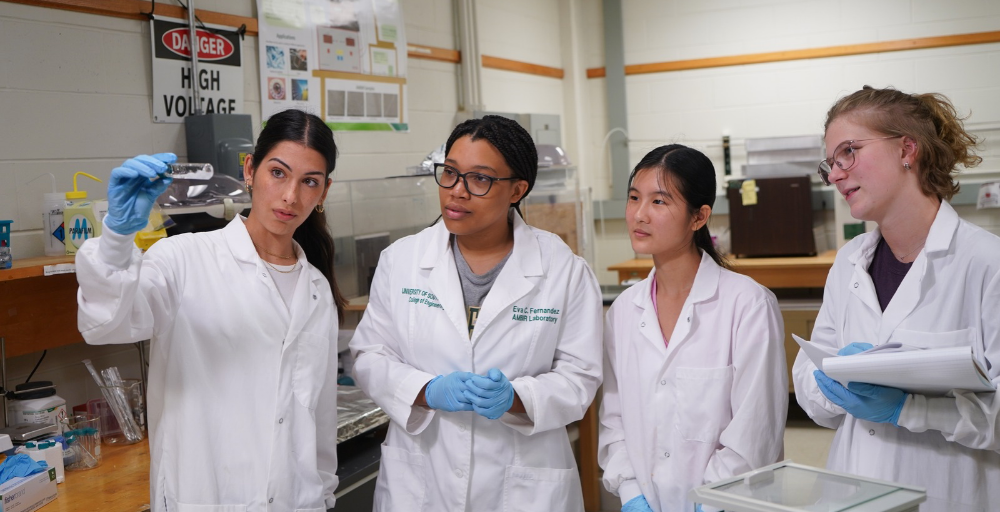
USF undergraduate students, Jaiden Brick, Krystal Walford, Jade Fei and Hannah Kirschenmann with their hydrogel
“What I like the most about the Student Spaceflight Experiments Program is that we fully immerse students of all ages in the practice of science,” said Stacy Hamel, SSEP senior flight operations manager. “They develop a research question, design an experiment to answer it and then analyze the results after the experiment is conducted. We enable students to be scientists, and then we stand back amazed at what they accomplish.”
CHALLENGES OF WOUND CARE IN SPACE
As space missions grow longer, researchers across the world are exploring new ways to treat injuries beyond Earth. During extended missions, astronauts experience weakened immune responses and some bacteria become more aggressive in microgravity, creating a need for lightweight, reliable wound-care materials that perform effectively in space.
To address that challenge, the student team proposed studying a chitosan-based hydrogel, a biodegradable material capable of absorbing and retaining large amounts of water. Hydrogels are widely used in wound care because they help maintain a moist healing environment, support tissue repair and create a protective barrier around injured tissue. The students selected chitosan, a biodegradable material derived from crustacean and insect shells, because it is biocompatible and naturally antimicrobial.
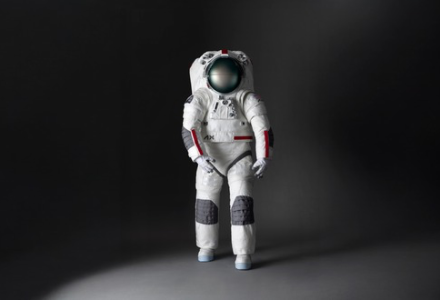
Axiom space suit [Photo courtesy of Axiom Space]
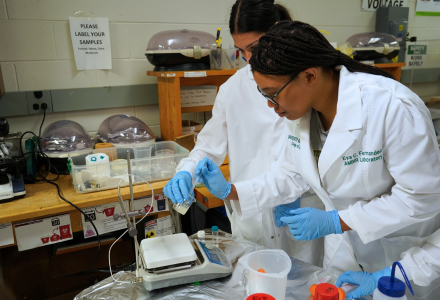
“On Earth, gravity can cause hydrogels to form with uneven pore structures,” Walford said. “In microgravity, fluids mix differently, which we believe could create a stronger, more uniform structure than what we can make on Earth. If that's the case, it could lead to better wound-care materials for astronauts during future missions.”
“This was my first experience in a lab outside of class," Brick said. “Being able to research a topic and watch the hydrogel form in the lab helped connect what we learn in class to something tangible. It's exciting to work on a project that could one day make a difference in space and on Earth.”
DEVELOPING THE IDEAL HYDROGEL
Creating a hydrogel suitable for spaceflight required months of experimentation. Working in the Advanced Membrane and Materials Bio and Integration Research Laboratory, directed by USF Professor Sylvia Thomas, the students evaluated various hydrogels to identify one that could withstand the conditions of spaceflight. They were guided throughout the process by advisors Eva Fernandez, a USF doctoral student and director of experiential learning, and postdoctoral scholar Ridita Khan, along with fellow USF doctoral students Rana Saha and Tuhin Bhattacharjee.
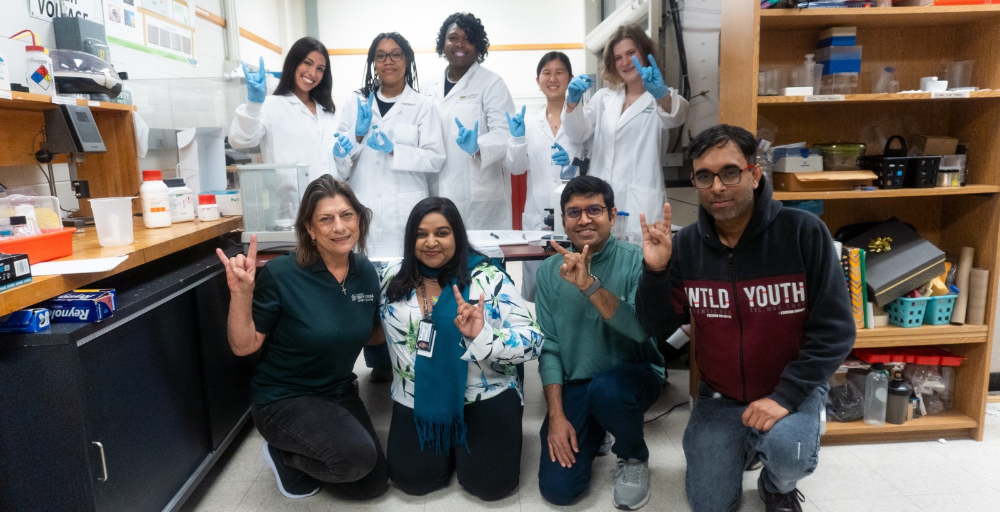
USF undergraduate students and their SSEP advisors
“As the major advisor to the USF SSEP team, I was elated to observe the enthusiasm, intellect and leadership that each team member brought to the project,” Thomas said. “This is an incredible honor and opportunity for our students and USF to contribute to space technology by sending a scientific project to space.”
Because the samples will spend weeks traveling to and from the ISS, durability was a key consideration throughout the process.
“We tested different formulations based on how much water they retained and how quickly they dehydrated over time,” Walford said. “That helped us narrow the options until we found one that could withstand the journey to and from space.”
[Video by Corey Lepak, College of Arts and Sciences]
The final experiment consists of two liquid solutions that astronauts will mix and shake aboard the ISS, allowing the hydrogel to form in microgravity. An identical sample will be created on Earth as a control. Once the samples return, researchers will compare the two hydrogels to determine how microgravity influenced the material's structure, stability and water-retention capabilities.
FROM LOW-EARTH ORBIT TO FUTURE APPLICATIONS
If successful, the findings could help guide the development of wound-care materials for future astronauts while advancing biomaterial research on Earth and informing future long-duration missions.
It’s not every day that a student has the opportunity to design an experiment destined for space. Through scientific excellence and innovation, the hydrogels team earned that honor. This hands-on experience will strengthen their competitiveness for graduate school and open the door to countless career opportunities.
Saundra Johnson Austin
USF Office of Student Engagement in Research and Innovation
Beyond human spaceflight, the team believes the research may have applications closer to home. Similar hydrogels are being explored for agricultural applications, where they could help plants retain moisture and reduce water use. Insights from the experiment could contribute to advances in healthcare and agriculture.
“No matter what the results show, we're going to learn something valuable,” Walford said. “Whether the material performs better in microgravity or not, the findings will help us better understand how these materials behave in space.”
The Student Spaceflight Experiments Program [or SSEP] is a program of the National Center for Earth and Space Science Education (NCESSE) in the U.S. and the Arthur C. Clarke Institute for Space Education internationally. It is enabled through a strategic collaboration with RhodiumScientific, America’s first commercial space biotech and Spaceflight Implementation Partner, working with NASA through a CASIS Agreement to utilize its facilities aboard the International Space Station. SSEP is the first pre-college STEM education program that is both a U.S. national initiative and implemented as an on-orbit commercial space endeavor.
Research reported herein was supported by the Center for the Advancement of Science in Space, Inc. and NASA under agreement number 80JSC018M0005 and with Rhodium Scientific under agreement number UA-2021-8282. Any opinions, findings, and conclusions or recommendations expressed in this material are those of the author(s) and do not necessarily reflect the views of the National Aeronautics and Space Administration or the Center for the Advancement of Science in Space.