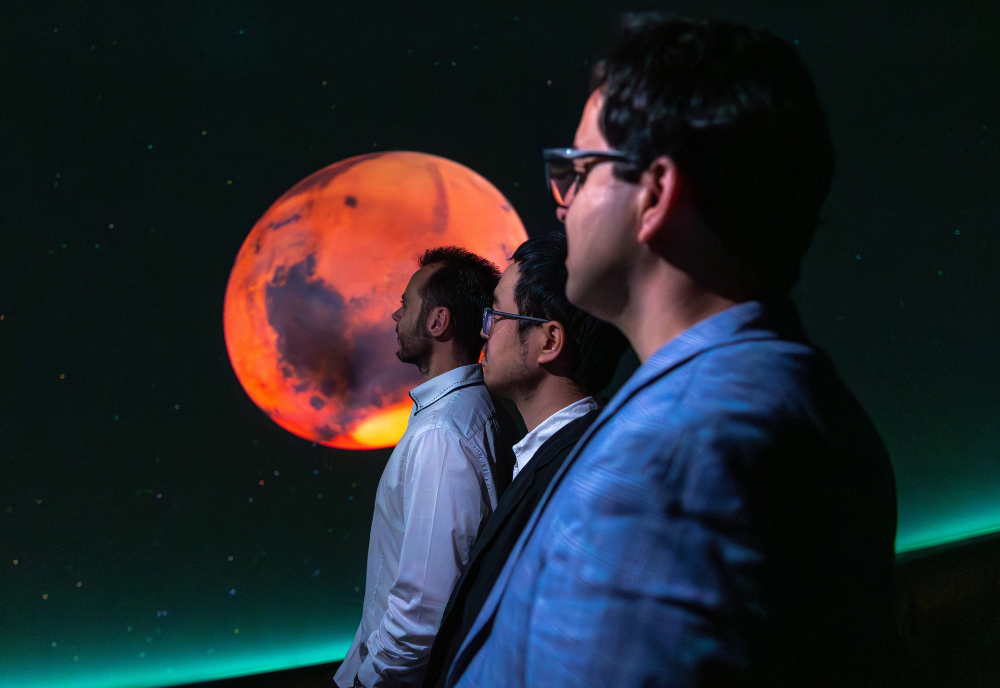
As Florida’s space industry accelerates at an unprecedented pace, the University of South Florida is stepping into a larger role by investing in space research, expanding faculty expertise and strengthening partnerships that position it at the forefront of the state’s growing space economy.
That momentum was recently underscored by USF’s admission into the Florida University Space Research Consortium, a statewide alliance of leading universities working in coordination with Space Florida and Kennedy Space Center to advance research, workforce development and innovation across the space sectors.
“Florida has a deep and influential history in space, anchored by the Kennedy Space Center and Cape Canaveral Space Force Station, and the state is making a very intentional push to build on that legacy and grow its space industry even further to play a more significant role in the future,” said Ahmad Vaselbehagh, associate professor and aerospace engineering program director at the USF College of Engineering. “USF is recognizing this moment and investing to be part of it, alongside other major research universities in the state.”
A Strategic Moment for Space, and for USF
With launches from Florida tripling in recent years and the global space economy projected to exceed $1 trillion by 2032, the state has made space a central economic and research priority. The Florida University Space Research Consortium was created to align university research strengths with this rapid growth, amplifying the impact of academic innovation across Florida. Members include the University of Florida, University of Central Florida, Embry-Riddle Aeronautical University, Florida Tech, Florida State and Florida International University.
USF’s entry into the consortium coincides with the launch of its new aerospace engineering program and a broader commitment to building long-term capacity in space-related research.
“We are not just observing what’s happening, we are building the expertise, infrastructure and partnerships needed to contribute meaningfully,” Vaselbehagh said. “That includes recruiting faculty whose research directly supports the future of space exploration and continuing to expand those capabilities over time.”
Building Smarter, Safer, More Autonomous Spacecraft
One area where USF is expanding its impact is in spacecraft autonomy - how spacecraft navigate complex environments and respond to unexpected conditions without relying on constant communication with Earth.
Andrea D’Ambrosio, who recently joined USF’s Department of Mechanical and Aerospace Engineering as an assistant professor, conducts research on optimal guidance and control of spacecraft, using artificial intelligence and machine learning to enhance autonomy while ensuring safety, reliability and performance. His work addresses a critical challenge facing the space community: how to trust and certify AI-driven control systems for real-world missions.
“AI has enormous potential in space, but these systems must be provably reliable,” D’Ambrosio said. “My research focuses on certifying the stability of machine-learning-based controllers and ensuring they adhere fundamental physics principles, so that they can be safely integrated with traditional control systems that have been used for decades.”
His research also advances space situational awareness, including the tracking, orbit determination and behavioral analysis of satellites and space debris – an increasingly urgent challenge as Earth’s orbital environment becomes more crowded. This work extends beyond Earth’s orbit into the cislunar region, the vast and highly dynamic space between Earth and the Moon that will support upcoming lunar missions, such as NASA’s Artemis program.
“This region exhibits significantly greater dynamical complexity, posing higher challenges and far less predictability than conventional orbits closer to Earth,” D’Ambrosio said. “We need new tools and new algorithms to maintain mission safety, enable effective collision avoidance, and ensure long-term sustainability in space, especially in the cislunar region.”
Designing the Next Generation of Space Missions
Xiaoyu Liu, who joined USF in January 2026 as assistant professor in the Department of Mechanical and Aerospace Engineering, complements that work through research on space mission design and planning, with an emphasis on how humans and robotic systems can work together effectively in extreme and uncertain environments.
Before artificial intelligence, most engineering systems relied on carefully designed, rule-based decision frameworks. While effective in controlled environments, those approaches exhibit significant limitations in space, where missions must respond to an enormous range of unknown and unpredictable conditions.
“In space, it is nearly impossible to design a decision tree for every possible scenario within realistic time and budget limits. The environment is too complex, the resources too limited, and the unknowns too great. That’s where machine learning becomes essential because it allows systems to adapt rather than follow rigid rules.”
Liu’s research explores how machine learning enables more adaptive, data-driven decision-making, allowing space systems to respond to situations that cannot be fully anticipated in advance. Rather than programming millions of possible outcomes, AI-based approaches can learn from data and adapt in real time - an essential capability for future lunar and deep-space missions.
Liu uses large-scale, simulation-based frameworks to study how teams of astronauts and robotic systems can be optimally configured for specific mission objectives.
“By running tens of thousands of simulations, we can generate evidence that helps mission planners make more informed decisions, especially when communication delays or unexpected events make real-time guidance from Earth impossible,” said Liu.
His work is particularly relevant to deep-space and lunar missions, where rapid decision-making is essential during critical phases such as landing, navigation, and hazard avoidance. By integrating machine learning with traditional engineering approaches, Liu’s research helps expand what autonomous systems can safely accomplish in space.
AI’s Expanding Role Beyond Earth
Together, this research reflects a broader transformation in space exploration: the growing reliance on artificial intelligence to support autonomy, adaptability, and resilience far from Earth.
“In space, you have limited resources,” Liu said. “AI-enabled systems allow spacecraft to operate more independently while still working alongside proven, certified technologies. That balance is essential as missions become more ambitious.”
Collaboration at the Core
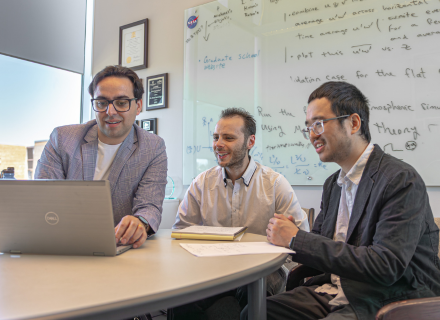
As part of the Florida Space Research Consortium, USF faculty are actively pursuing partnerships with government agencies, industry leaders, startups, and national laboratories, including opportunities tied to the International Space Station National Laboratory and future lunar missions.
“Advancing space research requires collaboration,” D’Ambrosio said. “No single institution can do it alone, so we need to combine expertise, infrastructure and perspective to move the field forward.”
Looking Ahead
For USF, joining the Florida Space Research Consortium marks the beginning of a sustained investment, participation, and collaboration not a single milestone.
“This is about building long-term capacity,” Vaselbehagh said. “The Consortium will enable all the members to leverage each other’s strengths towards a shared goal to advance Florida’s space research and industry and contributing to the next era of exploration, from Earth’s orbit to the Moon, Mars and beyond.”