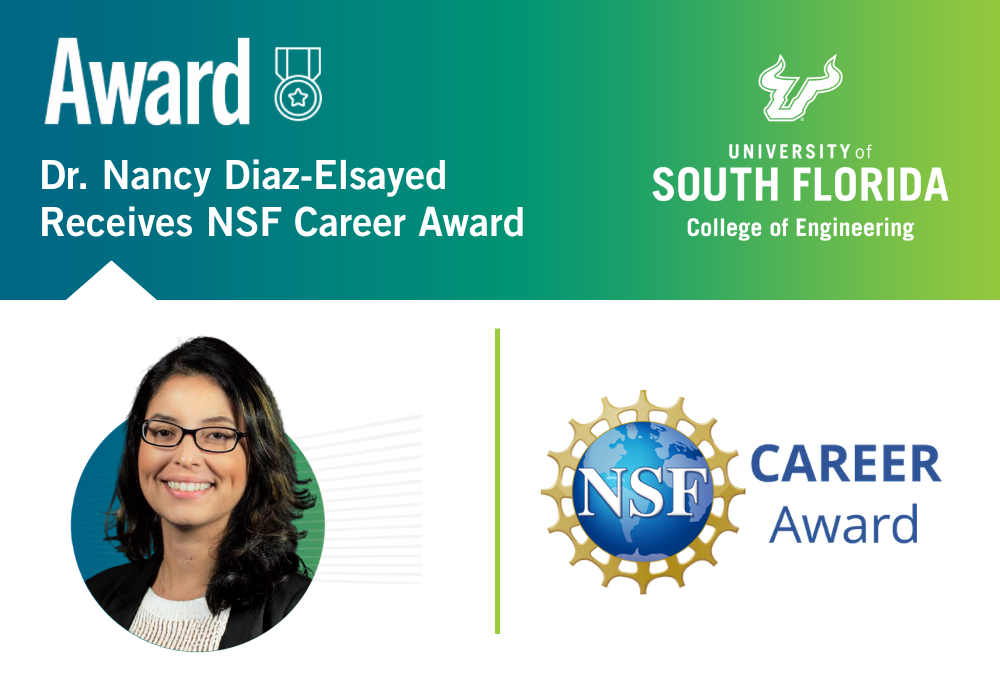
Manufacturing facilities are rarely as predictable as the models used to assess them. Energy consumption shifts. Costs fluctuate. Floods, power outages, and supply chain disruptions interrupt operations in ways that static analyses cannot anticipate. That gap between model and reality is exactly what University of South Florida Assistant Professor Nancy Diaz-Elsayed has set out to close.
Diaz-Elsayed has received the Faculty Early Career Development (CAREER) Award from the National Science Foundation, the foundation’s most prestigious honor for junior faculty. Her five-year, $499,975 award from NSF’s Environmental Sustainability program will fund the development of an uncertainty-resilient framework for evaluating the environmental and economic sustainability of net-zero manufacturing systems.
"The award will allow us to enhance environmental sustainability assessments," Diaz-Elsayed said. As she explained, evaluating a system’s environmental impact requires looking across its full life cycle, and that process inevitably involves trade-offs. Saving on the consumption of resources, for example, might mean material decisions that increase a product’s ecotoxicity potential elsewhere in the system.
The research centers on life cycle assessment (LCA), a technique engineers use to measure the environmental impact of products and systems over their lifetime. These assessments are powerful but can be limited. Conventional approaches often rely on static assumptions and limited data, which makes it difficult to account for the variability and disruptions that define real-world manufacturing environments. Diaz-Elsayed’s research seeks to overcome these limitations by integrating real-time operational data into LCA models; this will enable environmental impact estimates to evolve as conditions change.
"A key aspect of our project is coupling data-driven technology with Bayesian inference to enable adaptive predictions over the system’s life cycle," Diaz-Elsayed said. "Rather than producing a single, static assessment, the uncertainty-resilient framework will continuously update those predictions as new data become available. This will provide manufacturers with a more accurate picture of their environmental footprint over time.”
The framework will be tested on a pultrusion-based recycling system that converts post-consumer plastics into filament for additive manufacturing, a process that sits at the intersection of sustainability and advanced production. That test case will generate new insights into how system-level variability affects environmental trade-offs and production resilience, and how manufacturers can make better decisions under uncertainty.
Looking beyond the five-year award, Diaz-Elsayed sees an opportunity to expand the scope of the work even further. "This is going to set the stage for us to improve larger systems," she said, pointing to the potential for optimizing entire manufacturing networks and enabling a circular economy that leverages resources across communities rather than a single facility.
The potential reach of this research extends well beyond a single system. As manufacturing industries face increasing pressure to reduce resource consumption and operate sustainably, the tools available to assess that progress have not kept pace. Diaz-Elsayed’s research aims to change that, giving manufacturers a more reliable and adaptive way to evaluate the sustainability of their operations and design systems capable of meeting net-zero energy targets even as conditions evolve.
Beyond advancing research in environmental sustainability, the award will train the next generation of sustainability and manufacturing engineers. Diaz-Elsayed will launch Rising Innovators, a STEM camp that will introduce elementary and middle school students in the Tampa Bay region to engineering design and sustainability concepts through engaging, hands-on activities. The project will also develop an LCA agent to guide engineers through the environmental impact assessment process and provide them with the tools needed to build resilient systems for an uncertain future.
"I think keeping the lines of communication open with industry, if there are any partners that would like to work with us in this project, their feedback is certainly important," she said. "We are developing new technologies so that they could be implemented in industry. So, we'd be happy to expand our industry partnerships."
Dr. Nancy Diaz-Elsayed