
With the start of the spring 2026 semester, USF World continues to expand Virtual Global Exchange (VGE), a program that integrates international collaboration into coursework by enabling students to engage with peers around the world through high-impact, faculty-designed projects. For several semesters, Raja Benchekroun, an Arabic literature and culture instructor in the USF Judy Genshaft Honors College, has used VGE to connect students with partners in Morocco.
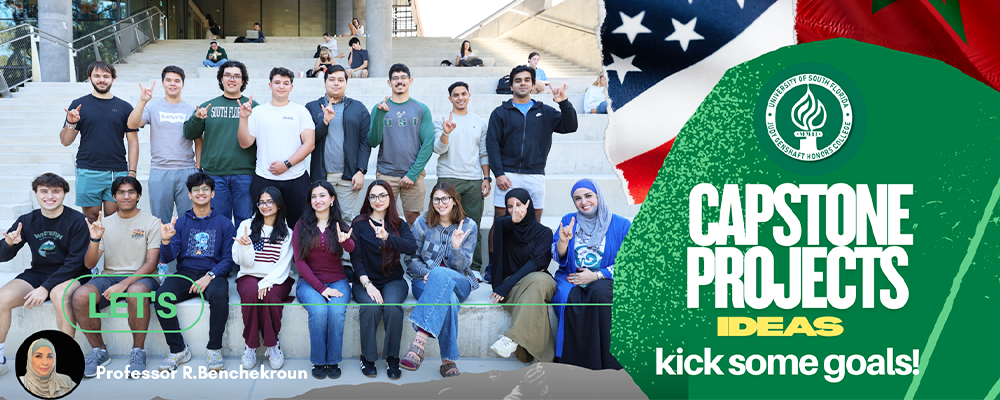
USF Honors Student Cohort Class Photo, taken at the Judy Genshaft Honors College Building, Fall 2025.
Most recently, Benchekroun introduced her students to the global cultural power of soccer in the Honors course, 2030 World Cup in Morocco: Tourism, Culture, and Sustainable Development.
Benchekroun has partnered with the Casablanca-based Jadara Foundation, a Moroccan organization dedicated to developing and empowering youth leadership after having connected with the organization at the YES Africa Summit 2025 in Marrakech.
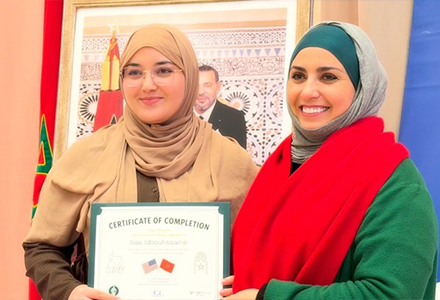 Meryem Chabouba El Idrissi, Operations Coordinator at Jadara Foundation, with USF
VGE faculty member Raja Benchekroun, Mohammed VI Polytechnic University (UM6P), Morocco.
Meryem Chabouba El Idrissi, Operations Coordinator at Jadara Foundation, with USF
VGE faculty member Raja Benchekroun, Mohammed VI Polytechnic University (UM6P), Morocco.Benchekroun said her primary goal for the collaboration was to “empower Moroccan and American youth to take active leadership roles in developing joint capstone projects.” Through the VGE partnership, USF Honors students and Jadara Scholars collaborated on interdisciplinary capstone projects aligned with Morocco’s preparations for the 2030 FIFA World Cup in alignment with the United Nations Sustainable Development Goals. Students explored themes such as sustainable tourism, infrastructure development, cultural preservation, and global equity.
The course also gave students the opportunity to examine real-world events like the Africa Cup on Nations 2025 and Morocco’s preparations for the 2030 World Cup, analyzing how large sporting events can shape infrastructure, economies and communities.
Students compared Morocco’s planning with the upcoming 2026 World Cup in the United States, gaining insights into how culture, governance, and economic priorities influence major events across different countries. “Events like AFCON 2025 and the 2030 World Cup provide a living laboratory for students,” Benchekroun said. “They see firsthand how strategic planning, cultural priorities, and international collaboration intersect, making their learning far more tangible and applicable than traditional classroom exercises.”
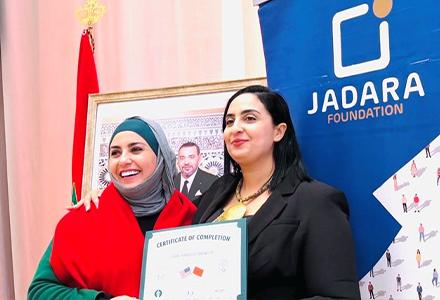 USF VGE faculty member Raja Benchekroun and Jadara Foundation CEO Oumaima Mhijri at
the Jadara Orient Action Event, held at Mohammed VI Polytechnic University (UM6P),
Benguerir, Morocco.
USF VGE faculty member Raja Benchekroun and Jadara Foundation CEO Oumaima Mhijri at
the Jadara Orient Action Event, held at Mohammed VI Polytechnic University (UM6P),
Benguerir, Morocco.The exchange emphasized dialogue, reflection and co-creation. Jadara Scholars served as cultural advisors, offering feedback on project feasibility, cultural relevance and long-term impact in Morocco, an experience that proved transformative for both groups.
“Our students — Moroccan and American — belong to the same generation and share similar aspirations for creating meaningful global impact,” Benchekroun said. “Serving as cultural advisors became a mission for the Jadara Scholars, driven by their pride in Moroccan heritage and their commitment to shaping their country’s future.”
USF Honors students emphasized the meaningful connections and mutual respect that developed early in the exchange. “Even though it was our first interaction, it already felt like a genuine exchange of perspectives,” USF Honors student Serene Abulhajja said. Many students also noted that collaborating across time zones, disciplines, and cultures strengthened their intercultural communication skills, problem-solving abilities and global awareness, which are key competencies for today’s workforce.
For Benchekroun, the collaboration reaffirmed the value of experiential and globally connected learning. “Teaching about something relevant, tangible, and human-centered fuels my motivation and reinforces my belief that the world needs more connection,” she said.
Learn more about Virtual Global Exchange