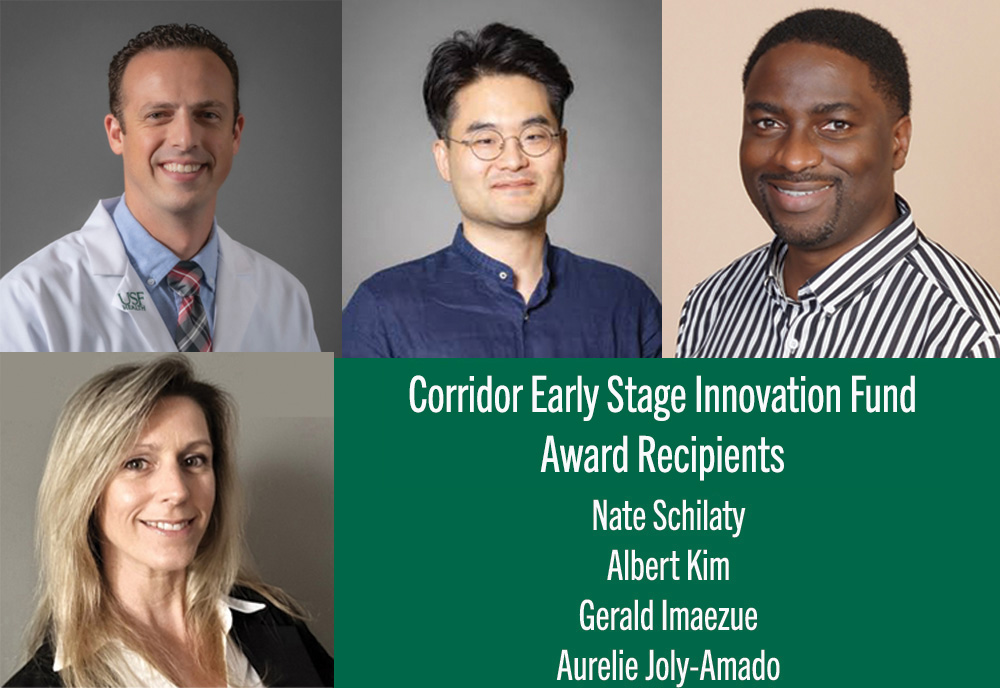
Four University of South Florida researchers have received the latest round of Early Stage Innovation Fund Awards, which provide up to $25,000 in seed funding to advance technologies toward market readiness. Their three projects advance healthcare training, medical technology and veterinary medicine. The Early-Stage Innovation Fund is a joint effort between the Florida High Tech Corridor and USF Research to support promising research at a critical inflection point.
CaseyMD: AI-powered clinical simulation platform for healthcare students

Principal Investigator: Gerald Imaezue, Assistant Professor, Department of Communication
Sciences & Disorders, College of Behavioral & Community Sciences
CaseyMD is an AI-powered clinical simulation platform that enables healthcare students
to practice the full clinical workflow with realistic virtual patients and caregivers.
Its unique approach offers adaptive scenarios, personalized feedback and detailed
performance analytics, helping students build essential communication and reasoning
skills before real-world placements. Funding will advance the platform’s technical
development, improve its user experience and support pilot testing with students and
educators, generating evidence needed for broader adoption in healthcare education.
This will help academic institutions make informed decisions about integrating CaseyMD,
expanding its reach and impact across multiple healthcare fields.
NeuTrode: Flexible, dry electrode for electroencephalogram (EEG) medical test
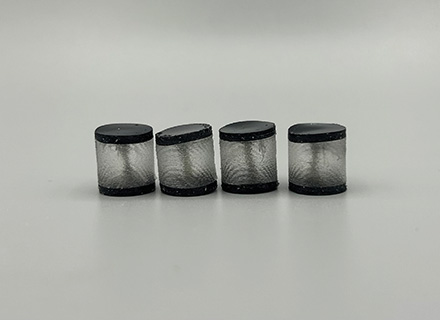
Principal Investigators: Nate Schilaty, Lincoln Endowed Chair in Chiropractic and
Biomechanics Research, Associate Professor of Medical Engineering, Associate Professor
of Neurosurgery & Brain Repair, USF Health Morsani College of Medicine; Albert Kim,
Associate Professor of Medical Engineering, College of Engineering and USF Health
Morsani College of Medicine
The NeuTrode is a type of flexible, dry EEG electrode designed to overcome the discomfort,
short lifespan and inconsistent signals of traditional wet electrodes. Its unique
wire-embedded polymer structure offers reliable electrical performance, greater durability
and compatibility with existing EEG systems, making it suitable for both clinical
and research use. Hospitals and research facilities can benefit from faster setup,
more consistent readings and lower costs per test. Funding will support further prototyping,
material improvements and manufacturing optimization, helping move the NeuTrode from
a proven prototype to a widely available, market-ready product.
translational advancement of Gene Therapy for Canine Cognitive Decline
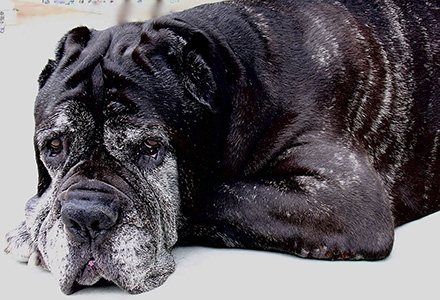
Principal Investigator: Aurelie Joly-Amado, Research Associate, Department of Molecular Pharmacology & Physiology, USF Health Morsani College of Medicine
This project is developing a new gene therapy to treat canine cognitive dysfunction,
a condition in older dogs similar to Alzheimer’s disease in humans. Unlike current
treatments that only manage symptoms, this therapy aims to address the underlying
cause by enabling the dog’s body to produce a protective protein, with early studies
showing improved memory and brain health in mice. Funding will be used to scale up
production of the therapy and create tests to monitor its effectiveness, paving the
way for studies in dogs and bringing the technology closer to real-world veterinary
use and potential future use in humans. These steps will also help attract future
investment and partnerships, increasing the chances of making this treatment widely
available.