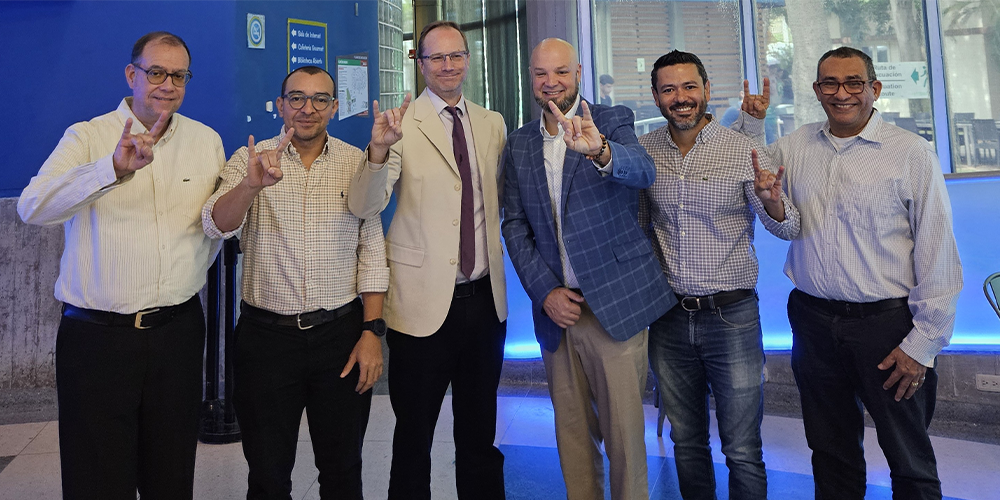
 Bula (left) alongside Dr. Rahman (right), his major professor during his doctoral
studies at USF.
As the first PhD student from UniNorte— the Universidad del Norte in Barranquilla, Colombia, an institution with which USF has a longstanding international partnership — Antonio Bula Silvera came to USF, shouldering considerable responsibility but also determined to fulfill a lifelong dream. “Since I was in high school, I was always looking for an opportunity to go to the U.S. for my studies,” Silvera says, noting the biggest problem was communicating with American schools — correspondence went through post offices and via international mail when a single exchange with a university took between 60 and 75 days. “At the time, e-mail didn’t exist, so it was impossible at the time.”
Despite the challenges, Silvera continued to prepare for his dream of studying in the U.S. “I continued my studies, graduating from UniNorte’s mechanical engineering program and entering the workforce,” Silvera says. “But at the same time, I was preparing myself.”
One day, he finally received a call. “My dean called me and said Dr. Carlos Smith, who had just retired from USF, is leaving for the airport soon. He told me I had 20 minutes to go see him,” Silvera explains. “So, I did.”
USF and UniNorte share an active academic alliance that has flourished for more than three decades, making it one of USF’s oldest international partnerships. The USF–UniNorte partnership began in 1993 as a joint initiative between engineering faculty at both schools. Today, the engineering programs in the alliance center on dual-degree transfer pathways, doctoral faculty exchanges, and joint research. More than 20 current and former UniNorte professors earned their doctoral degrees at USF.
He arrived at the university with time to spare, asking, “What is it that I need to do?”
When Smith asked if he had taken the examinations and if he was prepared, the answer was a resounding yes.
“I sent over all the information in April, and by May, I was requesting my visa and planning to get married in June,” Silvera says. “I was waiting for the opportunity, yes, but I never thought it was going to be that fast.”
USF and UniNorte share an active academic alliance that has flourished for more than three decades, making it one of USF’s oldest international partnerships.
And so, a newly married Silvera and his wife, Sandra, were off to USF to start a new chapter and fulfill his dream of studying in the U.S.
“It was a lot of responsibility. Depending on my performance, the door could either stay open for other students, or be shut,” Silvera says. “Everything went well, but it wasn’t easy.”
There were several challenges that Silvera faced before earning his master’s degree in mechanical engineering, and then in 1999, his doctorate in mechanical engineering.
“My first exam that I took as a graduate student at USF, I received a 27 out of 100,” Silvera recalls. “I remember asking, what am I doing here? I’m supposed to be better than this. It was a wake-up call.”
Instead of being discouraged, Silvera began reading the course textbook every day and putting in as much preparation as possible, saying that he could likely recite the book to this day. Ending the course with an A, Silvera did so well that he was invited back to be a teaching assistant. “It doesn’t matter how anything begins. That is not going to define who you are,” Silvera says. “You have to show you’re willing to work.”
The next challenge was learning to be patient.
“My major professor told me to prepare my dissertation proposal,” Silvera says. “I remember him smiling as he read it, saying to talk to the office manager about switching to the master’s program so I could learn how to write.”
“Looking back on it, it was no wonder that he told me to start with my master's,” Silvera says. “It worked out the way it should.”
His time at USF was not spent studying all the time. “We had many experiences, friends, and stories that helped shape our lives,” he says. “The friendships matter as much as the degree.”
“Some of the most important lessons I brought from USF were about high standards, patience and supporting graduate students.” — Silvera
Yet some of his best memories are from his doctoral studies, he adds, and says engineering professor Ronald Howell’s HVAC course was particularly memorable. Howell invited Silvera to join research projects in the mechanical engineering lab and provided him an opportunity to begin teaching. From those experiences, Silvera presented his first two papers at international conferences.
When Silvera returned to Colombia, he co-founded an engineering company that designed and installed industrial air conditioning and photovoltaic systems. He also returned to the Universidad del Norte to teach in the Mechanical Engineering department.
“Some of the most important lessons I brought from USF were about high standards, patience and supporting graduate students,” Silvera says. “My professors taught me that a bad start doesn’t define you, that a good researcher must also be a good writer, that a mentor’s job is to tell you the uncomfortable truth, and it’s important to bring students into real work. I have tried my best to be that kind of professor for my own students.”
Over his career, Silvera has published more than 150 articles and conference papers, eight books, developed three patented technologies, and guided 12 doctoral students to graduation. But Silvera’s connection to USF did not end with his degree.
“USF became a family story,” Silvera says. “My wife, Sandra, earned her master’s degree in public health from USF. Our daughters were born at University Community Hospital, right across the street from campus. They both graduated from USF as well. So, we are the Bulls’ Club.”