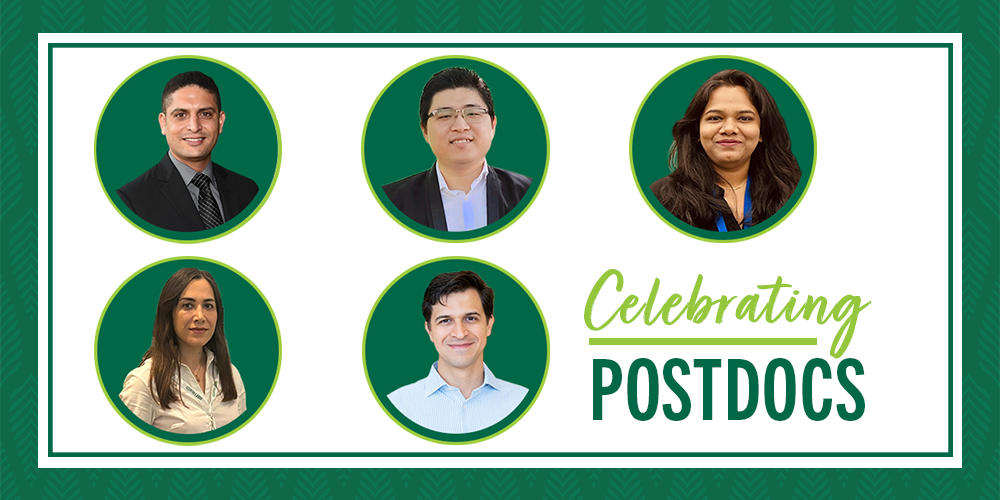
Any great global research university will acknowledge that postdocs are a powerhouse of contributions in scientific research, innovation and academic discovery. At the University of South Florida, more than 300 postdocs — with an estimated two-thirds of them traveling here from overseas — are being celebrated for the vital role they play in the research enterprise.
At the University of South Florida, more than 300 postdocs are being celebrated for the vital role they play in the research enterprise.
Now in its 17th annual observance, National Postdoc Appreciation Week, Sept. 21-25, raises awareness of the important role postdocs play in advancing discovery across a wide range of fields, from medicine and engineering to technology and the social sciences. This week, USF’s Office Graduate Studies and its Office of Postdoctoral Affairs will be celebrating with professional development events and social gatherings.
Postdoc positions usually last from one to five years, spanning the period after a graduate student has completed their PhD but before they start careers, frequently in industry, government research and development, or in consulting or other professional services. Fewer than one in five postdocs go on to become faculty members at higher education institutions.
“As research institutions continue to tackle complex global challenges, National Postdoc Appreciation Week serves as a reminder of the essential role postdoctoral scholars play in driving innovation, mentoring students, and translating new ideas into real-world impact,” said Tracy Costello, Assistant Dean for Postdoctoral Affairs and Graduate Student Success.
Nationwide, international scholars are a cornerstone of the U.S. research enterprise, with roughly six in 10 postdoctoral researchers in science and engineering fields coming from outside the United States, according to the National Postdoctoral Association.
USF’s Office of Postdoctoral Affairs has worked to put a spotlight on postdocs whose unique contributions to the university’s research programs are leading to globally significant discoveries and innovation. Several USF postdocs have been selected by The Scientist magazine to share insights on the projects being pursued by the university’s talented and dedicated postdocs.
Featured USF Postdocs

Dai-Nam Le
Department of Physics, College of Arts and Sciences
Dai-Nam Le develops theoretical tools to predict and control nanoscale quantum forces, including quantum friction and Casimir interactions, to enable next-generation nanodevices. He earned his PhD from Vietnam National University
“I was first drawn to physics by the unusual beauty of its mathematics. As a student in Vietnam, I worked on a problem about magnetic monopoles in nine dimensions. It was an abstract puzzle that most physicists never see, but its elegance showed me that mathematical structures can hide deep physical truths,” he told The Scientist.
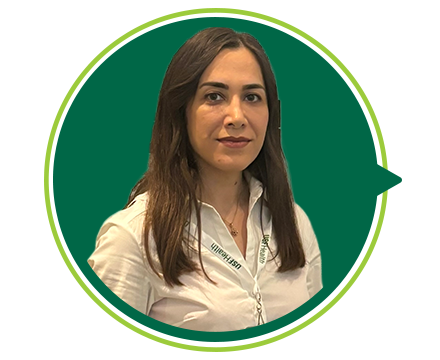
Ava Nasrollahi
Morsani College of Medicine Molecular Pharmacology & Physiology
Ava Nasrollahi conducts research on aging and neurodegenerative diseases and neural stem cells and specializes in neurovascular biology and blood–brain barrier dysfunction in neurological diseases such as stroke, intracerebral hemorrhage and Parkinson’s disease. She earned her PhD at Tabriz University of Medical Sciences.
“This work could transform how scientists think about vascular health and neurological disease. Rather than focusing solely on neurons, we may be able to target the blood vessels and supportive structures that help keep the brain healthy throughout life,” she shared with The Scientist.
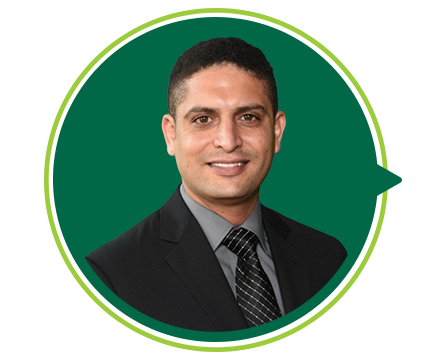
Mohamed Abassi
Department of Mechanical and Aerospace Engineering, College of Engineering
Mohamed Abassi's research applies deep learning and AI to unlock a deeper understanding of fluid dynamics, targeting complex issues like turbulent flows. He also teaches core mechanical engineering courses in thermodynamics. A former pilot in the Tunisian Air Force, Abassi studied at the French Air and Space Force Academy and later earned his PhD at University of California San Diego.
“If my research succeeds, new airplanes will be developed to be more efficient and ecologically friendly,” he told The Scientist.

Ananya Naha
Department of Medical Engineering, College of Engineering and Morsani College of Medicine
Aanya Naha investigates how ocular cells respond to mechanical stress to discover new therapies for glaucoma, the leading cause of irreversible blindness worldwide. She earned a bachelor’s and master’s degrees from universities in India before earning her PhD at Florida State University.
“Glaucoma research offers an opportunity to translate insights from biomechanics into a deeper understanding of disease mechanisms and potentially into new therapeutic strategies that preserve vision,” she told The Scientist.

Nikollas Benites
Department of Medical Engineering, College of Engineering and Morsani College of Medicine
Nikollas Benites’ research focuses on studying fundamental developmental mechanisms of the auditory nervous system and is working to more fully understand the mechanism behind the auditory nervous system development. A musician who earned a PhD from the University of São Paulo in Brazil. His research could help us better understand neurodevelopmental conditions like autism and ADHD, where auditory processing plays a role.
“As in an orchestra, all the instruments must be tuned. In this case, the instruments are the brain nuclei. All this fine-tuning starts before the day of birth. Studying the development of this system is complex, as in a good song,” he told The Scientist.
The Role of a Postdoc
- They conduct cutting-edge research. Postdocs are highly trained researchers who have already earned a doctoral degree and are focused on advancing knowledge through experiments, data analysis, publications, and discoveries. They contribute significantly to the research output that helps universities secure funding, publish in leading journals, and build scientific reputation.
- They bring specialized expertise. Many postdocs have unique technical skills, advanced methodologies, or interdisciplinary knowledge that strengthen research teams and enable faculty to pursue ambitious projects.
- They mentor students. Postdocs often work closely with graduate students, undergraduates, and research assistants, teaching laboratory techniques, research methods, scientific writing, and professional skills. This mentoring role helps develop the next generation of scientists and scholars.
Source: National Postdoctoral Association