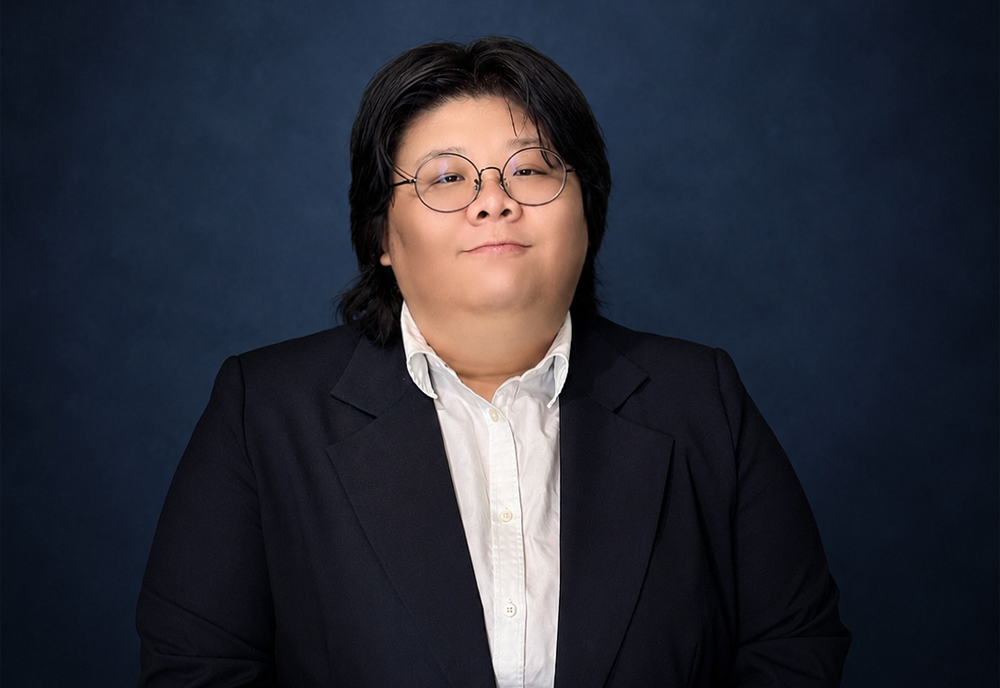
Few professionals move from studying psychology to practicing law before returning to academia, but Sy-Woei Hao has built a career that bridges all three disciplines. She earned bachelor's degrees in biology and psychology from the University of South Florida before pursuing a law degree at Stetson University College of Law. After graduating, she returned to Stetson as assistant director of dispute resolution, where she mentors law students and prepares them for advocacy competitions. Today, she continues serving as assistant director while practicing law and pursuing a doctoral degree at USF in curriculum and instruction, where she is exploring her passion for educational psychology.
Although her path may be considered unconventional, Hao leverages her experience in
advocacy to inform her work in educational psychology, helping her better understand
and address the needs of students. She was first inspired to change her path as an
undergraduate student at USF when she saw inequalities in the legal system for those
who were unable to communicate in fluent English. Today, through teaching students
and pursuing legal advocacy, she empowers others to navigate complex legal challenges.
You graduated from USF and the Honors College with bachelor’s degrees in biology and
psychology. What inspired you to pursue a career in law, and how did that transition
unfold?
I graduated with degrees in biology and psychology and for the longest time, I had my eyes set on pursuing a doctoral degree in psychology. Clearly, ten years later, I can confidently say that did not happen, and life is sometimes just weird.
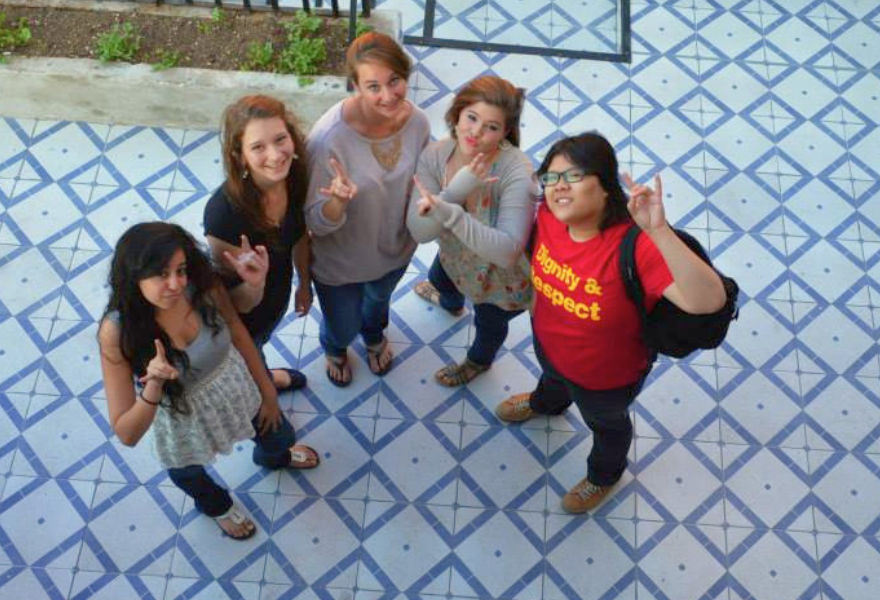
During my spring semester of junior year, my parents’ house went through foreclosure. We were referred to an attorney who was a friend of a friend. After we squared away this issue, my brain already went to the next legal battle my family would encounter, so the 21-year-old me thought if I “interned” for this attorney, would I be able to get free legal advice? The answer – sort of. I did get a career out of this “internship” though, so I guess I need to consider this a win.
In my senior year, the attorney really wanted me to go to law school and would remind me daily of his interest. I paid to take my LSAT, bought a $20 review book from Barnes & Noble two days before the exam, took the exam, and called it a day. I never wanted to go to law school.
The story continues with – of course – rejection from the PhD program.
Now, late April of my senior year, with much objection from my mother who really wanted me to be a doctor, I applied to law school. My friends celebrated with their white coats, and I quietly put on my black suit.
During my last year at USF, there was a rise in international students from China who regularly dined at my parents’ Chinese restaurant. My parents wanted to provide these students with a home here and served as their “elderly figures” while they were studying abroad. Through my parents, I met a lot of these students and learned how they were charged higher fees at student apartments, or they were sold a used car that was falsely advertised and did not know how to remedy the situation. I performed a few translations for these students, and we notably observed the different reactions received when someone spoke fluent English to the other side.
I have argued on both sides of the coin for this in different cases, but under Florida
law, even if you cannot speak or read English and sign an agreement, there is a presumption
that you knew what you were signing, and you are generally bound to this agreement.
Regardless of which side you are on for this law, speaking fluent English and being
able to read and write in English here in America makes a big difference when there
is a dispute. Even though I was not necessarily inspired by anyone to go to law school,
I went into law school hoping I could be the voice of someone who may be confused,
may be afraid to speak up when unfair things happen to them, or simply just needed
someone to help.
You are currently pursuing a doctorate in educational psychology at USF. What motivated
your return for this degree, and how do you hope to integrate your doctoral work with
your experience in law to create meaningful impact?
I have always been interested in psychology, so as I began closing out my legal education,
I again applied for a PhD in psychology. I was deeply saddened to learn I was again
rejected. Thankfully, once again, a friend of a friend referred to me to educational
psychology. It was a blessing because there was a focus on curriculum and instruction,
and I also had a passion for teaching.
After I graduated from Stetson, I was recruited back to coach for their advocacy boards,
where students compete nationally and internationally with law students in practical
skills competitions. I specifically focus on dispute resolution competitions, which
include client counseling, mediation, negotiation, and arbitration. There are some
people who describe these competitions as the “sports” of law school.

My dissertation focuses on the experiences and challenges these students face while preparing and competing at these competitions. I want to learn how I can be a better coach, a better teacher, and a more supportive person to these students during a high-stress period. I recently documented the number of hours each student practices for these competitions per week, and it can easily be considered a part-time job with scheduled meetings for up to 20 hours a week, more if you consider individual preparation time.
This research is meaningful because more resources should be devoted to this type of experiential learning for law schools. Historically, law schools focus on lectures, case law, and exams; students learn how to think like a lawyer but not how to be a lawyer. If you recite legal statutes to your client, there is going to be a disconnect. I hope my research can play a part in creating additional instruction to create practice-ready lawyers.
In your roles as an attorney and Assistant Director of Dispute Resolution at Stetson University College of Law, what motivates you most? What have you learned about yourself as you've progressed in your career?
I also am a practitioner in residence at Stetson as a non-tenure-track faculty member. I am still getting used to people calling me “Professor” Hao. As for my attorney work, I worked for the same firm all throughout college, law school, and the first half of my PhD program. In August 2024, I transitioned to counsel for the firm and started my own practice.
My motivation is creating possibility and positivity for my clients as an attorney, and for my students, as an assistant director at Stetson. It lights up my world when I walk into a room, and a student is excited to tell me something about their day or simply smiles.
At Stetson, I was very fortunate to receive an office in the library. One day, close to midnight, a student I knew was talking to the night shift janitorial staff outside my office, and I opened my door to offer everyone a popsicle and joined in on their conversation. Law school can be scary. It is a lot of hard work. But knowing that even after you have given feedback for over an hour to a student on their performance during practice and they can still “like” you enough to share a popsicle late at night means a lot. These moments are special and priceless.
I do believe life is circular in nature. I entered law school to be the voice of people. I now enter law school again to listen to people. You cannot learn about others and what others may need if you are the one talking. Similarly, if you want something from another person, merely telling them that you want something may not be most effective way to achieve that goal. Another approach can be to ask them what the both of you need to do to meet the goal. I hope that my listening and the guidance that I provide can help students move towards solutions to some of their dilemmas.
How did your Honors education shape your academic and professional path?
In one of the first few weeks as a first-year student at USF, I was sitting in my Honors philosophy class, and the assistant dean, Dr. George Kleine, came into the classroom to welcome us. He asked us to raise our hands if we would be taking summer classes. I raised my hand because summer classes were a graduation requirement. He frowned. He proceeded to tell us we should be exploring the world, not sitting in a classroom reading textbooks. This memory shaped the rest of my academic and professional career.
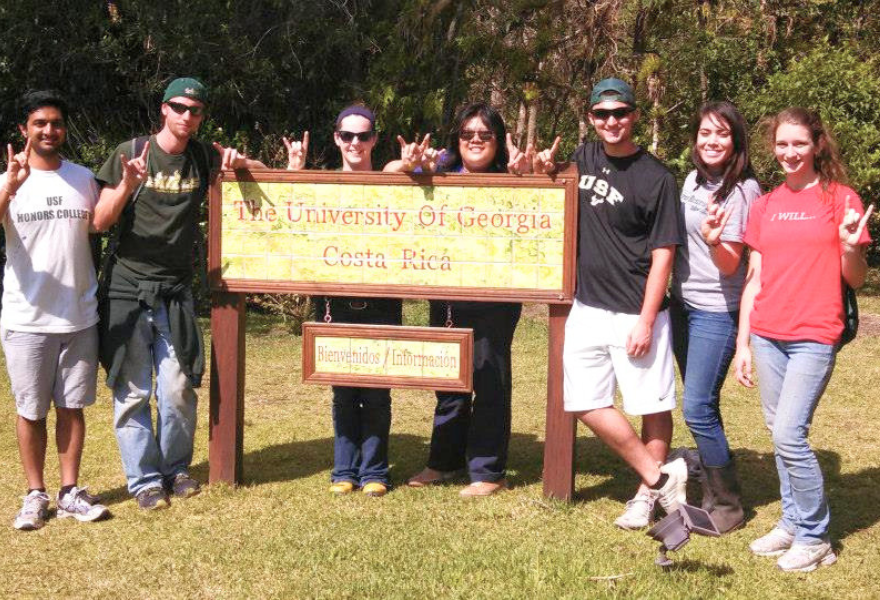
That summer, I signed up for an Honors Geographical Perspectives class about Costa Rica, which was co-taught by our wonderful Dr. Cayla Lanier. At the conclusion of the class, we traveled to Costa Rica for a service trip, drew a world map, built a playground for a school, and dug a biodigester tunnel for a farmer that converted cow manure into fuel for cooking and heating. That same summer, I participated in the 2013 Overseas Youth English Teaching Volunteer Service Program in Taiwan hosted by the Ministry of Education and taught English to middle schoolers. I met university students from all around the world and networked with local university students from Taiwan who served as our counselors. The summers of 2014 and 2015, I traveled to Honduras and Nicaragua through USF’s Global Medical Brigades to set up health clinics and assist local community members with health education.
Dr. Kleine’s words of encouragement to travel made a big impact on my extracurricular activities in college and continued into law school and the present time. The Honors College made it happen with their generous funding for student professionalism and development such as travel scholarships. I also had many memorable days at Raymond James Stadium working the concession stands to fundraise for these opportunities.
What advice would you offer current Honors students who may feel uncertain about how to pursue their goals or define their path?
My advice to current Honors students is simple – be a good person. I say this in the broadest way. When you are ordering your bagel at Panera in the Marshall Student Center, and there is not a long line, ask your attendant how their day is going and thank them for taking your order. Make sure to show up early to meetings so that you do not delay the meeting or the schedule for meetings that follow. Volunteer for tasks that may benefit others even when there is no individual benefit. We sometimes make things more complicated than necessary, which is why my go-to advice — solicited or unsolicited — is to be a good person. I often say that a “good morning” and a smile can go a very long way in brightening someone’s day.
You can have definitive goals and a clear direction of a path, but being a good person will draw others to you who can likely provide additional resources and guidance to make the journey a little smoother and easier to navigate away from obstacles. Of course, running into these obstacles is important to see how you process these challenges, but having people cheering you on can be that extra boost and motivation. You can be uncertain about how to pursue your goals or lack a clear path to those goals, but again, being a good person opens doors and opportunities that you may not have explored on your own.