At the University of South Florida, students interested in research are not hard to find. Open laboratory positions, however, can be harder to come by.
Judy Genshaft Honors College student and National Merit Scholar Chloe Jones encountered that challenge.
Motivated to break into a research career, chemistry major Jones visited USF’s Office of National Scholars (ONS) to look for opportunities to get involved in laboratory research. There, she learned about the U.S. National Science Foundation’s Research Experiences for Undergraduates, or REUs, which connect students with research institutions around the country. The programs allow students to diversify their research experience, find new mentors, and pursue opportunities that may not be available at their home universities.
Growing Her Love for Chemistry
Jones’ love for chemistry began during elementary school, when she checked out Theodore Gray’s The Elements: A Visual Exploration of Every Known Atom in the Universe from her school library. As soon as she enrolled in the University of South Florida, Jones declared a chemistry major.
Jones chose USF in part because of the benefits it offered National Merit Scholars and the opportunity to take interdisciplinary courses through the Judy Genshaft Honors College.
"A really big part of my journey so far has been figuring out that I was a National Merit Scholar. USF just does so much for National Merit, and I really wanted more of a holistic, well-rounded education,” she said. “I joined the Honors College because I knew it would give me the opportunity to diversify.”
Taking a Chance on Research
As Jones took more chemistry courses and became familiar with the fundamentals, she knew she wanted to apply her knowledge to a laboratory experiment that would have impact. She decided to visit ONS to receive guidance on applying to outside research experiences, like REUs. At ONS, she benefitted from workshops led by Dr. Sayandeb Basu, director of ONS.
"I felt like I had a bird's eye view of the whole process of applications,” she said. “Thanks to the advice of Dr. Basu to specifically mention a publication title and date from the lab I wanted to get into, they actually listed that as the reason why they accepted me.”
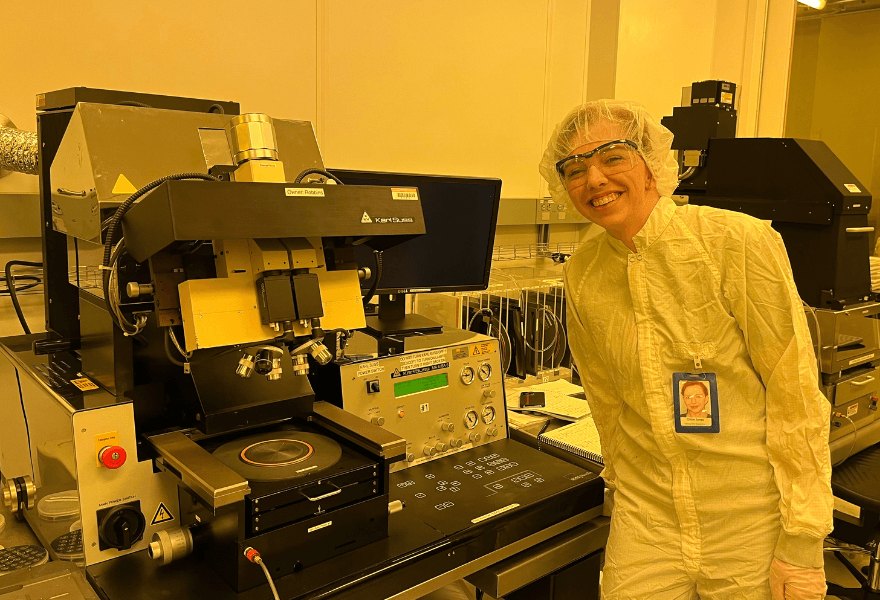
Chloe Jones poses next to spectroscopy machine at her REU at University of Texas at Dallas.
She applied to Research Experiences for Undergraduates across the country, and in 2025, was accepted to the program at University of Texas at Dallas. There, she gained experience in mass spectrometry, a technique used to identify the chemical composition of a sample by measuring the mass-to-charge ratios of its components. The real-world application of her study was to test how quickly a liver enzyme, pyruvate kinase, processes sugars.
“Mass spec allows us to test these drugs without all of the time and the resources required for clinical trials and advanced testing, so you can throw out some of the drugs that aren't working long before they would reach the clinical trial,” Jones said. “It also cuts down a lot of money, which allows research to proceed faster.”
Following her laboratory experience, she was able to present her team’s research at two conferences: University of Texas’s SPUR (Summer Platform for Undergraduate Research) and TechCon in Austin, Texas. At both conferences, Jones was challenged to explain her complicated research to people outside her field. At the SPUR conference, she was awarded the Erik Jonsson School of Engineering and Computer Science Award for her presentation.
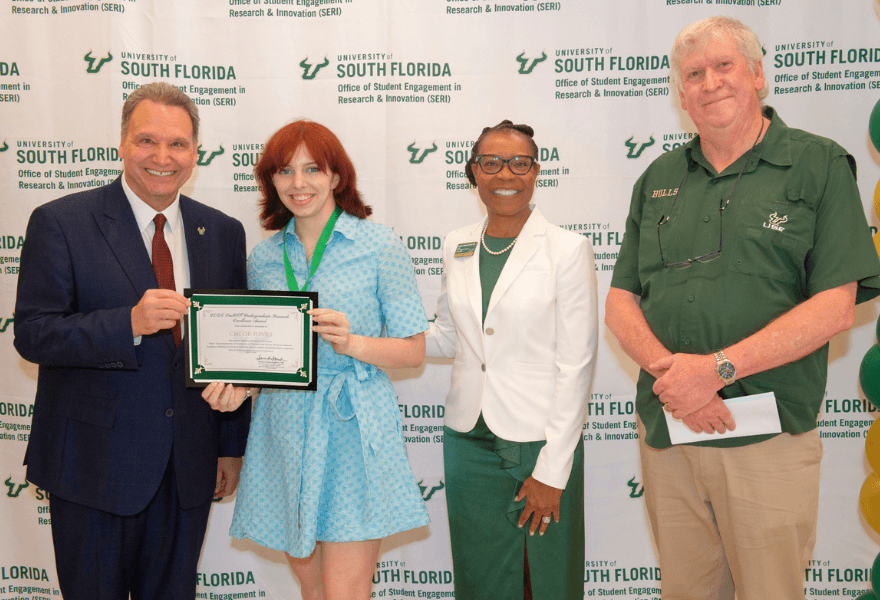
Chloe Jones holds OneUSF Undergraduate Research Excellence Award, accompanied by USF President Moez Limayem, Dr. Saundra Johnson-Austin, and Dr. Randy Larsen, associate dean of the College of Arts and Sciences for Research and Scholarship.
“I love talking about conferences because I think it’s a great way to form a lot of connections,” she said. “At the end of REUs, typically they will have some kind of undergraduate research symposium. Presenting at SPUR was an amazing experience. It was my first time presenting to judges and learning how to convert my research for people weren’t in my direct field.”
After she returned to USF, Jones had the opportunity to present her research at the OneUSF Undergraduate Research Conference on the Tampa campus. There, she received the OneUSF Undergraduate Research Excellence Award and a $500 grant from the USF College of Arts and Sciences to support her professional development.
When she returned to USF in the fall, Jones began a position in the Merkler Lab where she continues to work today.
Broadening Laboratory Experience
This past summer, she found another REU that furthered her breadth of chemistry experience and gave her the unique opportunity to work in a facility unlike any other.
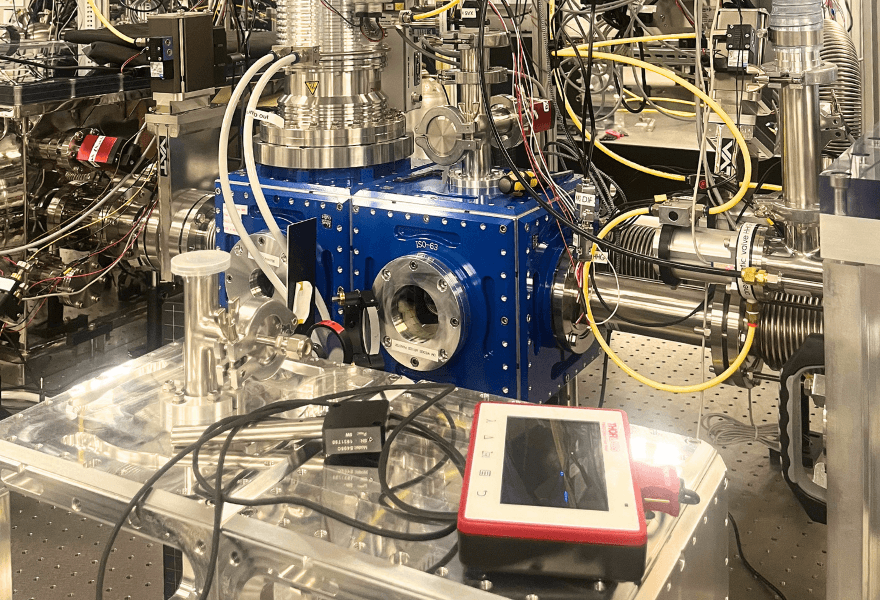
Spectroscopy machine at Ohio State University
In the program, she worked in the NSF NeXUS facility at The Ohio State University, short for National eXtreme Ultrafast Spectroscopy — the only open-access facility for extreme ultrafast science in the United States. The facility uses spectroscopy and extreme ultraviolet (XUV) technology to study electron dynamics, allowing scientists to observe how molecules respond to energy input on femtosecond timescales.
She specifically worked on analyzing the quantum mechanics of excited-state molecules. Although the type of work at Ohio State differed from her work at UT Dallas, she was excited to broaden her horizons.
“I wanted to gain more experience in the physical chemistry field to better understand the dynamics of chemistry at a deeper level,” she said.
In her summer project, she studied the light-oxygen-voltage (LOV) sensing domain of Avena sativa, or oats, which plays a role in the plant’s ability to respond to light. Using computational biophysics methods, Jones modeled how environmental factors affect photochemical reactions of proteins. She was able to apply this data to data produced in spectroscopic experiments, showing an understanding of quantum mechanics and a potential reduction in the need of time- and resource-intensive experiments.
Building Toward a Future as a Researcher
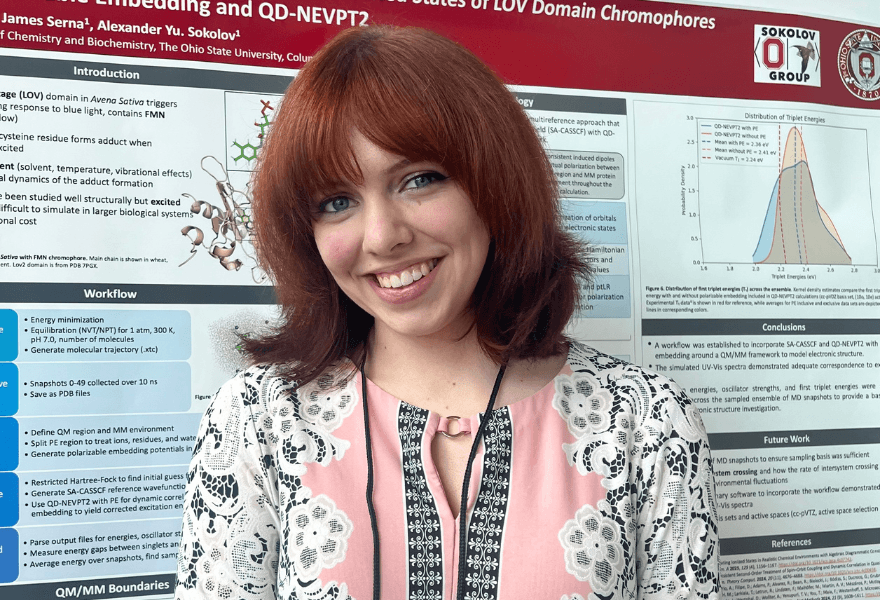
Chloe Jones presents a research poster from her work at Ohio State University.
REUs opened up doors for Jones to launch her research career. Through her two experiences, she gained mentors, the skills to present her research, and direction about her focus in graduate study.
The ability to experiment in different areas of chemistry at UT Dallas and Ohio State prepared her to develop her own research idea. Now she’s applying for the NSF Graduate Research Fellowship Program — a competitive fellowship that provides up to three years of financial support for graduate study — and using her REU experiences and ONS support to bolster her application and direct her research proposal that combines approaches from both of her REUs.
Without REUs, Jones isn’t sure she would have been able to find such a wide variety of experience in chemistry. She also appreciates the program’s funding in supporting her travel and ability to research without worrying about a part-time job.
“REUs take away the barriers of time and money that might be in place for some students. The stipend at Dallas was really helpful. I got to put it toward my graduate school funds. They covered travel costs for me as well, which would have been an issue,” she said.
She continued that her REU experience led to impactful mentor relationships that extended beyond the end of her summer term.
“REUs provide the perfect opportunity for one-to-one, mentor-mentee relationships. Not only am I still in contact with my PI, Dr. Sheena Darcy from UT Dallas, I'm also still in contact with my graduate student Evan Bonnand, who was absolutely instrumental in teaching me most of what I know,” she said.
Jones advises students interested in applying for REUs to utilize the resources they have on and off campus to craft an application that leaves an impression.
“Reach out to the Office of National Scholars — they are absolutely the subject matter experts when it comes to opportunities like this. If you need help crafting your personal narrative, you can go to your PI or someone who knows you really well. Because within REU, the important thing is not how much experience you have, it’s your narrative,” she said.