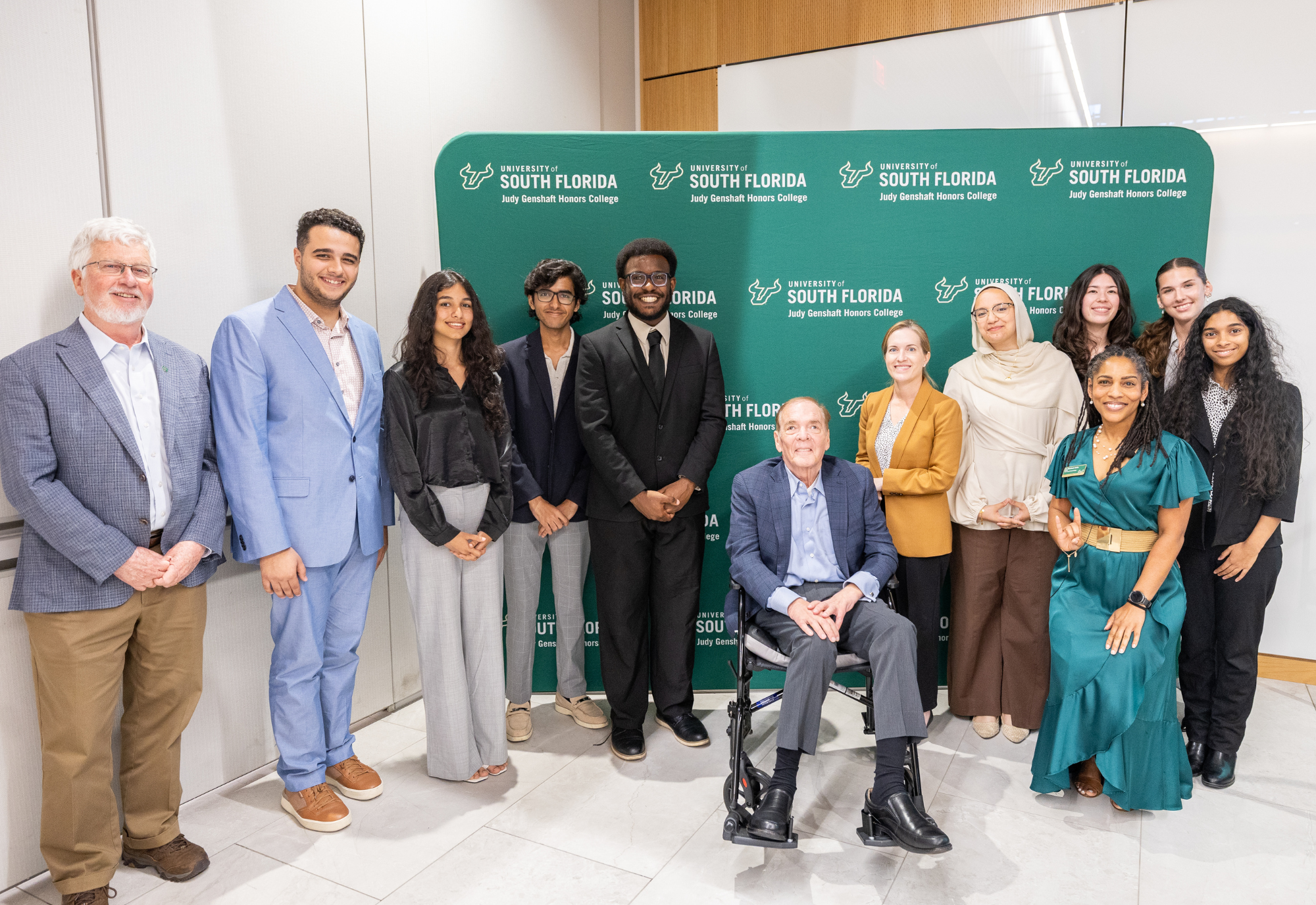
Museums are built to reflect human stories, but not everyone experiences them the same way. The Grand Challenge Competition at the Judy Genshaft Honors College invites students of all disciplines to envision practical accessibility solutions for issues that people with disabilities may face in museum settings.
The competition is made possible by a strong network of supporters dedicated to expanding disability studies initiatives. Now in its ninth year, the Grand Challenge Competition continues to inspire innovation, supported by the Salem Scholars Program for Applied Disability Studies through a generous endowment from Richard and Jule Salem.
This year, judges from USF Bellini College of Artificial Intelligence, Cybersecurity and Computing, Judy Genshaft Honors College, and the Tampa Museum of Art ensured that contestants were assessed by a wide array of perspectives. Artificial intelligence played a central role in this year’s competition, serving as a tool to explore creative approaches to accessibility.
To participate in the Grand Challenge Competition, students at the Judy Genshaft Honors College designed projects that combine accessibility and artificial intelligence to improve guest experiences in Tampa Bay museums. The winning teams of the challenge received $500 dollars in summer research funding and were provided the opportunity to launch their projects into real-world scenarios with local museum partnerships.
The winning teams showcased how AI can make museums more accessible and guest experiences more personalized. Adaptive tours for visitors with traumatic brain injuries and AI-powered artwork interpretation for visually impaired and non-English-speaking guests demonstrated how technology can used as an innovative tool to help communities with disabilities. The top teams from the challenge created plans to address these accessibility gaps, and now, their projects are being implemented for the benefit of the public in local Tampa museums.
Meet the Winning Teams
NeuroMuse
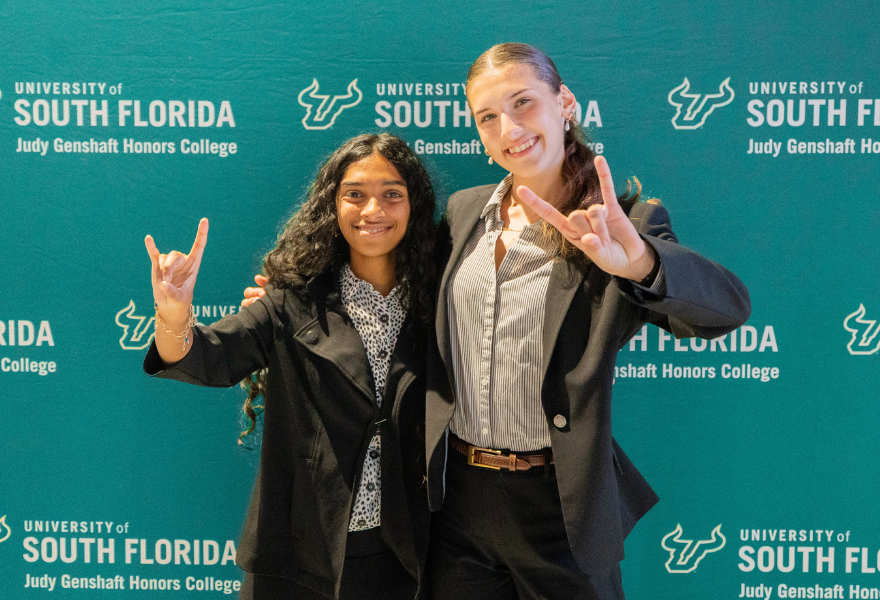
Katelyn Carlsen and Sarah Ismail celebrate after presenting their "NeuroMUSE" project at the Grand Challenge: Night at the Museum live event in the Judy Genshaft Honors College.
Katelyn Carlsen and Sarah Ismail’s project “NeuroMUSE” addressed museum attendees who have suffered traumatic brain injuries. Their AI-powered application can be used to set accessibility preferences, such as shorter visit times or lower light areas. The adaptive tour the app provides includes detailed explanations of art pieces, prompting the user to engage with the art thoughtfully and emotionally.
To design the app, Carlsen and Ismail conducted ethnographic research in local museums to determine the structure and culture of the environment. Carlsen noted that making sure the app could be seamlessly integrated into any museum’s operating system was a principal aim of their research.
“Rather than framing it solely as a supplementary tool, we hope to cultivate an app that can effectively work with the ecosystem of any given museum,” Carlsen said.
As the team continues its research, Carlsen has become passionate about finding new ways to support traumatic brain injury survivors beyond the museum setting. As an undergraduate research assistant in a clinical trial developing therapy for veterans with traumatic brain injuries (TBI), she is gaining a deeper understanding of how to expand accessibility and better serve the TBI community.
"My work has deepened my understanding of the lived experiences of TBI survivors and their needs while reinforcing the importance of social interaction post-injury, underscoring why engagement with community spaces like museums matters so much,” she said.
Worth A Thousand Words
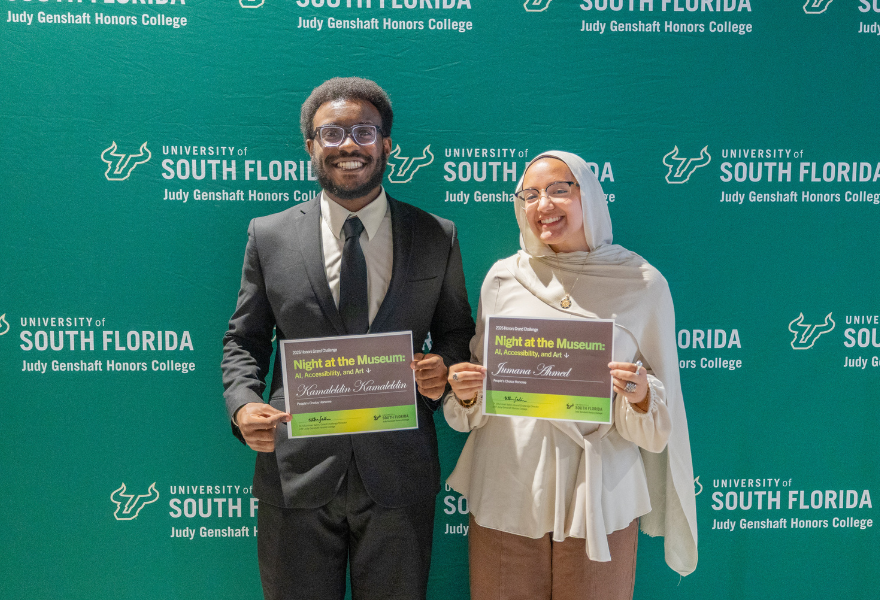
Kamaledin Kamaledin and Jumana Ahmed display certificates of their People's Choice Award at the Grand Challenge: Night at the Museum live event in the Judy Genshaft Honors College.
Kamaledin Kamaledin and Jumana Ahmed’s project, “Worth a Thousand Words,” presented an audiovisual experience for visually-impaired and non-English speaking museum guests. Through new Claude-powered interpretive tools that allow for non-English speakers and visually-impaired individuals to enjoy artwork, this project incorporated a walk-through plan for guests, with AI asking questions like “What does it feel like?” and “Why does it matter?” This alternative interpretation of art created an immersive experience for viewers that helps them to appreciate art through non-visual means. The live audience voted Kamaledin and Ahmed’s “Worth a Thousand Words” to receive the People’s Choice Award.
For Kamaledin, the process of designing the project helped him see the disability experience beyond adding accommodations to an already established experience.
“Our research on the challenges that visually impaired and non-English speaking visitors face shifted our perspective from thinking about accessibility as simply providing accommodations, to viewing it as creating opportunities for all visitors to engage more fully with art and culture,” he said. “It reinforced the importance of designing experiences with diverse audiences in mind from the very beginning.”
Both teams will present their research at a national conference this fall. Currently, Kamaledin is conducting research at art museums in Boston, while Ahmed is partnering with museums throughout the Tampa Bay area and preparing for a research trip to Egypt. There, she will continue her research into museum accessibility for attendees with disabilities, where she'll conduct international, place-based, and comparative research.
Challenging Student Growth
The Honors Grand Challenge Competition has a history of serving communities with disabilities, but this year is the first to challenge students to use artificial intelligence as the keystone of their project design. Director of the Salem Scholars Program for Applied Disability Studies Dr. Ulluminar Salim shared that the competition’s new direction requires a willingness to learn new technologies and intentional engagement with the disability community.
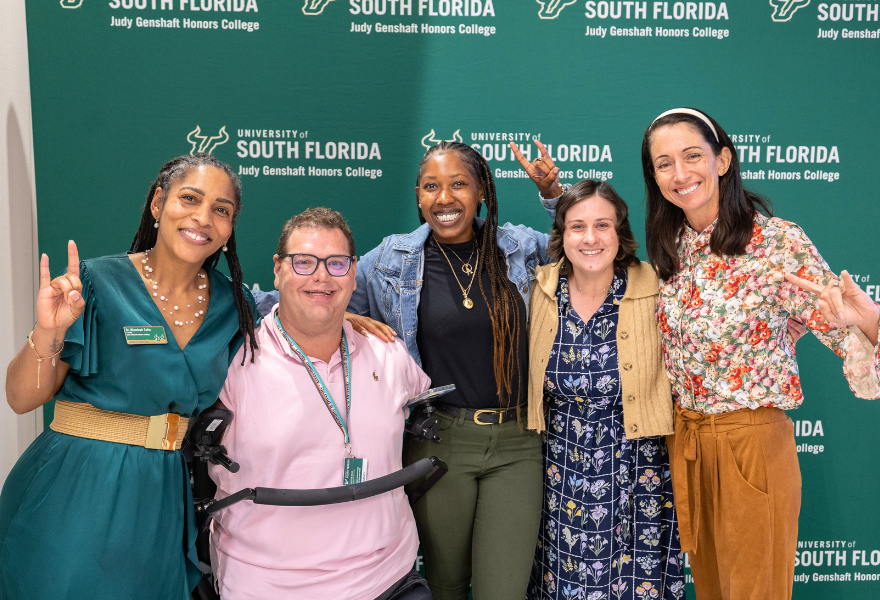
Honors College faculty members Ulluminair Salim, Kyle Romano, Catherine Wilkins, and two guests share a photo at the Grand Challenge: Night at the Museum live event in the Judy Genshaft Honors College.
“AI raises important questions about ethical design, cultural impact, and the unintended consequences of purposive action,” Salim said. “This is our first year foraying into the brave new world of AI technologies, so we have much to learn, question, and discuss, particularly alongside the diverse disability community.”
Looking ahead, Salim said the winning projects will continue to expand through prioritizing collaboration and real-world application.
“We are excited to see how these projects evolve through museum partnerships and implementation,” she said. “Their potential extends far beyond the competition and could help shape more accessible cultural experiences that make a lasting impact both within and beyond the Tampa Bay area.”
Endowed Judy Genshaft Honors College Dean Charles Adams said the competition not only gives students the opportunity to collaborate on a real-world project, but it also serves as an incubator for future innovators across a wide range of careers.
“The projects proposed this year bridge the gap between art and technology to enrich the users' enjoyment of art, but just as importantly, they help our students imagine possibilities for interdisciplinary problem-solving in a host of other fields,” said Adams. “We're deeply grateful to Richard and Jule Salem for making such a life-changing program possible."