After a successful pilot program last spring, the University of South Florida’s Judy Genshaft Honors College Mentorship Program is approaching the end of its first full semester, bringing a wide array of students and industry professionals together to exchange perspectives and help guide students as they make the transition from upper-level classes to graduate school, the working world, and other post graduate opportunities
Students from a range of academic disciplines have been paired with Honors College alumni, USF partners, and members of the Tampa Bay community, gaining insight into a wide range of career possibilities. But the benefits of these relationships extend beyond career advice. Mentors, too, have found opportunities to learn from the students they support.
Finding the Perfect Match
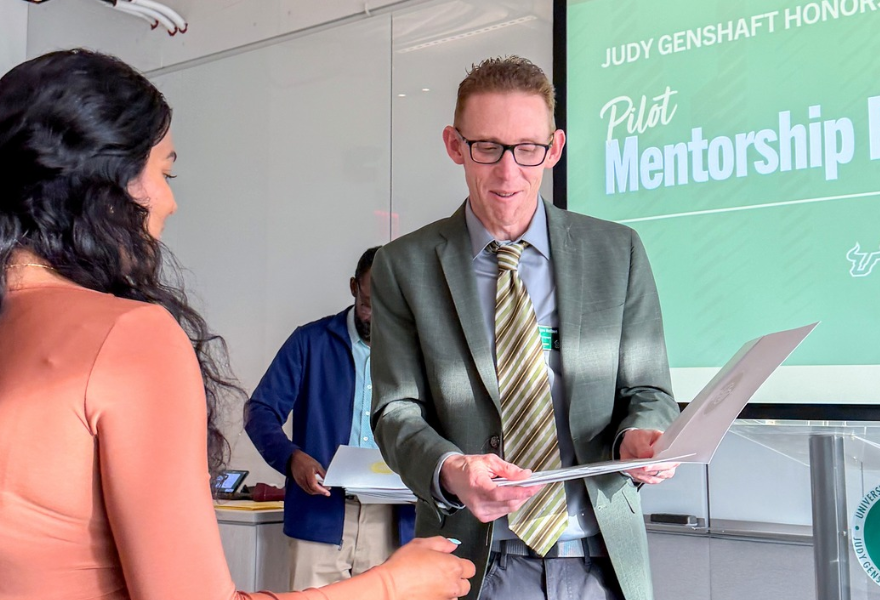
Mark Lane-Holbert leads the Pilot Mentorship Program Reception in April 2026.
Mentorship has long been part of the Honors experience at USF, developing organically through the involvement of engaged faculty and community partners. Honors Mentorship Program Director Mark Lane-Holbert saw an opportunity to build on that foundation and ensure every Honors student — regardless of background or existing connections — has access to a meaningful mentorship experience.
“It's especially useful for those students who maybe they're first generation, maybe they have no exposure to their field in their family,” said Lane-Holbert. “And for those students, that can really change their opportunities in their field and where they're going for graduate school.”
Lane-Holbert designed the program to provide structure for the connections that develop between mentors and mentees. From facilitating the matching process to preparing both participants for productive conversations through workshops and exercises, the program helps everyone make the most of the experience.
“What we do in terms of structure is just allowing two people to find each other through a bit of matching at the beginning of the year,” Lane-Holbert said. “We also provide some scaffolding for the students so that they are mentoring-ready, and they have some goals set out for the time with their mentor.”
The relationship between Sindara Kehinde, a mentee, and Stephanie Anspaugh-Naples, her mentor, illustrates the mutually beneficial connections the program can foster.
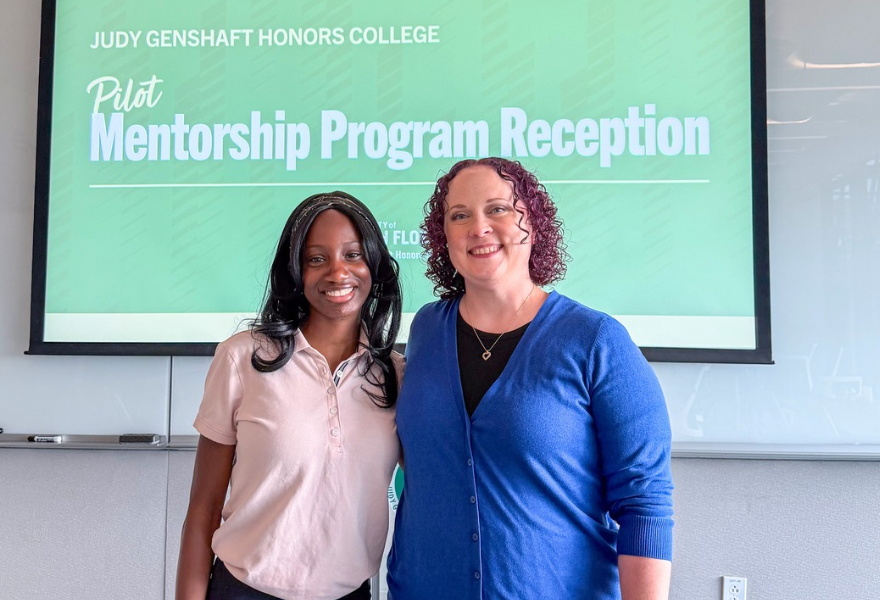
Stephanie Anspaugh-Naples and Sindara Kehinde connect in-person at the 2026 Pilot Mentorship Program Reception.
Anspaugh-Naples graduated from the Judy Genshaft Honors College in 2004 and returned to USF in 2016 to earn her doctorate in public health. As the first person in her family to earn a four-year degree, she was drawn to the mentorship program as an opportunity to support students who may be in a similar situation and share lessons from her own experiences.
"To see the next generation pushing things forward and wanting to be so involved, it gave my heart a little hope to be able to be a part of that process,” Anspaugh-Naples said. “Part of the motivation for me was looking back at college me and saying, ‘It’s okay, not everything is going to go perfect.’”
Kehinde initially joined the program seeking guidance as she began working toward a career in medicine. But Anspaugh-Naples' mentorship soon expanded her perspective on career planning and the importance of remaining open to new possibilities.
"[I’ve learned about] being open to new experiences, being open to maybe not even a different profession, but a different specialty. The other thing I learned was also being open and putting yourself out there,” Kehinde said. “It puts you in experiences that you may never have again and prepares you for the profession that you want to go into. And you can find out if you like it or not.”
Inspired to gain more direct experience in healthcare, Kehinde went on to obtain her medical assistant license, giving her an opportunity to explore the field and determine whether it was the right path for her.
Nonlinear Paths
Beyond career advice and networking, the program gives participants an opportunity to gain a deeper appreciation for personal and professional growth.
Lane-Holbert's PhD research in educational psychology has also shaped the program's focus.
“The research more broadly into mentorship shows that the most powerful thing that students get out of it is this sense of belonging ... and having that vote of confidence that they don't have to be perfect and they don't have to have all the answers because their mentors certainly didn't,” Lane-Holbert said.
As part of the experience, students conduct a “life story interview” with their mentors, asking questions about their mentors’ formative experiences, professional successes, and perceived failures. Through these conversations, students learn about the importance of resilience and adaptability.
“[The life story interview] asks a lot of questions about highs that you’ve had in your life and some of the lows and how you got past that,” Anspaugh-Naples said. “In no way was it a one-sided transaction ... I have absolutely learned from her experiences, and it’s changed the way that I approach things in my life and in my work.”
Lane-Holbert encourages mentors to approach the experience with an openness to learning from their mentees, recognizing that sharing knowledge with students can be just as rewarding as receiving it.
“Giving [alumni] the opportunity to give back in that generativity and that place that they care about is really a great opportunity for them to reconnect and grow,” he said. “And there’s a bit of intergenerational learning where they’re learning from the students, sometimes just as much as the student is learning from them in different ways.”
For alumni and industry professionals in the Tampa Bay area and beyond, Lane-Holbert encourages anyone considering becoming a mentor to embrace the experience and discover what they might gain from it.
"If you’re considering joining, you’re just the right person,” Lane-Holbert said.