
Carlyn Scott, College of Marine Science
Growing up on the water, Alexander Ilich, a recent graduate of the College of Marine Science, spent hours on his dock with a net or trap, always curious to see what interesting critters he could pull up. This early curiosity grew into an academic path, and he developed a broader interest in environmental conservation and management. This led him to the lab of Steve Murawski, where Ilich earned his master’s degree using underwater video and multibeam sonar to map seafloor habitats and study reef fish communities in the Gulf.
Ilich continued in Murawski’s lab to pursue his doctoral degree, expanding on his master’s work by mapping new areas, investigating the role of spatial scale, and examining how fish communities respond to their environment. During his time at the college, Ilich received several awards, including the William and Elsie Knight Endowed Fellowship Fund for Marine Science. His work has led to six first-author publications, four co-authored publications, and two open-source software packages.
Now a postdoctoral researcher working on seafloor mapping at the college, Ilich reflects on what he learned during his graduate school experience.
What made you choose to study oceanography at the College of Marine Science?
I specifically chose the USF College of Marine Science (CMS) because of the Marine Resource Assessment program and its focus on the intersection of marine science, conservation, and management. I was also excited by the opportunity to be advised by Dr. Steve Murawski, a former Chief Scientist for the National Marine Fisheries Service. All of this, along with the college’s proximity to state and federal agencies such as the Florida Fish and Wildlife Conservation Commission, U.S. Geological Survey, and National Oceanic and Atmospheric Administration, was especially appealing because I knew I wanted to pursue a career conducting research to address real-world problems in the marine environment. Being so close to these agencies offered unique opportunities to build relationships and collaborate with scientists and managers doing the kind of work I hoped to pursue after graduate school. And, of course, the prospect of living in sunny St. Pete didn’t hurt!
What is your research?
My research focuses on mapping seafloor habitats and understanding fish communities off the Gulf Coast of Florida using two main technologies: underwater cameras and multibeam sonar. Much like a medical ultrasound uses sound waves to create images of structures inside the body, multibeam sonar uses sound waves to create detailed images of the seafloor. The sonar is mounted beneath a large research vessel and allows us to map large areas relatively quickly. We can then use an underwater camera system to directly observe a smaller portion of those areas, giving us a detailed look at the habitats and fish found there.
Together, these technologies can be used to create habitat maps, estimate fish abundance, and understand how fish communities differ from place to place and change over time. As part of my research, I also develop free open-source software tools, with the goal of making scientific methods more accessible, reproducible, and easier for researchers to use and build upon collaboratively. Ultimately, this research can help us better understand and manage important fish populations and the habitats they depend on.
What about your field is exciting to you?
One of the most exciting parts of my field is getting to map and see areas of the seafloor that very few people have the opportunity to observe. Even on the continental shelf, there is still so much we don't know about what lies beneath the surface and the organisms that live there.
I'm also excited by the increasingly collaborative and open nature of science. I enjoy developing tools that other scientists can use, adapt, and build upon, allowing us to learn from one another and move the field forward together.
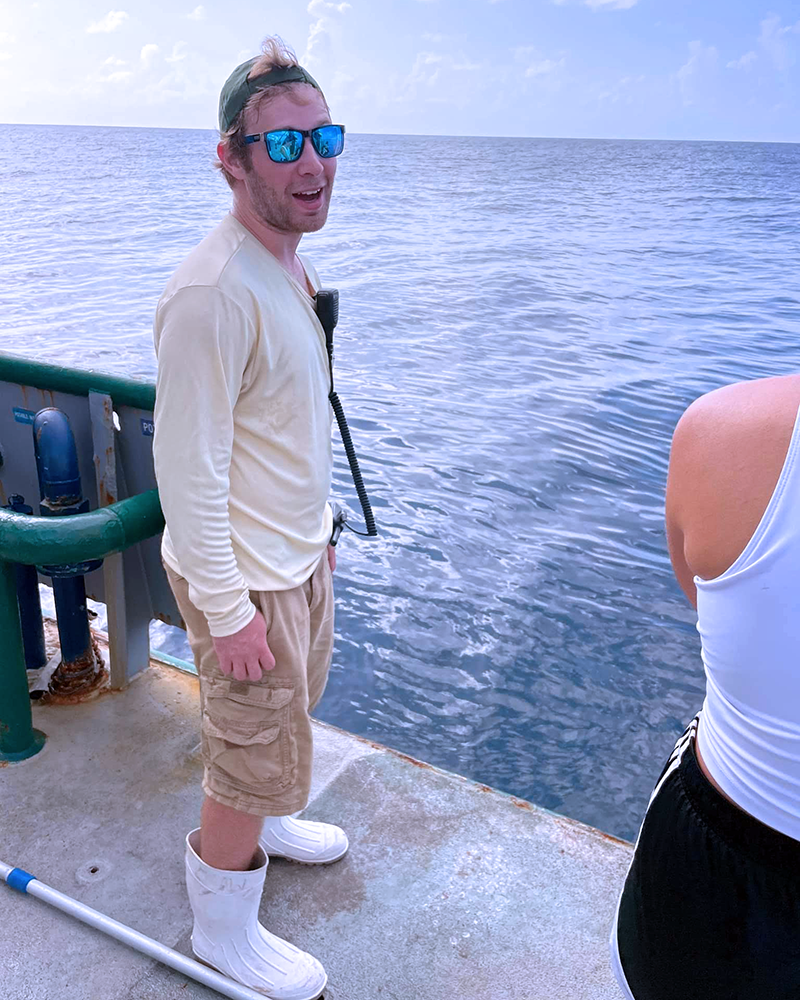
The college provided opportunities to develop the diverse skills and experience that shaped his research and professional development, such as conferences and hands-on ship time. Courtesy of Alexander Ilich
At the same time, we're gaining access to larger datasets that span decades and cover broad geographic areas. Combining these long-term datasets with new technologies and advances in computing allows us to understand marine ecosystems in ways that weren't possible before, including how they function and how they are changing over time.
Ultimately, what excites me most is the ability to apply this knowledge to real-world problems. Better understanding our oceans and how they are changing can support science-based management and policy decisions that help ensure the health of marine ecosystems for future generations.
How has your time at the College of Marine Science positively impacted your life and career?
My time at CMS has had a tremendous impact on both my personal and professional life. I’ve made lifelong friends and become part of a community that has made St. Petersburg feel like home. I’ve also built professional relationships with scientists at CMS, government agencies, universities, and research institutions around the world. I’ve had the opportunity to collaborate on a wide variety of research projects, which has helped broaden my interests and shape the direction I want my career to take.
CMS has also provided opportunities to develop the diverse skills and experience that have shaped my research and professional development. I’ve gained hands-on experience at sea and received training in processing multibeam sonar data. I was also fortunate to receive fellowships that supported my graduate research, along with travel scholarships and awards that helped me take advantage of additional professional development opportunities, including attending the international GeoHab marine habitat mapping conference, where I’ve developed a network of collaborators from around the world.
I’ve been especially fortunate to have an advisor who encouraged me to pursue opportunities beyond the immediate requirements of my degree, whether that meant attending conferences and workshops, seeking out additional training in scientific computing, learning new skills, collaborating on new projects, or developing open-source software. The combination of that support and the opportunities available through CMS has helped me grow as a scientist, build a strong professional network, and prepare for the next stage of my career.
What are your plans for post-graduation?
I’ve loved my time at CMS, and I’ll be sticking around as a postdoctoral researcher in Dr. Steve Murawski’s lab, continuing my work on seafloor mapping as part of the Center for Ocean Mapping and Innovative Technology. I’ll likely be involved in several different projects, including a crowdsourced bathymetry project that uses depth measurements from sonar systems already found on many recreational boats. The project provides participating boaters in Tampa Bay with small, low-cost data loggers that record these measurements during their normal boating activities so the data can later be retrieved and processed. By combining measurements collected by many different boaters, the project aims to provide more up-to-date information about seafloor depths and improve navigational safety.

A map of the seafloor created using multibeam sonar, one of the technologies Ilich used to study seafloor habitats and fish communities in the Gulf. Courtesy of Alexander Ilich