
Carlyn Scott, College of Marine Science
May 2nd was a typical Saturday for University of South Florida graduate student Emily Kaiser. She was working on figures for her dissertation when she received a text from a friend. It showed the Marine Science Laboratory (MSL) engulfed in flames.
“I was shocked, I couldn’t believe that picture was real,” said Kaiser, a doctoral candidate at the USF College of Marine Science, where she works in the lab of Amelia Shevenell.
Just a day before, the college had gathered on the lawn of the MSL, its primary research facility, to celebrate the end of the year with its annual party, Spring Fling. Kaiser had won the Vembu Subramanian award for her leadership and contributions to the college and had left the party with high hopes for the summer.
“It had been such a great day on Friday,” Kaiser said. “Then everything got turned upside down.”
As firefighters put out the blaze at the MSL, graduate students worried about more than the building. Inside were years of research, drafts of dissertations, and samples collected from around the world along with the equipment needed to analyze those samples, along with personal mementos and memories.

The recovery of samples has been a bright spot for many students who rely on these materials for their research.
"It's a surreal feeling to know that some of your work and belongings are gone and how quickly it all can happen," said Jessica Van Vaerenbergh, a master’s student in Chris Stallings’s Fish Ecology Lab.
In the days that followed, the recovery process became clearer. Crews began retrieving equipment, lab notebooks, and refrigerators and freezers containing valuable research materials.
When Kaiser saw the fridge containing her lab’s samples being hauled from the building, she felt a sense of relief.
“The vials in that fridge are the result of many long hours of sample preparation,” Kaiser said. “It is essentially years’ worth of work.”
They are also irreplaceable; many of these samples were collected in Antarctica and are critical to demonstrating how ocean temperatures have changed over geologic time. Recovering the samples is an essential first step, but it will take time to replace the instrumentation needed to analyze these samples and ensure that they weren’t contaminated by smoke.
These samples are important not only to Kaiser’s work but also to a broader goal of understanding how Antarctica’s ice sheets evolved over the past 50 million years.
“We had an enormous archive of Antarctic marine geological samples in the building,” she said. “I feel a duty not just to my research, my lab, and the college, but to the entire Antarctic research community to recover these samples which represent over 50 years of field work.”
Other graduate students felt a similar mix of hope and uncertainty during the recovery process. Isabella Iannotta, a graduate student in Mark Luther’s lab, was thankful that her samples of deep-sea minerals collected during a research expedition to the Cook Islands were recovered, though many of the instruments needed to analyze them were destroyed in the fire.
“It’s not as simple anymore as walking down the hallway to use the lab,” Iannotta said. “But I am currently in the process of coordinating with other universities to gain access to the necessary instruments so I can complete my analysis as soon as possible.”
The recovery process revealed the strength of the college’s community. Graduate students, faculty, and staff have spent countless hours sorting recovered materials, helping preserve decades of scientific research.
“The grad students are amazing to watch,” said Ethan Goddard, scientific researcher at the college. “They arrive in teams, ready to work on incredibly short notice to do anything that needs doing, including sorting, lugging, and loading tens of thousands of samples, and rescuing thousands of pounds of sediment cores from our cold storage systems.”
Their support for each other has extended beyond recovery operations. Since the fire, Iannotta and the Marine Science Advisory Council, a student-run organization at the college, have spearheaded gatherings, outings, and pizza parties to reconnect and navigate the challenges they’ve faced.
"It has been important to gather and check in on one another," Iannotta said. "Many of us are dealing with delays and uncertainties, plus the emotional toll of knowing things will never be the same again."
For Kaiser and others, that sense of community has become one of the most important parts of recovery.
"I want to make sure I show up for my lab mates and the other grad students," Kaiser said. "No one else understands exactly how this feels, so it's important to support one another."
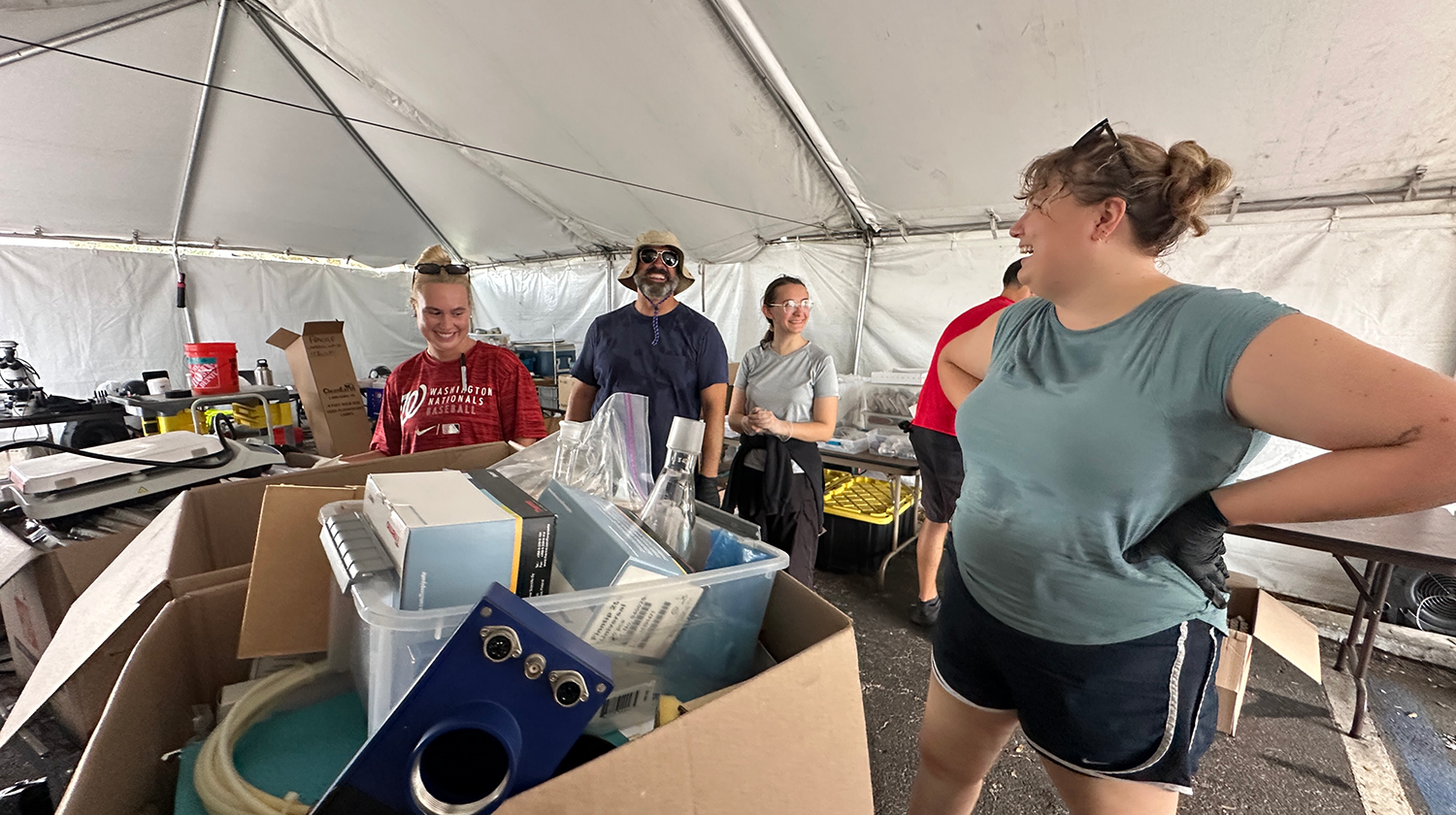
After the fire, graduate student Emily Kaiser (right) assisted in recovering critical samples for her lab and helped other students in the process.
While the road ahead remains uncertain, graduate students continue to demonstrate the resilience and dedication that define the College of Marine Science community. The students have continued their research in new locations, adapting to makeshift lab and office spaces, and sometimes working at each other’s houses to foster a sense of community. While there is a long road to recovery, the students have committed to supporting each other and resuming their research.
“I am incredibly proud of how our graduate students have stuck together and stayed so strong through everything,” said Tom Frazer, dean of the College of Marine Science. “They have shown so much heart, lifting each other up and supporting the college while keeping their research going through really tough times. At the end of the day, our students' well-being means everything to this university, and seeing their spirit and dedication has been truly inspiring.”