
Dyllan Furness, College of Marine Science
Every year, large mats of a floating seaweed called sargassum stretch 5,000 miles across the tropical Atlantic from west Africa to the Gulf. These seaweed mats, collectively known as the Great Atlantic Sargassum Belt, offer habitat for marine life in the open ocean but can harm coastal ecosystems, economies, and public health when they wash ashore in large quantities and decompose along coastlines.
A collaborative $1.5 million project led by marine scientists at the University of South Florida aims to better understand sargassum blooms — why they have exploded in size and what factors sustain their growth. By combining an ocean expedition, satellite observations, and analyses of chemistry, biology, and genetics, the researchers hope to unlock the mysteries of the sargassum belt and help improve the forecasting and management of inundations in coastal regions.
The project was awarded by the National Science Foundation in August and includes collaborations with researchers at Texas A&M University and Texas A&M University-Corpus Christi.
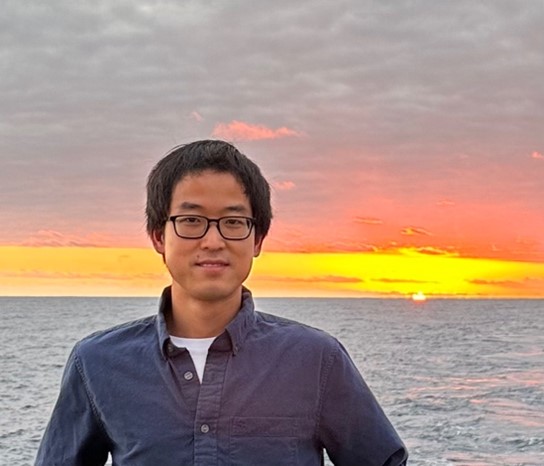
Weiyi Tang, assistant professor
“Since 2011, sargassum blooms have become a major problem for coastal communities across the Caribbean and Gulf regions, but we still don’t understand why these blooms have become so extensive or what nutrient sources allow them to persist,” said Weiyi Tang, assistant professor at the USF College of Marine Science and principal investigator of the project. “This collaborative research will hopefully answer key questions about the Great Atlantic Sargassum Belt and allow communities to better prepare.”
Despite efforts to observe and model sargassum blooms, the factors that drive this phenomenon remain poorly understood. The new research project will address this critical knowledge gap and test central hypotheses about the supply of nutrients to sargassum and the role that microbial communities play in bloom persistence during trans-Atlantic transport.
Embarking from Cape Verde off the coast of west Africa, the researchers will follow the sargassum belt observed by satellites across the tropical Atlantic, collecting and processing samples of water and sargassum, and carrying out novel experiments along the way. The researchers will ultimately disembark at the USF College of Marine Science in St. Petersburg.
Students and early-career scientists will carry out scientific research and gain hands-on experience by participating in the research cruise and sample processing. A documentary will be filmed during the expedition to highlight the research to a broad audience.
Measurements of dissolved nutrients, stable isotopes, microbial communities, and other parameters will assist researchers in determining the sources of nutrients and functions of microbes across the sargassum belt. These results will aid in predictions of bloom dynamics, improve the representation of nutrient supply in models, and — more broadly — provide a framework for understanding floating macroalgal ecosystems.
“This project is a really exciting fusion of research and illustrates the broad expertise we have at the College of Marine Science,” said Tim Conway, professor at the college and co-principal investigator of the project. “By combining Dr. Weiyi Tang’s innovative work on nitrogen, Dr. Chuanmin Hu’s use of satellite technologies, and my research on iron, we hope to unravel the complicated picture behind the Great Atlantic Sargassum Belt.”
The USF College of Marine Science has become a leader in sargassum research since the Great Atlantic Sargassum Belt was first discovered in 2011 by a team led by Chuanmin Hu, USF Distinguished University Professor and co-principal investigator of the new project. Hu and his team used NASA satellite observations to identify the belt, which has been called the largest bloom of macroalgae in the world.
Since then, the bloom has become an annual liability for many communities throughout the Caribbean and Gulf regions, with annual economic impacts to businesses and governments in the United States reaching millions of dollars and some governments issuing regional emergency responses due to massive inundations.
“Sargassum has become a critical issue throughout the region since 2011,” Hu said. “Our prior work on sargassum includes monitoring and tracking, measuring the impact on coastal communities, and understanding how ocean physics influences blooms. This new project will allow us to expand our investigations in biology and chemistry and continue to be a thought leader in the field.”
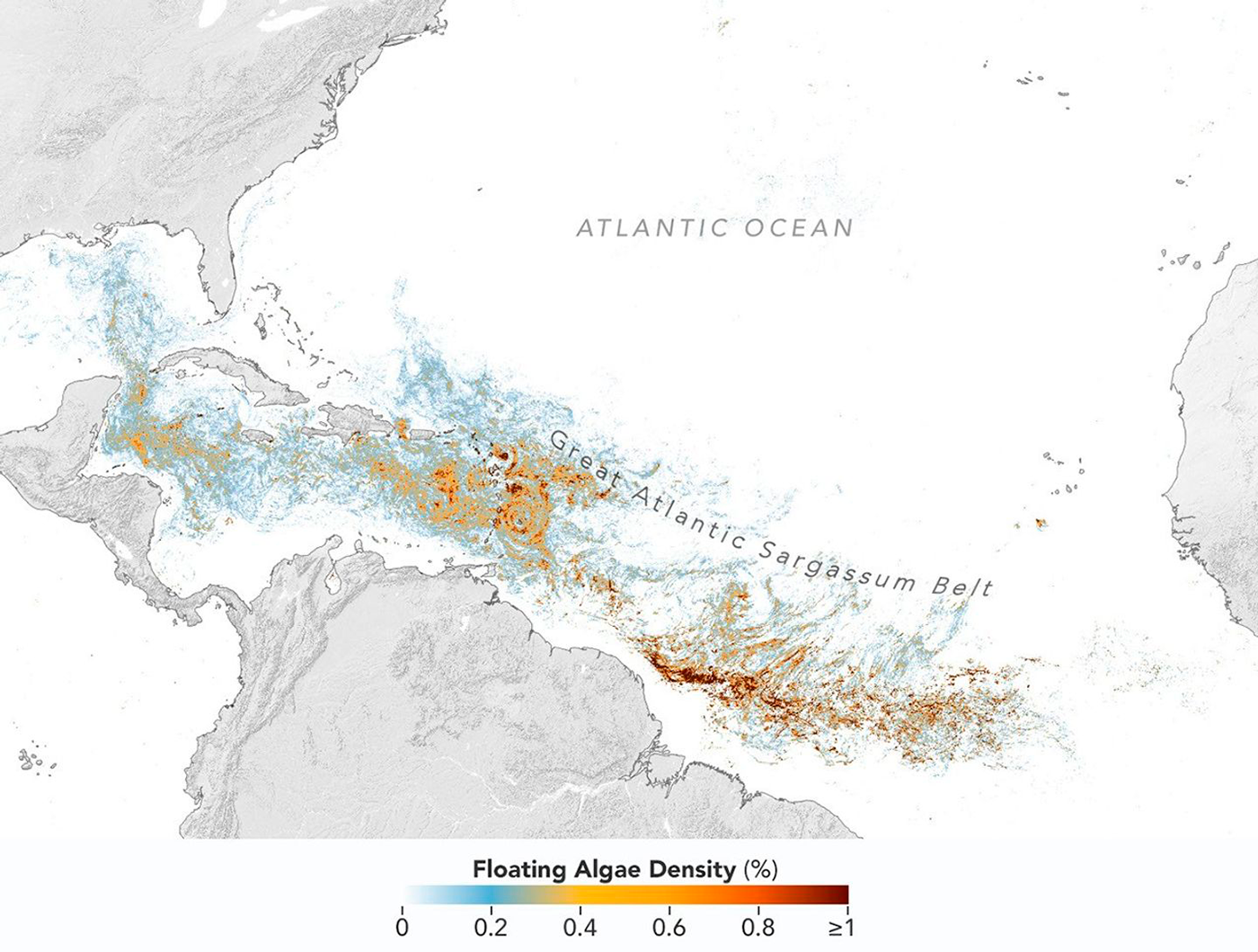
This map, based on data provided to NASA by the Optical Oceanography Lab in the USF College of Marine Science, shows sargassum highly concentrated in the tropical Atlantic in May 2026. Credit: NASA Earth Observatory/Lauren Dauphin