by Ann Comer-Woods, USF Research
Gerald C. Imaezue, PhD, an assistant professor in the Department of Communication Sciences & Disorders and director of the Brain & Aphasia Recovery Lab at the College of Behavioral and Community Sciences, kept encountering a recurring challenge in his classroom: finding enough patients with aphasia and other communication disorders to provide his graduate students with meaningful clinical interactions with them. That challenge led to his development of CaseyMD, an AI-native, multi-agent platform that delivers adaptive, unscripted conversations that require students to respond and reason in real time, mirroring authentic clinical encounters with patients and their caregivers.
Unlike traditional simulation tools that rely on predetermined scripts and branching scenarios, CaseyMD generates clinically appropriate patient cases and realistic voice-enabled virtual agents from natural language inputs. Students can conduct case histories, perform assessments, develop treatment plans, provide counseling and complete clinical documentation within a single simulated environment.
It’s something that students can use anytime anywhere on their devices whether it’s a laptop or a smart phone. They can have a clinical classroom in their pocket if they want it.
Gerald C. Imaezue, PhD
Assistant Professor of Communication Sciences & Disorders and Brain & Aphasia Recovery Lab Director
Moving CaseyMD from Lab to Market
With assistance from the USF Technology Transfer Office, Imaezue has filed three provisional patents for CaseyMD and founded Converstation.AI, a startup developing AI-powered conversational simulation platforms for speech-language research and clinical education.
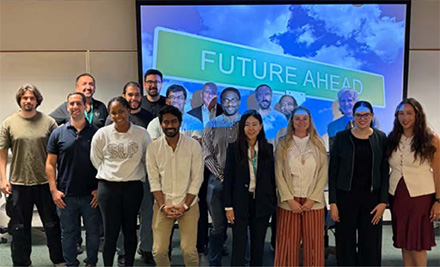
Gerald C. Imaezue, PhD, Rajesh Butta and Celine Davis with their spring 2026 NSF I-Corps cohort. [Photo by Colleen Parker]
Last spring, he and doctoral students Rajesh Butta and Celine Davis brought CaseyMD
to the National Science Foundation I-Corps Hub: Southeast @ University of South Florida, a USF-based program that trains researchers to transition their technological innovations
from the university laboratory to the commercial market. They conducted 19 interviews
with students and clinical instructors in the College of Behavioral and Community
Sciences, identifying five persistent challenges in healthcare education: documentation
burden, the gap between classroom learning and clinical practice, uncertainty in treatment
planning, underutilization of simulation technologies and low student confidence before
externships.
“That [experience] helped us realize that both students and instructors share different
as well as overlapping pain points,” Imaezue said. “It helped us develop CaseyMD to
not only meet the needs of students but instructors as well. We wouldn’t have gotten
to that fundamental insight if we hadn’t engaged in NSF I-Corps.”
In August, USF Research and the Florida High Tech Corridor provided an Early Stage Innovation Fund Award of $25,000 to Imaezue and his research team to advance CaseyMD’s technical development
and user experience by testing the technology with students and educators in a large-scale
efficacy study.
“We were assigned students at random through the platform and they went through cases
using the AI platform,” explained study participant Emily Glass, a speech language pathologist and assistant instructor in USF’s speech pathology
graduate program. She and her fellow instructors then verified the accuracy of CaseyMD’s
user assessment capabilities by reviewing the transcripts of the students’ conversations
with their virtual patients and the performance score that the platform assigned to
each of them.
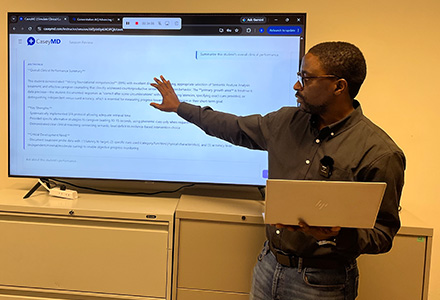
Gerald C. Imaezue shows the output from Anthonia, an AI bot embedded in CaseyMD that measures students' performance on the platform. [Photo by Ann Comer-Woods]
CaseyMD includes an AI bot named Anthonia after Imaezue’s mother, a retired teacher.
“Anthonia takes into context each student’s record and it’s able to provide personalized
responses to the instructors for that student’s performance in that particular session,”
Imaezue said. “With this, instructors can easily navigate the evolutionary report
of their students in a shorter period of time – a technology that is not available
in other simulation platforms. This makes CaseyMD a powerful tool for both students
and instructors to optimize the teaching and learning process in relation to clinical
education.”
Glass said, “It worked out nicely because students received exposure to different
types of aphasia. Then we were able to connect that with what students learned in
the classroom and get an idea of how they synthesized that knowledge.”
“We are just taking in all the feedback we can get from the users, from students,
from instructors, to improve the technology,” Imaezue said. “It’s well beyond the
prototype stage. It’s a fully functional product we are still learning much more about.”
Addressing a Growing Market Need
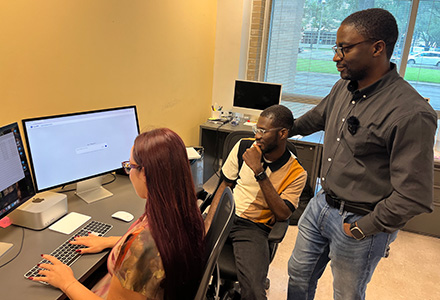
Gerald C. Imaezue, PhD, observes the work of postdoctoral researcher Monika El Jaouhari, PhD, and doctoral student David Ajayi. [Photo by Ann Comer-Woods]
Standardized patient programs often provide realistic experiences but can cost between
$150 and $300 per session and are difficult to scale. Existing digital simulation
platforms offer greater accessibility but typically rely on scripted interactions
that limit flexibility and spontaneous clinical decision-making. CaseyMD, a 2026 finalist
for the Cade Prize for Inventivity, seeks to combine realism, scalability and accessibility by providing adaptive dialogue,
custom case generation, complete clinical workflow simulation and on-demand access
through a single platform. “It’s a perfect representation of how humans and AI can
improve clinical education,” Imaezue said.
USF CONNECT Executive-in-Residence Diana Shapiro is helping Converstation.AI with
its business execution and growth strategy for CaseyMD. The company intends to focus
on accredited speech-language pathology graduate programs as its initial market, but
plans to expand into nursing, medicine, counseling, occupational therapy, pharmacy
and other healthcare disciplines.
“If we can show that students who use this technology improve their clinical confidence and clinical judgment, it will go a long way in convincing our major customers – largely universities – to adopt our product and help their students improve their clinical performance,” Imaezue said. “We’ve come up with amazing technology that we know will revolutionize the health care field and make the world a better place. We have no doubt about that.”