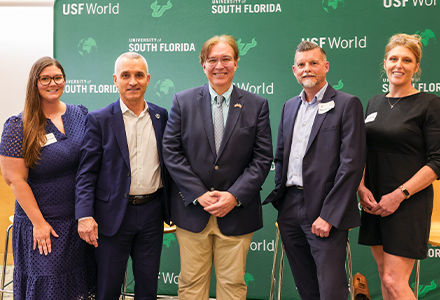
 The panel was moderated and led by (from left to right) Jennifer Burrington, Xavier
Avat, Bill Chute, Marcus Cooke, Autumn Waska.
The panel was moderated and led by (from left to right) Jennifer Burrington, Xavier
Avat, Bill Chute, Marcus Cooke, Autumn Waska.Nearly two years ago, Acadiant Digital Health CEO Bill Chute was part of a trade mission introducing life sciences technology companies to Florida’s wide range of assets in the sector. The group toured the state before visiting Tampa toward the end of the mission. That visit changed everything for the digital health company, which was already successful in Great Britain, where it works on data‑driven software that helps make health care services more efficient.
Chute found in Tampa Bay something he had not encountered elsewhere: immediate engagement, practical collaboration and a clear pathway from conversation to action. Chute recalled sitting down with leadership at the University of South Florida’s Morsani College of Medicine and asked a simple question: What challenges are you trying to solve? The candid answers that followed revealed problems that Acadiant’s technology was uniquely positioned to address and ultimately convinced the London‑based company to anchor its U.S. expansion in Tampa.
“There’s something very special about USF as opposed to anywhere else, even in the state of Florida — the openness to experimentation, to judicious innovation, taking a bit of a risk,” Chute said.
“There’s something very special about USF as opposed to anywhere else, even in the state of Florida — the openness to experimentation, to judicious innovation, taking a bit of a risk.” — Bill Chute, Acadiant Digital Health CEO
Acadiant’s journey to Florida and Chute’s impressions of the region as a soft-landing spot for a British company represented what’s becoming a thriving corridor between Florida and the U.K. in the life sciences sector. On April 30, the British American Business Council of Central Florida put a spotlight on this new facet of the historic trade relationship, which has intensified since a new memorandum of understanding was signed between Florida and the U.K. in 2023.
Gathering at the Patel Center and hosted in partnership with USF World, the evening marked the close working relationship between the university and international partners that extends to helping developing economic ties, as well as professional development opportunities for students.
Joining Chute in the discussion were Xavier Avat, Executive Vice President and Chief Business Officer at Moffitt Cancer Center; Autumn Waska, Vice Consul and Trade & Investment Officer for Life Sciences & Advanced Engineering & Manufacturing in the Department for International Trade at the British Consulate in Houston; and USF Professor Marcus Cooke, who is Chair of the Department of Molecular Biosciences and leads the Oxidative Stress Group, which investigates environmental and other stressors that can damage DNA. Cooke is a native of England who joined USF in 2020.
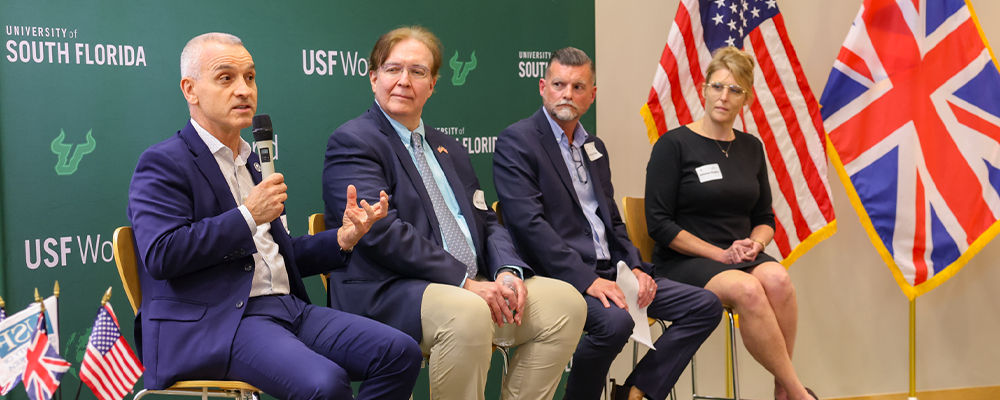 Avat underscored the importance of alignment between international companies and local
institutions, noting that successful partnerships depend on shared goals, cultural
understanding, and the ability to bring complementary expertise to the region.
Avat underscored the importance of alignment between international companies and local
institutions, noting that successful partnerships depend on shared goals, cultural
understanding, and the ability to bring complementary expertise to the region.The UK–Tampa Life Sciences Corridor is a key component of the 2023 memorandum of understanding, which focused on reducing barriers for companies, both Florida-based organizations seeking to expand into the U.K. and British companies looking to establish a presence in Florida. Life sciences represent a major strength for both Florida and the United Kingdom, making this sector a natural area for collaboration and continued growth.
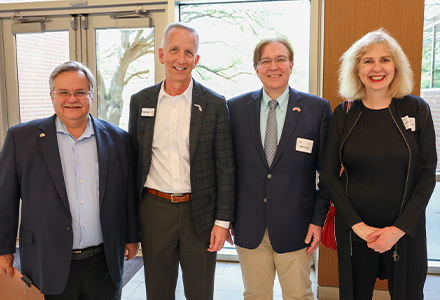 The corridor brought together global industry experts to discuss Tampa Bay’s emergence
as a major life sciences hub.
The corridor brought together global industry experts to discuss Tampa Bay’s emergence
as a major life sciences hub.The panel was moderated by Jennifer Burrington, Vice President of Research and Strategy at the Tampa Bay Economic Development Council, who framed the discussion around Tampa Bay’s emergence as a major life sciences hub. Burrington said the region now supports more than 26,000 healthcare and life sciences workers across over 1,200 establishments, representing a 41% increase in employment over the past decade — more than double the national average.
“We’ve really transitioned from an emerging life sciences market to one with real scale,” she said. “And it’s driven by talent production (and) industry growth, as well as institutional anchors.”
Throughout the discussion, panelists emphasized that Tampa Bay continues to emerge as a strong hub for life sciences innovation, driven by leading research institutions, industry partnerships, and a collaborative regional ecosystem. Cooke highlighted the importance of universities and research institutions in supporting life science companies, noting that strong academic partnerships create opportunities for commercialization, workforce development, and scientific advancement.
Throughout the discussion, panelists emphasized that Tampa Bay continues to emerge as a strong hub for life sciences innovation.
The panelists also discussed the critical role of community engagement and infrastructure in attracting international companies. “The entire state (of Florida) is so enthusiastic,” Waska said. “… There’s the infrastructure, there’s the talent, but there’s the enthusiasm. I think that’s the most important thing.”
Avat underscored the importance of alignment between international companies and local institutions, noting that successful partnerships depend on shared goals, cultural understanding, and the ability to bring complementary expertise to the region. Establishing a local presence, he explained, allows companies to deepen collaboration and contribute meaningfully to advancing scientific research and innovation.
The discussion also explored how universities can strengthen international partnerships and serve as anchors for innovation.
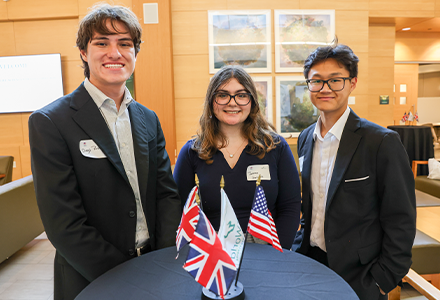 The event attracted USF students for professional development opportunities and to
learn more about the benefits of global partnerships.
The event attracted USF students for professional development opportunities and to
learn more about the benefits of global partnerships.Cooke emphasized that companies seeking to engage with universities should focus on building long-term relationships by participating in advisory boards, collaborating with faculty, and contributing to curriculum development. Universities, he noted, play a critical role in enhancing credibility, attracting global talent, and providing the expertise necessary to support emerging industries.
Looking ahead, panelists identified technology adoption and knowledge sharing as key opportunities to deepen collaboration between the Tampa Bay Region and the U.K. Waska highlighted the importance of ensuring that research and innovation developed in one region can be effectively adopted and applied in another, ultimately benefiting patients, communities, and industries on both sides of the Atlantic.
She also noted that accessible resource platforms and support networks can help companies navigate new markets and establish meaningful connections abroad. And in the end, the panel agreed, a welcoming environment matters.
“Florida created a pathway, but Tampa made it real,” Chute said.