
Carlyn Scott, College of Marine Science
The Atlantic Meridional Overturning Circulation (AMOC) has inspired headlines in recent years, with many studies warning that this essential system that drives currents throughout the Atlantic Ocean could weaken dramatically or even collapse as temperatures warm.
The AMOC is a large-scale ocean circulation system driven by wind and changes in seawater density. This massive system transports heat, oxygen, carbon, and nutrients throughout the basin, influencing climate in the United States and Europe and the health of marine ecosystems. A decline in its strength would be devastating.
But the headlines may be overblown according to two studies by researchers at the University of South Florida. Using direct observations from instruments in the North Atlantic and a new satellite-based method, the researchers found no significant weakening in the portions of the AMOC they examined.
They attribute the difference between headlines and their results to insufficient data for models.

Yao Fu, assistant professor of physical oceanography, used long term observational data to study changes in the AMOC.
“We need longer observations and more data to have confidence in saying that the AMOC is changing,” said Yao Fu, an assistant professor of physical oceanography in the USF College of Marine Science who studies large-scale ocean circulation. “A lot of the media coverage is based on studies that use model simulations or proxy data, which lack the physics of certain mechanisms within the system that cannot be simulated well.”
For example, some model-based studies have predicted a weakening of the AMOC in the North Atlantic due to meltwater from the Greenland ice sheet. This influx of freshwater could inhibit the process that drives global circulation, potentially weakening the system that relies on the movement of seawater based on density and salinity. But the AMOC spans an entire ocean basin and has a range of strength, speed, and temperature throughout its journey across latitudes, making it difficult to tease apart climate-related shifts from natural variability.

Professor Don Chambers uses satellite observations to study ocean dynamics.
“Models can be useful, but they can't simulate all the physics perfectly,” said Don Chambers, professor of physical oceanography at the college who uses satellite observations to study ocean dynamics. “Since they have to make some approximations, the models don’t capture a lot of smaller scale physical processes that are important to consider.”
In-situ measurements, which are taken from the field, are particularly valuable when observing trends in the AMOC because they capture certain physical processes that are often absent from model outputs.
In a 2025 study, Fu and his colleagues analyzed in-situ observations from 2014 to 2022. The measurements were collected by the Overturning in the Subpolar North Atlantic Program (OSNAP), an international program that deploys an array of moorings across an entire latitude to measure currents and ocean properties throughout the water column.
The study, published in Geophysical Research Letters, found that despite increased freshwater and interannual variability in individual currents, there was no significant weakening in the region.
While in-situ observations like those collected from the OSNAP array are the most reliable source for observing currents, these records can take years to be made public because of the time it takes to recover the instruments and process the data.
To fill gaps in the observations, Chambers turned to satellites.
In a study published in the Journal of Geophysical Research, Chambers and his student Jordan Meyers used Gravity Recovery and Climate Experiment (GRACE) satellite data to evaluate if changes in the Labrador Current could be detected using satellite gravity measurements. As water moves through the ocean, it redistributes mass, and a large enough current such as the Labrador Current creates differences in pressure that GRACE satellites can detect from space.
To validate this method, they compared the satellite gravity estimates with direct measurements from the OSNAP in-situ data. The method successfully captured large interannual changes in Labrador Current transport between 2002 and 2024, but the researchers found no statistically significant increase or decline.
“Our results match the OSNAP data well enough that we can now use it as a proxy to fill in gaps and get data more quickly than we can recover from the moorings,” Chambers said.
While the programs such as the OSNAP are the gold standard of measuring the variability of currents, the longest trans-Atlantic array program has only been around for two decades, noted Fu.
“The AMOC is a feature that spans a very long-time scale,” Fu said. “The 20 years of data we have is not long enough to understand the entirety of the dynamics and long-term variability — it’s just a snapshot.”
Chambers and Fu plan to combine OSNAP's direct measurements along with satellite data to refine estimates of the Labrador Current transport which could help improve forecasts for the system.
While both researchers agree that more data is needed for modeling the future of the system, they feel confident that the AMOC is not slowing at the concerning rate.
“If the AMOC is going to slow down as some models predict in the next 15 years, then we should be detecting such trends and the reduction of the AMOC through the direct measurements or through the Labrador Currents transport variations,” Chambers said. “We now have 20 years of data and not seen any large evidence of a consistent slowdown.”
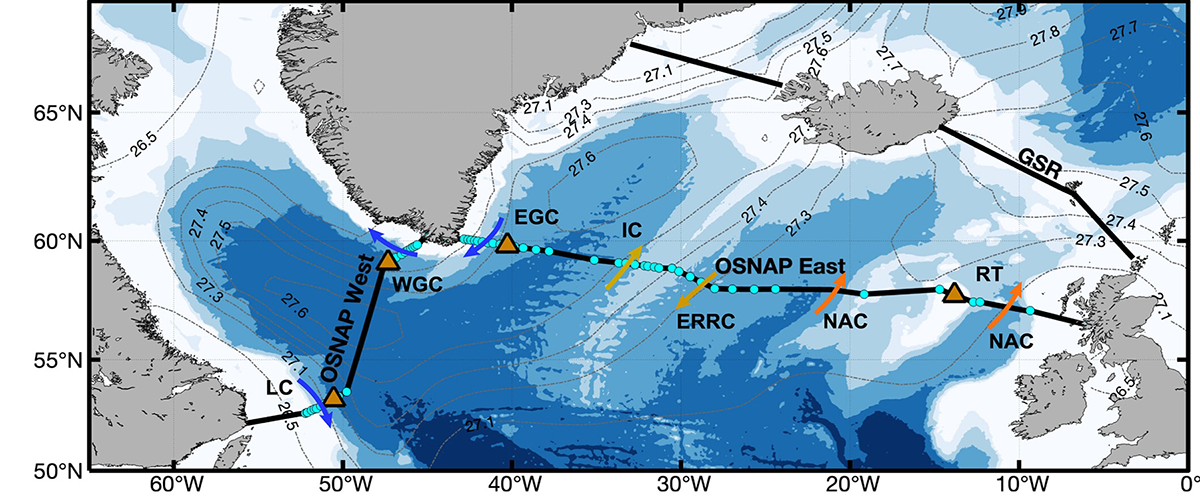
Map of the subpolar North Atlantic where the OSNAP arrays record valuable ocean circulation data. Figure modified from Fu et al. 2025.