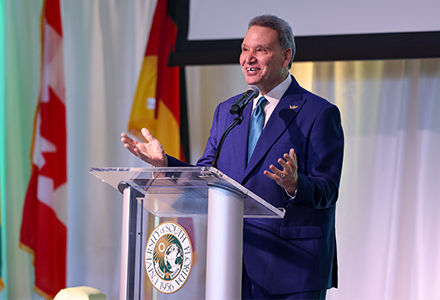
 USF President Moez Limayem welcomed a capacity crowd to the Third Annual USF International
Business Forum.
USF President Moez Limayem welcomed a capacity crowd to the Third Annual USF International
Business Forum.The Tampa Bay region’s emergence as one of the nation’s fastest‑rising destinations for international business and foreign direct investment was on full display at the University of South Florida’s Third Annual International Business Forum, where leaders from higher education, state economic development and the private sector examined how growth is being translated into global competitiveness. The discussions were punctuated by an expo featuring over 30 leading firms and organizations from the Tampa Bay community.
The takeaway from the day’s in-depth conversations: The Tampa Bay Region is rising in prominence as a strategic foothold for international companies seeking long‑term U.S. market opportunity in an interconnected global economy.
“Global engagement is not a side strategy. It’s not an afterthought,” said USF President Moez Limayem in his opening remarks to a gathering of more than 300 in the USF Marshall Student Center. “I want to add to that: Global engagement does not just happen to a region. We choose it. We decide it. We are intentional about it through the partnerships we build, the talent we develop, and the vision we set.”
"Global engagement does not just happen to a region. We choose it. We decide it." — USF President Moez Limayem
The April 1 forum built on last year’s rankings of Tampa as the leading city in the nation for international businesses in the Financial Times-Nikkei Investing in America report. The ranking surprised many in larger cities, but confirmed for state, local and regional economic development officials that their long-term strategy to build the nation’s most business-friendly state, coupled with Florida’s healthy growth rate and comparative quality of life was resonating on a global scale.
SelectFlorida President and CEO Matt Swanson said Florida’s deliberate and strategic decisions to become one of the nation’s most supportive states for businesses have been central to the state’s success in attracting international companies and foreign direct investment. Powering the growth trajectory is long-term investments in talent development and infrastructure, including building research and innovation capacity at Florida’s leading research universities, and focusing on student success to fuel one the nation’s best talent pipelines.
Further, a focus on emerging technologies — including advanced air mobility, cybersecurity, and quantum computing — along with leveraging historic strengths such as agricultural technology and strengthening the maritime industrial base, are globally significant moves signaling that Florida is home to the future innovation economy, Swanson said.
In the current fiscal year alone, there have been 20 projects involving international investment, creating 2,300 jobs and totaling $1.2 billion in capital investment, with a quarter left to go, Swanson noted. More than 455,000 jobs in Florida have been created by international companies, and more than $100 billion in international capital investment has flowed into the state in recent years.
“The opportunity out there is, in my opinion, limitless,” Swanson said. “We just have to provide the right infrastructure, the right workforce, and the right ecosystem.”
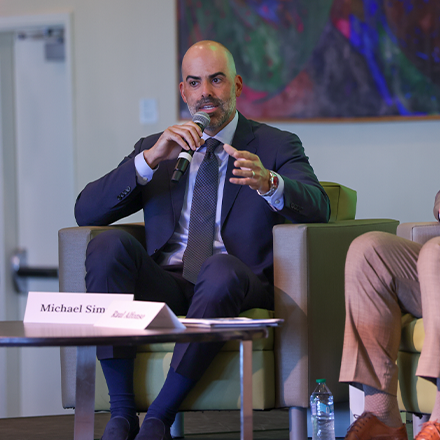
Florida Council of 100 President and CEO Michael Simas
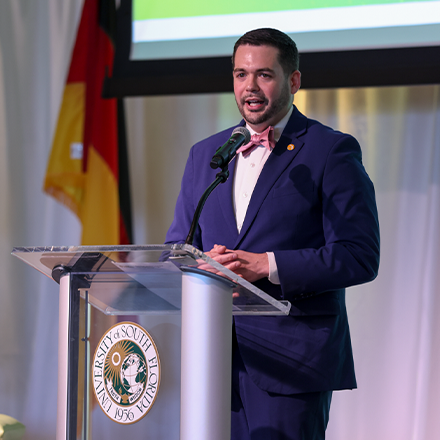
SelectFlorida President and CEO Matt Swanson
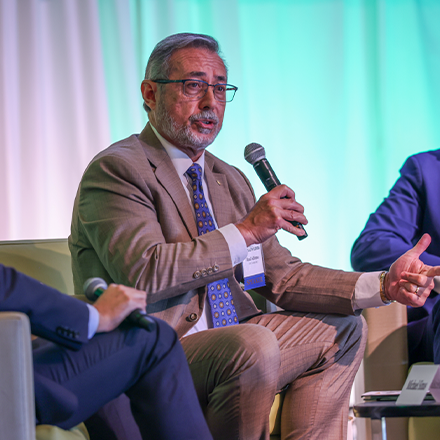
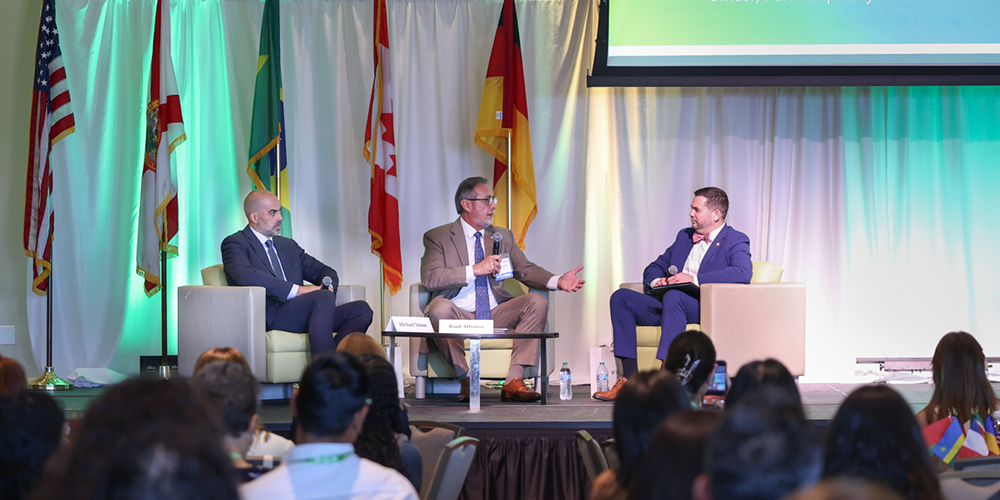
Port Tampa Bay Executive Vice President and Chief Commercial Officer Raul Alfonso
In a fireside conversation, Port Tampa Bay Executive Vice President and Chief Commercial Officer Raul Alfonso described how the port’s diversified business and global linkages create a foundation for growth across multiple industries. Port Tampa Bay has a $34.6 billion annual economic impact. “The best is yet to come,” Alfonso said. “I think we all believe we are in the right place at the right time.”
Florida Council of 100 President and CEO Michael Simas discussed efforts to promote Florida as a destination for ambitious companies through a $10 million marketing campaign highlighting the state’s entrepreneur‑friendly culture, where businesses can build and scale rapidly.
“I would say every region needs to focus on its assets — what are their best bets — and really line up around those assets, the ecosystem that supports them, from venture capital to innovation to aligning the marketplace more efficiently and developing talent pipelines,” Simas said.
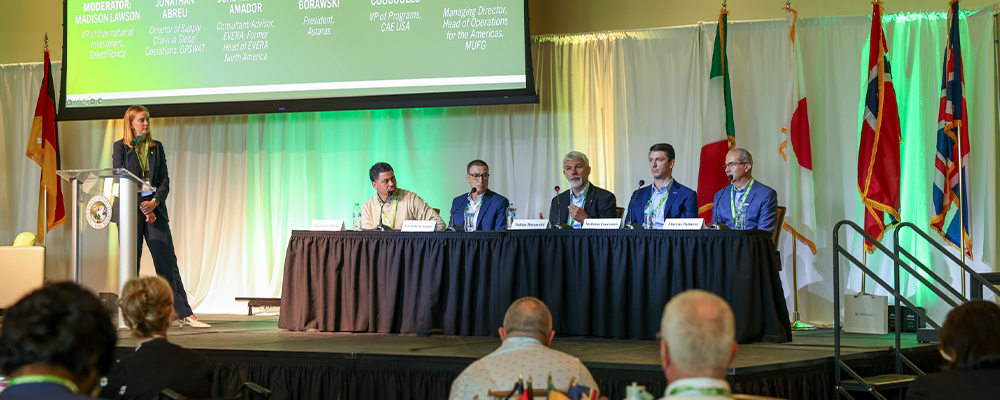
Madison Lawson, SelectFlorida’s Vice President of International Investments, (left)
leads a conversation with executives from internationally-owned companies whose U.S.
operations are based in the Tampa Bay Region.
Photo by Giovanna Silveira Chitto
International Business Leaders Highlight What Attracted and Keeps Their Companies in the Tampa Bay Region
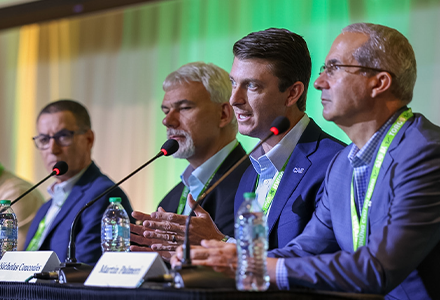
 Martin Palmeri, Managing Director and Head of Operations for the Americas, for Japan’s
MUFG said the bank plans to grow its workforce in Tampa to more than 600 in the years
to come.
Martin Palmeri, Managing Director and Head of Operations for the Americas, for Japan’s
MUFG said the bank plans to grow its workforce in Tampa to more than 600 in the years
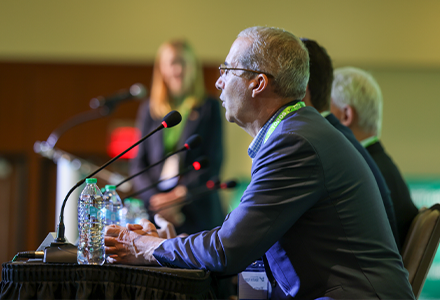
to come.Talent, infrastructure, and quality of life are driving Tampa Bay’s rise as a destination for international business investment, according to global executives who spoke during a session moderated by Madison Lawson, vice president of international investment at SelectFlorida. Lawson framed the discussion around a central question she hears frequently from international companies: Why Tampa Bay?
Martin Palmeri, managing director and head of operations for the Americas at MUFG Bank, said Tampa Bay exceeded expectations when the Japanese financial institution was selecting a new East Coast operations hub. MUFG is Japan’s largest bank and opened its hub for East Coast U.S. operations in Tampa in 2024. The Tampa operation has grown to about 450 employees, with plans to reach 600 to 700 within the next two years.
“We were kind of blown away,” Palmeri said. “It hit a lot of the criteria that were very important to us — access to talent, the number and quality of universities, availability of office space, and airport accessibility. It started ticking off all the boxes.”
Palmeri said the region’s collaborative business environment stood out compared to larger banking centers. “In places like New York, everything feels zero‑sum,” he said. “Here, it’s the opposite. If one company succeeds, the region succeeds.”
For technology firms, talent availability was a recurring theme. Jonathan Abreu, director of supply chain and global operations at international cybersecurity firm OPSWAT, said Tampa’s growing workforce made it a natural fit.
Talent, infrastructure, and quality of life are driving Tampa Bay’s rise as a destination for international business investment, according to global executives who spoke...
“We saw a diverse and growing pool of professionals,” Abreu said. “Compared to the (U.S.) West Coast, the cost structure makes sense, but more importantly, the talent here has been incredible. That made this a very easy decision.”
Tobias Borawski, managing director of Astaras, a German-owned manufacturer of welding consumables, said Tampa Bay offered both workforce depth and logistical advantages critical to industrial operations. “You have a strong airport, an active seaport, and competitive export rates,” he said. “For companies serving customers across the United States, this is a very efficient place to operate.”
Government and defense-related activity also play a major role in the region’s international appeal. Nicholas Coucoules, vice president of programs at CAE USA, said Tampa’s proximity to MacDill Air Force Base and U.S. Central Command was a key factor in CAE’s long-term presence. Canadian company CAE Inc. is the parent company of the U.S. subsidiary.
“Being here matters. About 40% of our Tampa workforce are veterans, many of whom retire from MacDill (Air Force Base) and want to stay in this region,” Coucoules said.
 Nicholas Coucoules, Vice President of Programs at CAE USA, touted the defense tech
company’s long-standing partnership with the USF College of Engineering.
Nicholas Coucoules, Vice President of Programs at CAE USA, touted the defense tech
company’s long-standing partnership with the USF College of Engineering.CAE has operated in Tampa Bay for more than 25 years and recently opened a new state-of-the-art training and simulation facility near Tampa International Airport. The company has a long‑standing partnership with USF, working to develop students to work in the defense, aviation and simulation industries. The company supports engineering capstone projects, participates in career fairs and provides internships across disciplines. CAE leaders also engage directly with students through guest lectures, mentorship and experiential learning opportunities.
From an agricultural and global trade perspective, Joao Roberto Amador, board adviser to EVERA, a division of the Brazilian company Citrosuco, and an adjunct professor at Florida Southern College, emphasized Tampa’s importance in the international citrus industry. While much of Florida’s orange juice now originates from Brazil, Amador said the region is a central and growing player in the scents and flavoring industry, which relies heavily on citrus products.
“Florida is still the center of decision‑making and innovation for citrus,” Amador said. “We invested more than $20 million in Tampa because the infrastructure, ports, and customers are here. From this region, we export finished products to the world.”
“The future here is very strong. Tampa has already proven it can support global operations.” — Jonathan Abreu, Director of Supply Chain in Global Operations, OPSWAT
Throughout the discussion, Lawson highlighted how Florida’s economic development ecosystem — from state and county agencies to universities and international chambers of commerce — supports business growth after companies arrive.
“Companies don’t just land here and get left alone,” Lawson said. “There’s a deep network that helps them succeed from site selection to workforce development.”
Panelists also candidly discussed challenges, including housing affordability and insurance costs, but remained optimistic about Tampa Bay’s trajectory. Many pointed to continued investment, university partnerships and regional collaboration as keys to sustaining growth.
“The future here is very strong,” Abreu said. “Tampa has already proven it can support global operations.”
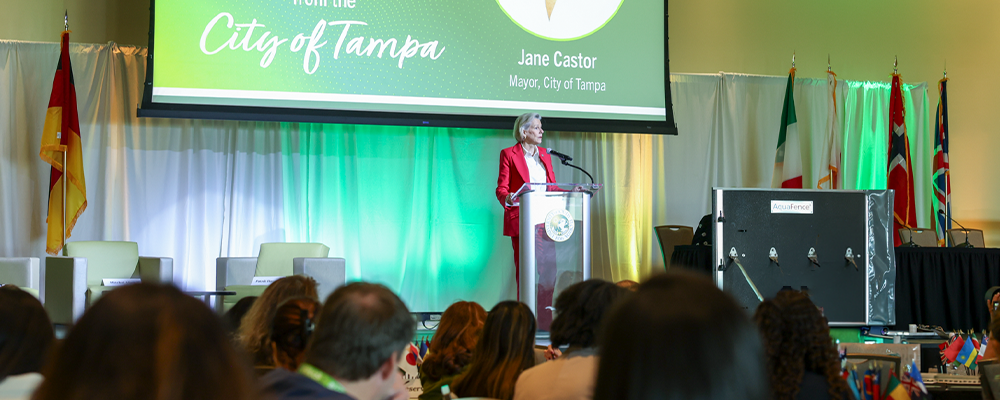
Tampa Mayor Jane Castor said nearly 500 foreign-owned businesses operate in the region, representing 40 different nations. Those companies are “ambassadors” for drawing additional international investment in the region, the mayor said.
Photo by Giovanna Silveira Chitto
Tampa’s Mayor Highlights the City’s Global Business Strength
Tampa Mayor Jane Castor emphasized Tampa’s economic diversity as one of its greatest strengths. Unlike regions that rely heavily on a single industry, Tampa has built a broad portfolio that includes health sciences, cybersecurity, manufacturing, tourism, maritime activity, and more.
“That really puts us in a strong position,” she said. “When you look across the nation and internationally, many places dominate in just one area. That leaves them vulnerable to downturns. We’re fortunate not to be.”
Tampa Mayor Jane Castor emphasized Tampa’s economic diversity as one of its greatest strengths.
The mayor also highlighted Tampa’s global footprint, noting that nearly 500 foreign-owned businesses operate in the region, representing 40 different nations. Those companies, she said, become some of Tampa’s strongest ambassadors.
“When businesses have positive experiences here, those conversations travel,” Castor said. “That’s incredibly valuable.”
While technology enables global outreach, Castor stressed that human interaction remains the most powerful recruitment tool. She described traveling internationally with USF, the Tampa Hillsborough Economic Development Corporation, chambers of commerce, and regional partners to promote Tampa in markets across Europe, Asia and Latin America.
“We’ve been to France, Germany, Japan, Mexico — all over the world,” she said. “And it has paid off.”
She also emphasized the region’s collaborative approach, citing joint recruitment missions that include leaders from Hillsborough, Pinellas and Pasco counties. “If any one of us wins,” she said, “the entire region wins.”
Castor shared just how personally she approaches business recruitment. While Tampa was competing to land the U.S. headquarters for Suzuki marine engines, she found herself in the market for a new boat. “And I’ll tell you, I took it personally,” she said. “I just happened to be buying a new boat at the time. You know what kind of motor is on that boat? That’s right — a Suzuki.”
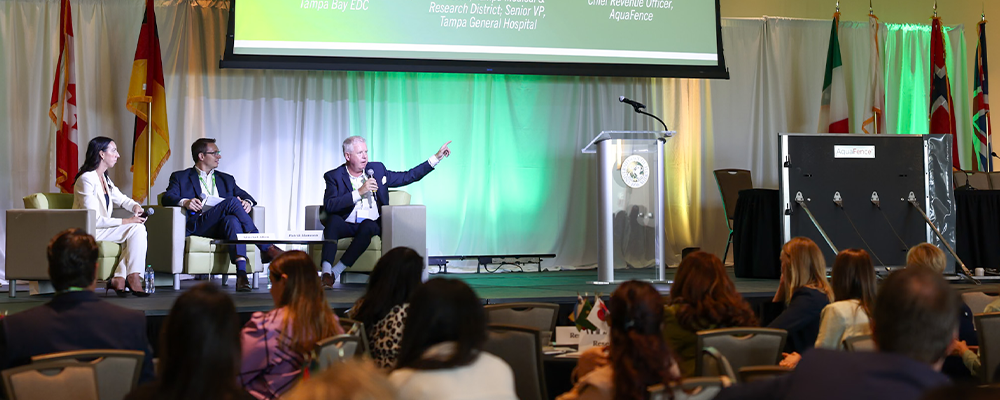
AquaFence Chief Revenue Officer Patrik Hansson (right) explains in a conversation with Tampa General Hospital Senior Vice President and Tampa Medical Research District President Jennifer Crabtree (left) and Mitchell Allen, Senior Vice President of Economic Development for the Tampa Bay Economic Development Council, how the company works with TGH to install flood protection barriers when hurricanes threaten.
AquaFence Leaders Highlight Resilience, Innovation and Community Investment
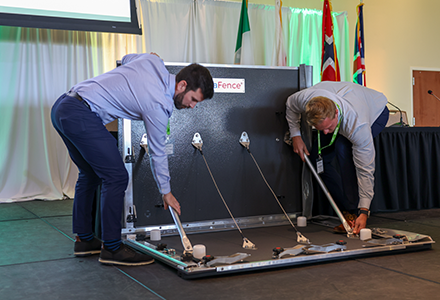
A sample size of the AquaFence system. The barrier deployed at TGH during recent hurricanes reaches almost a full story and holds back devastating storm surge.
When hurricanes Helene and Milton threatened Tampa in 2024, Tampa General Hospital’s vulnerable location on Davis Islands put their investment in a flood barrier system engineered by Norwegian company AquaFence to the test. A video of the storm surge being held back while the hospital’s first floor remained dry became a global viral sensation.
AquaFence’s flood‑protection expertise is rooted in its founding in Oslo, where managing water is a constant challenge shaped by fjords, dense urban development, rivers, snowmelt and heavy seasonal rainfall. The company views flooding as a design and infrastructure problem, said AquaFence Chief Revenue Officer Patrick Hansson, not merely an emergency response.
AquaFence’s system focuses on load‑bearing systems designed to withstand water pressure, storm surge, wind, and debris, developing modular barriers that become more stable as water levels rise. By the time a TGH official came across the company at a trade show, AquaFence had made its U.S. reputation in New York City, another island vulnerable to storm surge, where it was protecting more than 50 buildings, including One World Trade Center and the tunnels going in and out of Manhattan.
While Tampa had its unique challenges as a customer for its business, the experience of protecting TGH also provided an undeniable attraction for AquaFence. Last year, the company opened its U.S. headquarters in Tampa, seeing it not just a lucrative market for its systems but a place that Hansson, originally from Sweden, and his teammates wanted to call home.
We see Tampa at the intersection of growth, innovation, and risk.” — Patrick Hansson, Chief Revenue Officer, AquaFence
“During the hurricanes in 2024, a woman told us her mother was in Tampa General Hospital and did not have to evacuate,” Hansson said. “Stories like that are why we wake up in the morning. We’re not just working for a paycheck, we’re doing good.”
Hansson explained the business case for AquaFence to establish its U.S. presence in Tampa in a conversation with TGH Senior Vice President Jennifer Crabtree, who also serves as president of the Tampa Medical & Research District, and Mitchell Allen, senior vice president of economic development for the Tampa Bay Economic Development Council. “We see Tampa at the intersection of growth, innovation, and risk,” Hansson said. “You have incredible talent, strong institutions, and real-world conditions where, if our system works here, it will work anywhere.”
Crabtree described the unique vulnerabilities facing Tampa General Hospital, located on Davis Islands, and why the hospital’s leadership rethought its approach to storm preparedness after years of planning for first‑floor flooding. “As the region’s only Level I trauma center, shutting down was never an option,” Crabtree said.
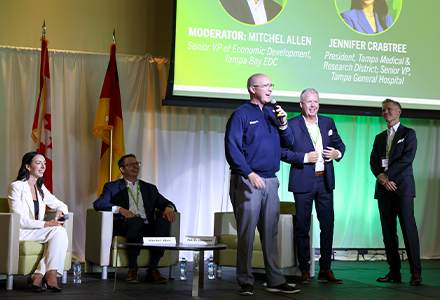
Florida Aquarium President and CEO Roger Germann accepts the donation of an AquaFence system to protect the waterfront facility and its delicate, and often endangered, inhabitants.
“We performed 30 major surgeries during one storm, including two kidney transplants,” she said. “That simply would not have been possible without AquaFence.”
The session concluded with a major community announcement: AquaFence is donating a flood protection system to The Florida Aquarium, reinforcing the company’s commitment to Tampa.
Accepting the donation, Florida Aquarium President and CEO Roger Germann praised the partnership and its impact on the region’s quality of life. Like TGH, the waterfront aquarium faces flood risks, some of which might be severe enough to require moving its delicate, and sometimes endangered, inhabitants during a storm.
“On behalf of the 20,000 animals we care for, our staff, and the million people who visit us every year — thank you,” Germann said.